AI Is an Amplifier, Not an Equalizer
Thanks Agus Hocky and Institut Bisnis dan Teknologi Pelita Indonesia for the invitation, and Hendri Zhang 张维前 for connecting.
I gave a talk last night to over 340 faculty members and undergraduate students studying business and entrepreneurship from Indonesia. This article is the written version of that talk, with the slides included.
Thanks Agus Hocky and Institut Bisnis dan Teknologi Pelita Indonesia for the invitation, and Hendri Zhang 张维前 for connecting.
Quick background: I have been building businesses for 19 years. Failed one, sold one, and one I am building right now. I was also an AI researcher at NTU Singapore, and today I run AI agents for real business workflows daily at nanogent.ai. What I am about to share comes from doing this, not from reading about it.
The title of my talk was “How to Prepare for the Age of AI.”
If there is only one message the audience could take away, it would be the following:
AI is an amplifier, not an equalizer. It does not replace experts. It replaces people with nothing worth amplifying. And it creates enormous opportunities for those who are ready.
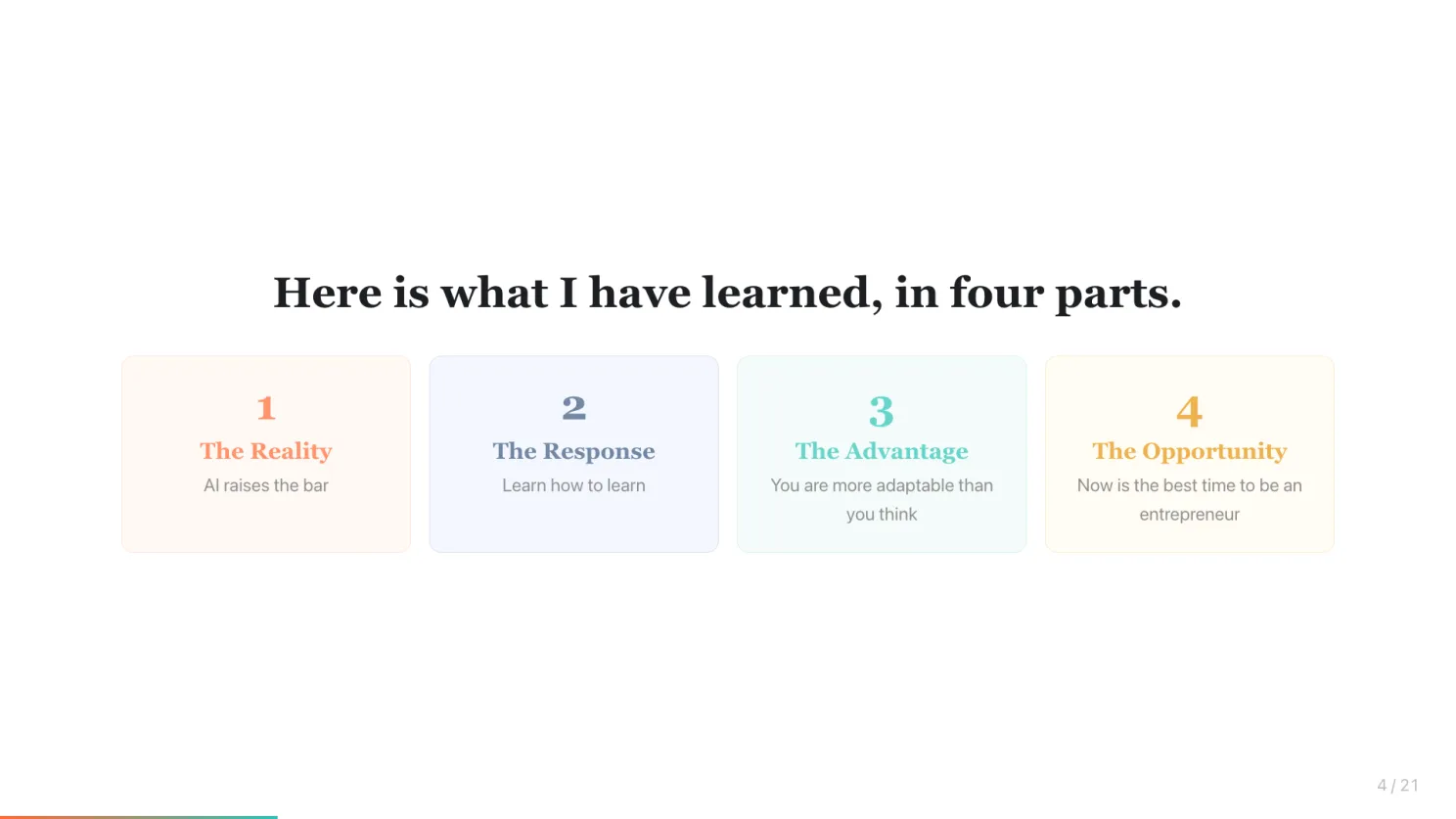
Part 1: AI Raises the Bar
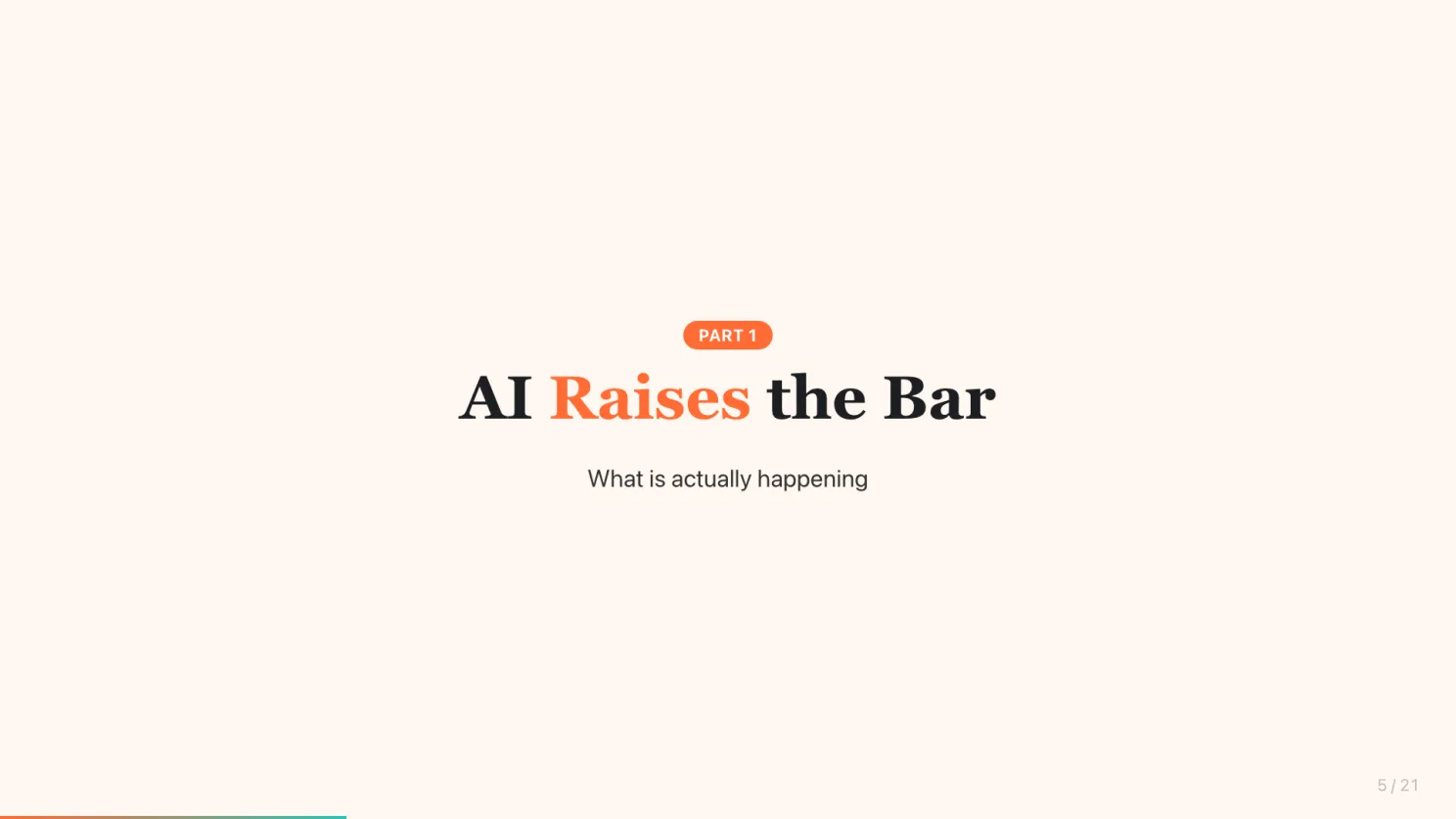
For decades, most knowledge workers were paid for what they know. You go to university, get a degree, gain knowledge, and companies pay you for it. That was the deal.
AI just broke that deal.
Before AI, knowledge was scarce. If you wanted legal advice, you paid a lawyer. If you wanted a marketing strategy, you hired a consultant. If you wanted code written, you hired a developer. The knowledge was locked in people’s heads, and that is what made them valuable.
After AI, anyone can access expert-level knowledge in seconds. For free.
So here is the uncomfortable question: if AI knows what you know, what makes you valuable?
The answer is not more knowledge. It is something else.
AI produces average output by design
Most people do not understand how AI actually works.
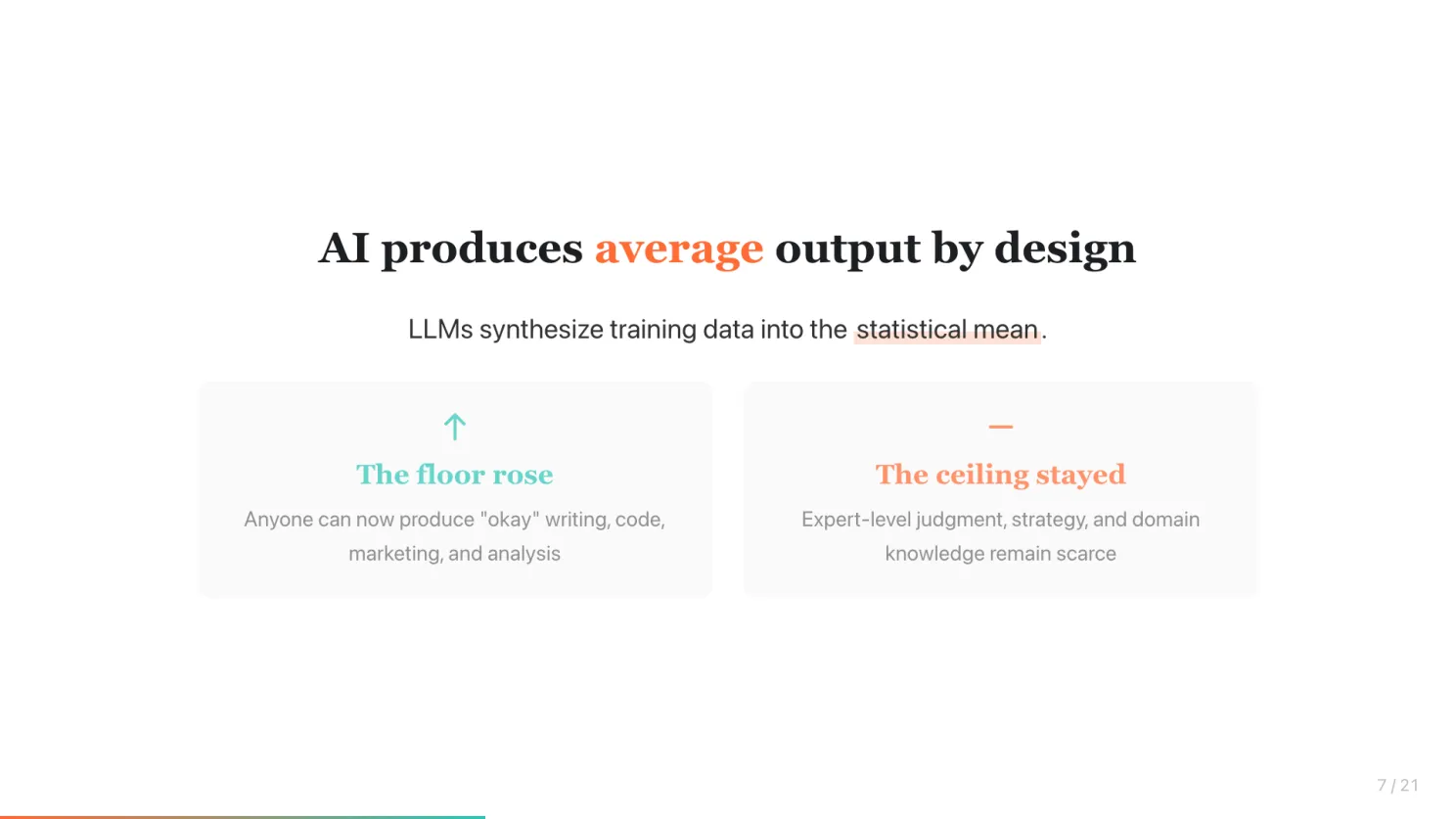
Large language models, ChatGPT, Claude, Gemini, produce output by synthesizing their training data into the statistical mean. In simple terms: AI gives you the average of everything it has seen.
This means two things.
The floor has risen. Anyone with a free ChatGPT account can now produce okay work. Okay writing. Okay code. Okay marketing plans. Five years ago, you needed training and experience to produce this level of output. Now you need a laptop and an internet connection.
But the ceiling has not moved. Expert-level judgment, deep domain knowledge, strategic thinking, these are still scarce. AI cannot produce them because AI does not have experience, context, or stakes in the outcome.
Same AI. Different result.
Let me show you what this looks like in practice. Take two people. Give them the same tool. The same AI. The same task: build a website for YTMI Foundation.
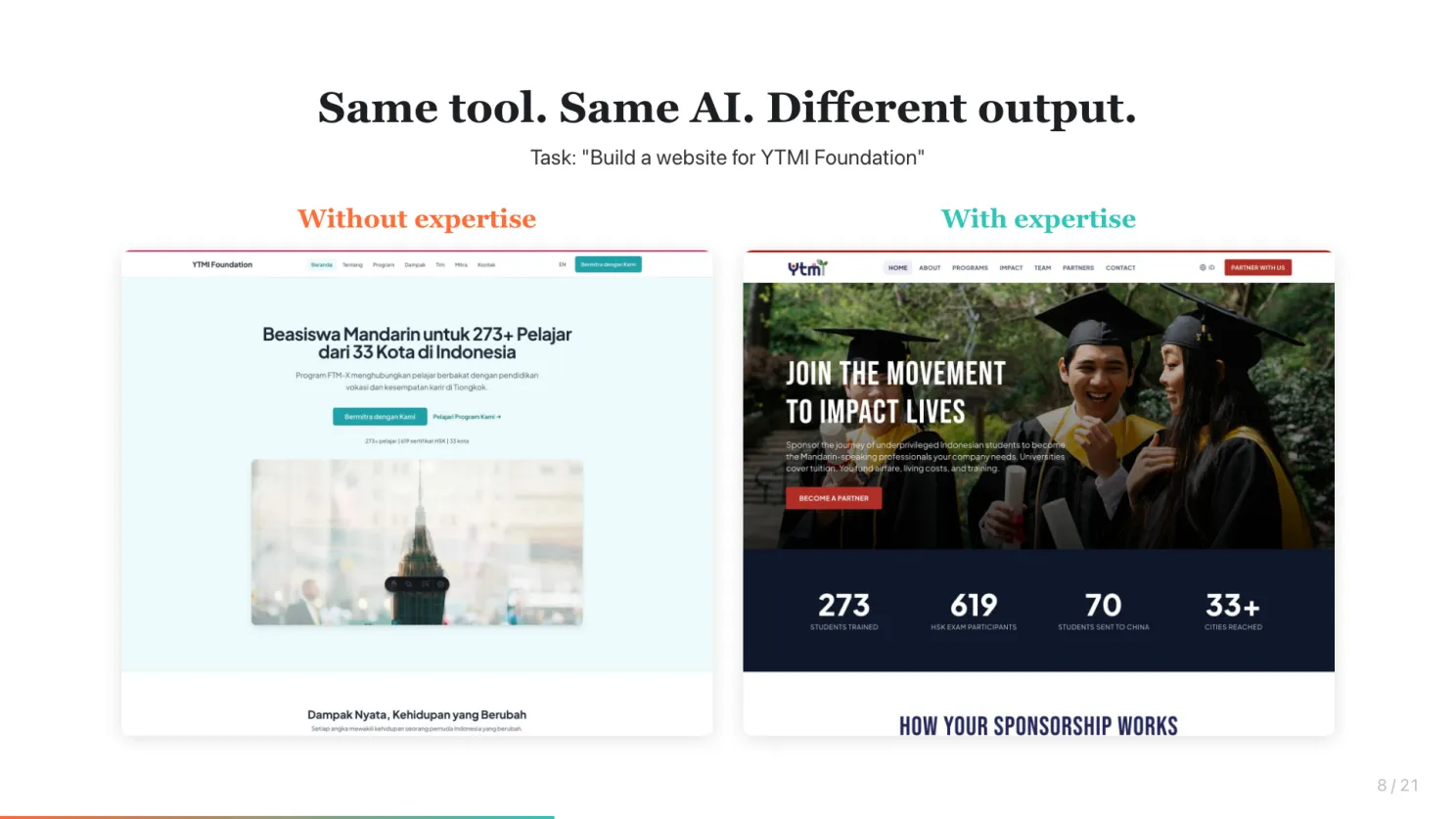
On the left, someone without expertise. The AI helps them build something that looks like a template. Functional, but no strategy. No clear value proposition. No understanding of what makes a visitor convert.
On the right, someone who understands branding, messaging, and user experience. They guide the AI to create something with purpose. A strong hero section. Clear sponsorship model. Compelling social proof. A design that builds trust.
Same tool. Same AI. Completely different output.
The variable is not the technology. The variable is who is orchestrating the AI.
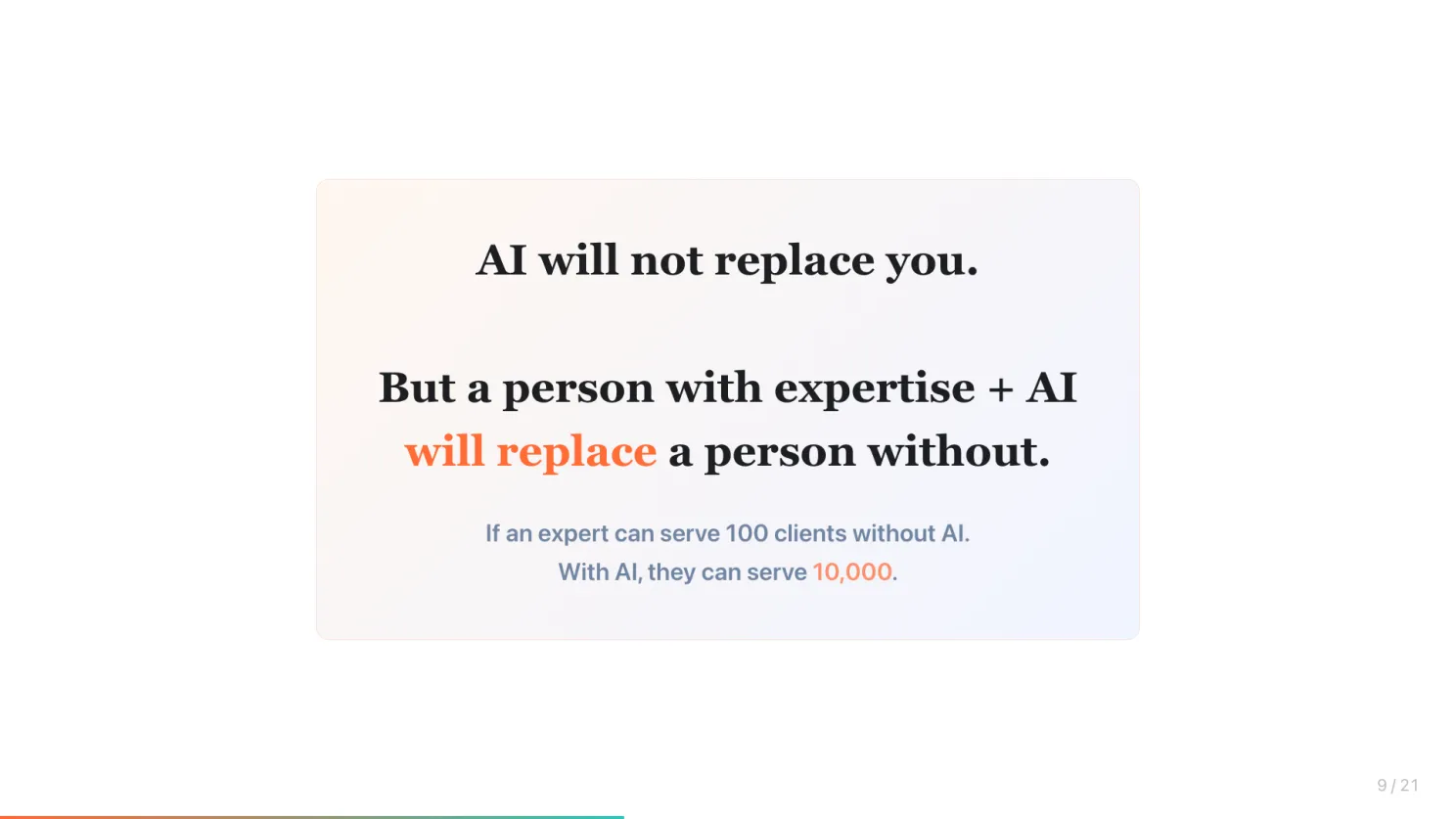
AI will not replace you. But a person with expertise plus AI will replace a person without expertise.
The bar for “average” just moved up. If an expert can serve 100 clients without AI, with AI, that same expert can serve 10,000. That is the multiplier effect, and it only works if you have the expertise to begin with.
Part 2: Learn How to Learn
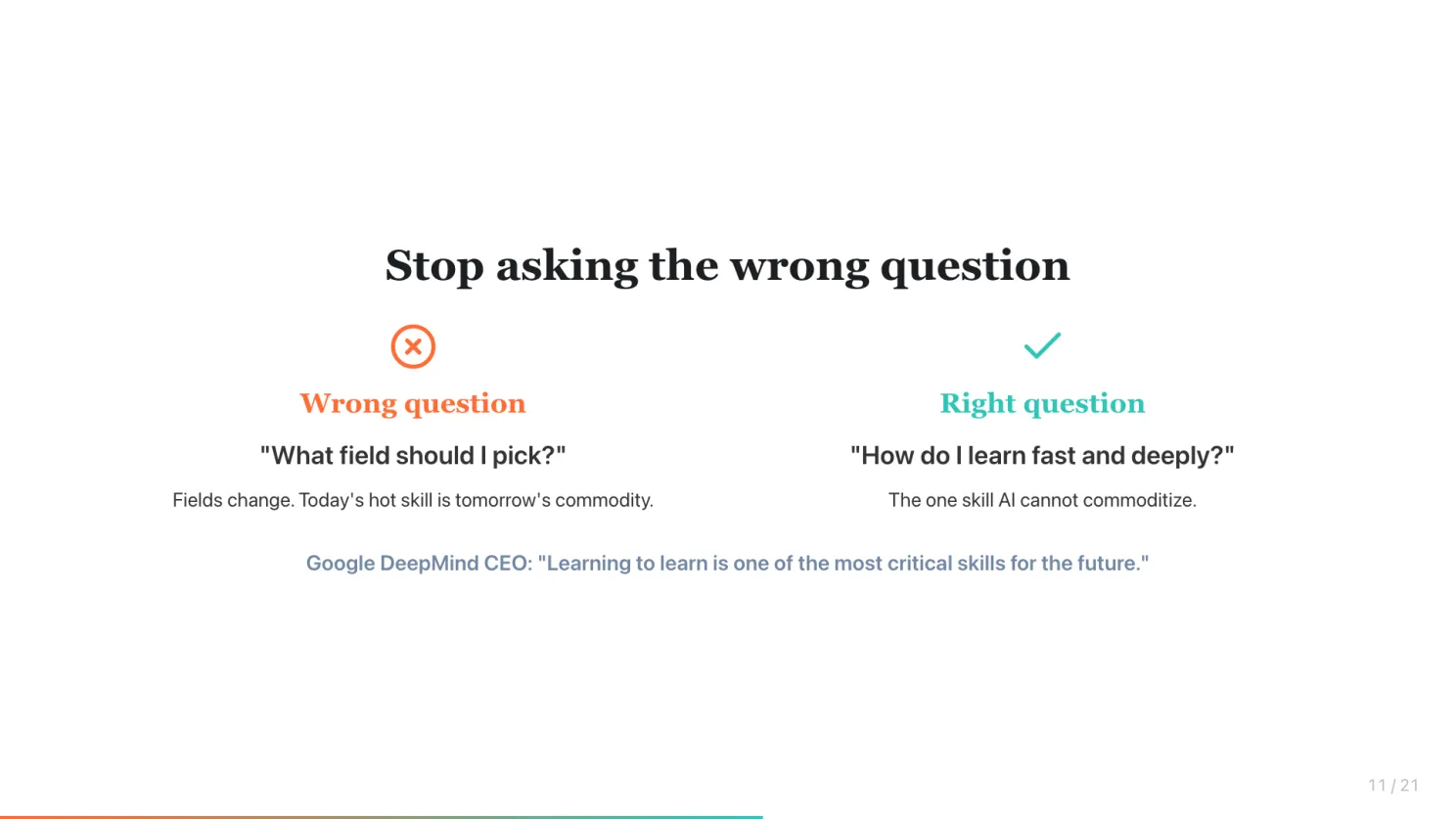
Most young people I speak to ask: “What field should I pick? Should I go into AI? Should I learn data science? Should I go into fintech?”
This is the wrong question. Fields change. Five years ago, everyone said “learn to code.” Now people say AI will write the code for you. What happens to the person who only learned to code because someone told them to?
The right question is: how do I learn fast and deeply?
The CEO of Google DeepMind said it plainly: learning to learn is one of the most critical skills for the future. This is not motivational fluff. This is the head of one of the most advanced AI labs in the world telling you that the skill that matters most is not what you learn, but how fast you can learn.
And here is the good news. AI is the best learning partner ever built, if you use it right.
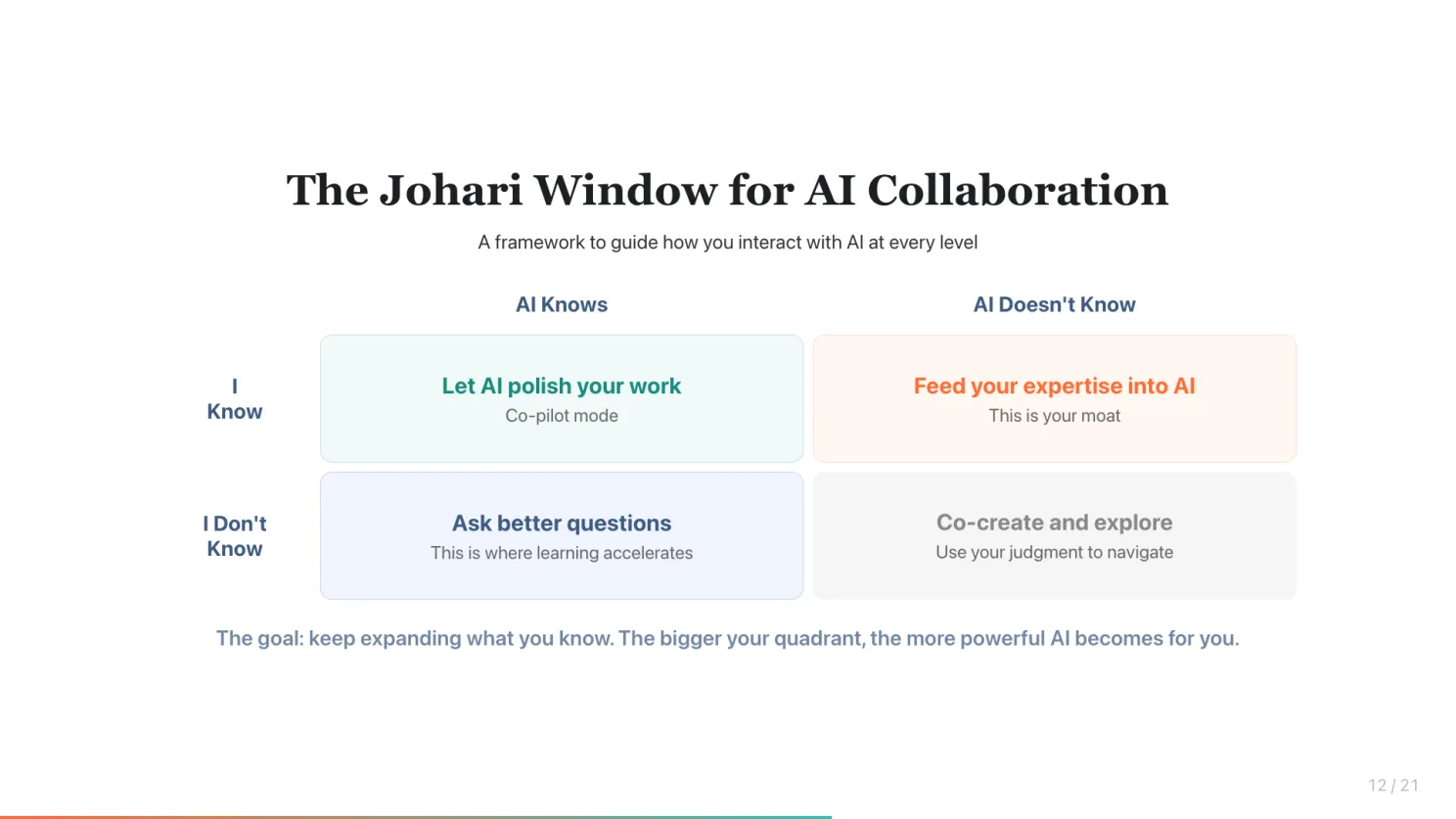
The Johari Window for AI
This is a framework I learned from a talk at Google, adapted from psychology and applied to how you collaborate with AI. Think of it as a 2x2 grid.
You know it, AI knows it. This is co-pilot mode. Let AI polish your work and speed up your execution. You focus on strategy while AI handles the grunt work.
You do not know it, but AI knows it. This is where learning accelerates. This is the most powerful quadrant for a fresh graduate right now. Ask better questions. Use AI to explain concepts, create learning roadmaps, quiz you. This is your personal tutor, available 24/7, for free.
You know it, AI does not know it. This is your moat. Your personal experience, your market context, your local knowledge of your industry and customers. AI does not have this. When you feed your domain knowledge into AI, that is when AI becomes truly powerful.
Neither of you knows it. This is co-creation. Brainstorming. Exploration. Use AI to generate diverse ideas, then rely on your judgment to pick the right direction.
The long-term goal is to keep expanding what you know. The bigger your knowledge, the more powerful every AI tool becomes for you.
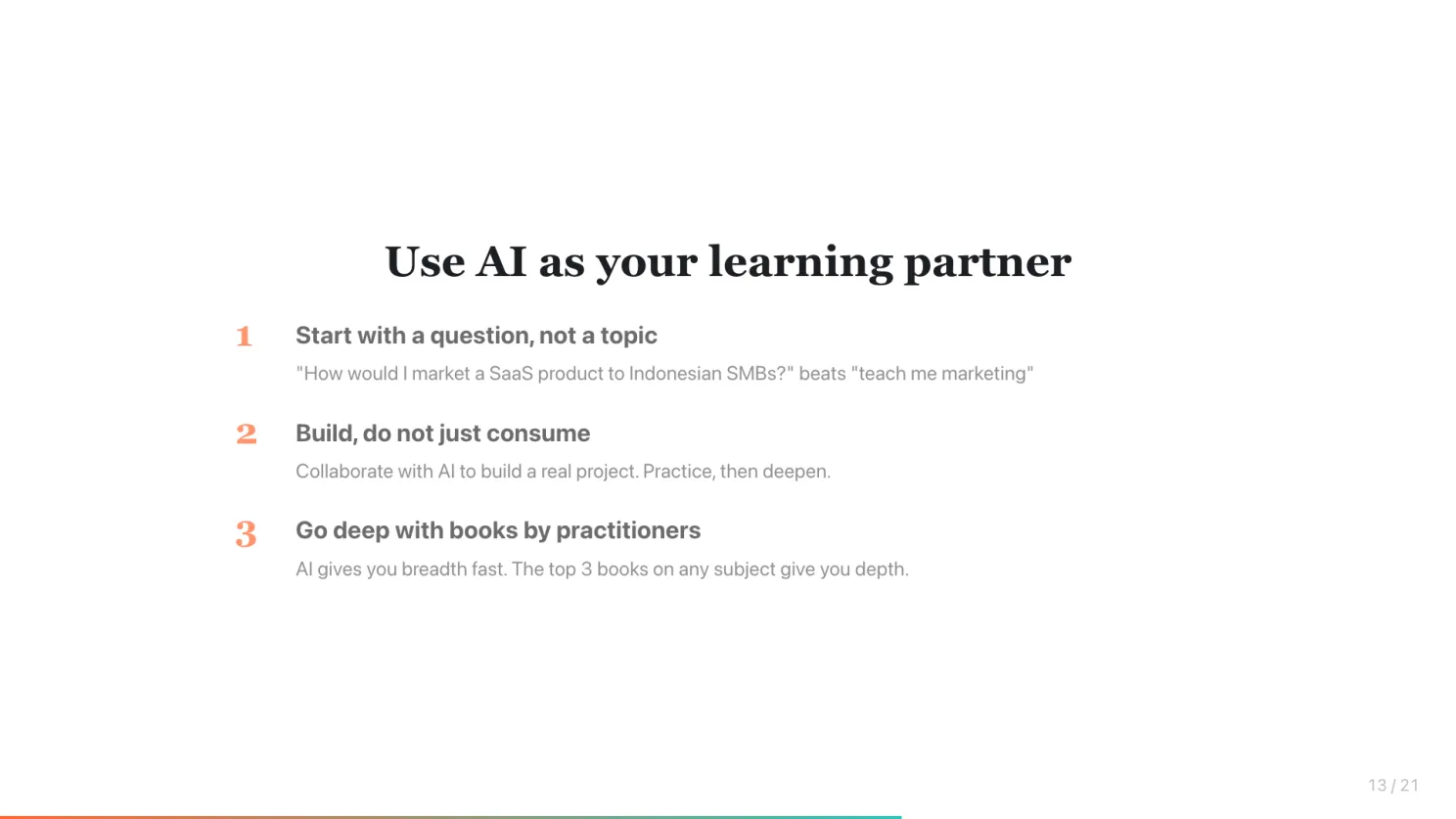
Three practical ways to use AI for learning today
One. Start with a question, not a topic. Do not say “teach me marketing.” Say “How would I market a SaaS product to Indonesian SMBs?” Frame learning around a real problem. You will retain it ten times better.
Two. Build, do not just consume. Collaborate with AI to build a real project. Do not just read AI’s answers, use them to create something. Active learning beats passive consumption every time. Brain science backs this up.
Three. Go deep with books by practitioners. AI gives you breadth fast. But depth comes from people who have actually done the work. Find the top three books on any subject, written by people who built something real, not just people who write about it.
Part 3: Your Hidden Advantage
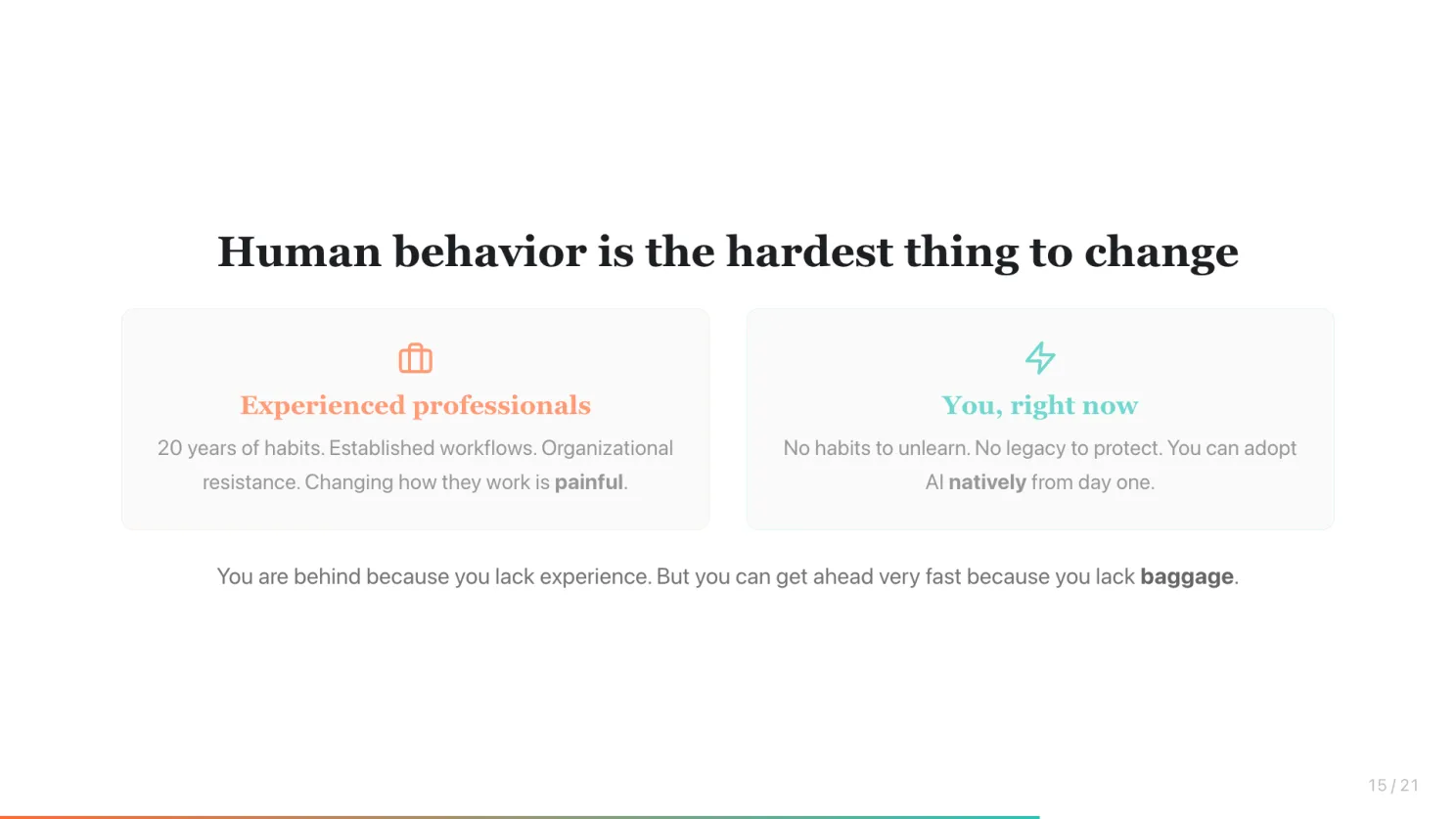
I work with companies and professionals who have been in their fields for 15, 20 years. Here is what I see. They are very slow with AI adoption. Not because the tools are hard. ChatGPT is not hard to use. But because changing how you work is hard. When you have done something a certain way for 20 years, your brain resists the change. Your organization resists the change. Human behavior is the hardest thing to change.
Now look at you. You are 24, 25, 26 years old. You have no habits to unlearn. No legacy processes to protect. No “but we have always done it this way.” You can adopt AI natively from day one. You can build your entire career with AI as a default tool, not an add-on.
You are starting behind because you lack experience. But you can get ahead very fast because you lack baggage.
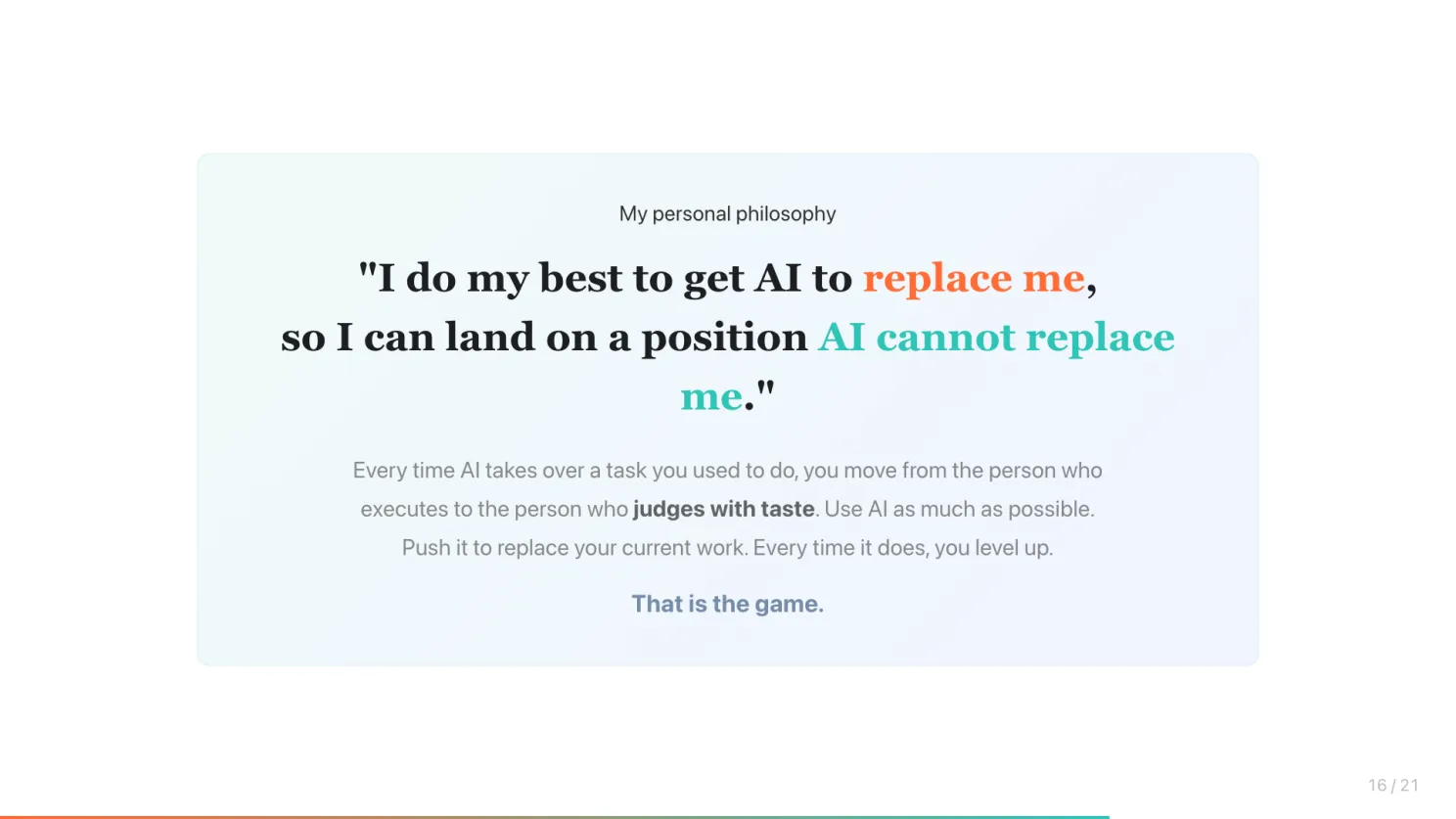
“I try to get AI to replace me”
This is my personal philosophy. This is how I have stayed ahead in a field that changes every three months.
I do my best to get AI to replace me, so I can land on a position AI cannot replace me.
What does this mean in practice? Every time I find a task I do regularly, I try to get AI to do it. Write a first draft? AI can do that. Analyze data? AI can do that. Write code? AI can do that, sort of.
And every time AI takes over a task, I move up. I stop being the person who writes drafts and become the person who judges drafts. I stop being the person who writes code and become the person who architects systems.
That is the game. Push AI to replace your current work. Every time it succeeds, you level up to something it cannot do yet. Then push again.
Part 4: The Great Opportunity
Now is the best time to be an entrepreneur. Let me show you why.
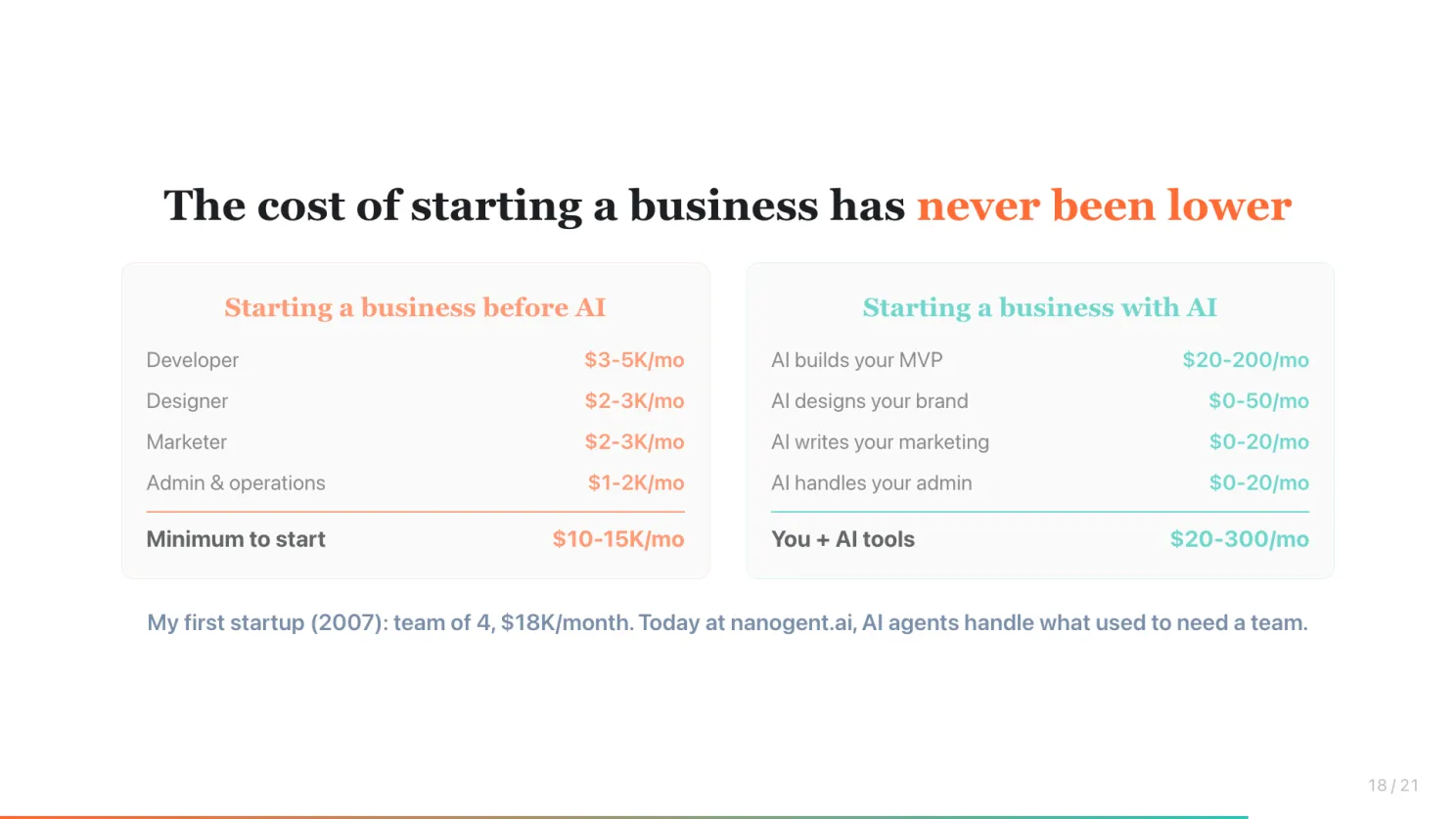
Before AI, starting a real business meant hiring a team. A developer, three to five thousand dollars a month. A designer, two to three thousand. A marketer, two to three thousand. Admin, another one to two thousand. That is ten to fifteen thousand dollars a month before making a single dollar in revenue.
With AI, you can build your MVP for twenty to two hundred dollars a month in subscription costs. AI can design your brand, write your marketing, handle your admin. The total? Twenty to three hundred dollars a month.
That is not a small reduction. That is a fundamental change in who gets to be an entrepreneur.
I know this firsthand. My first startup in 2007 had a team of four people and eighteen thousand dollars a month in salaries. Today at nanogent.ai, AI agents handle what used to need that entire team.
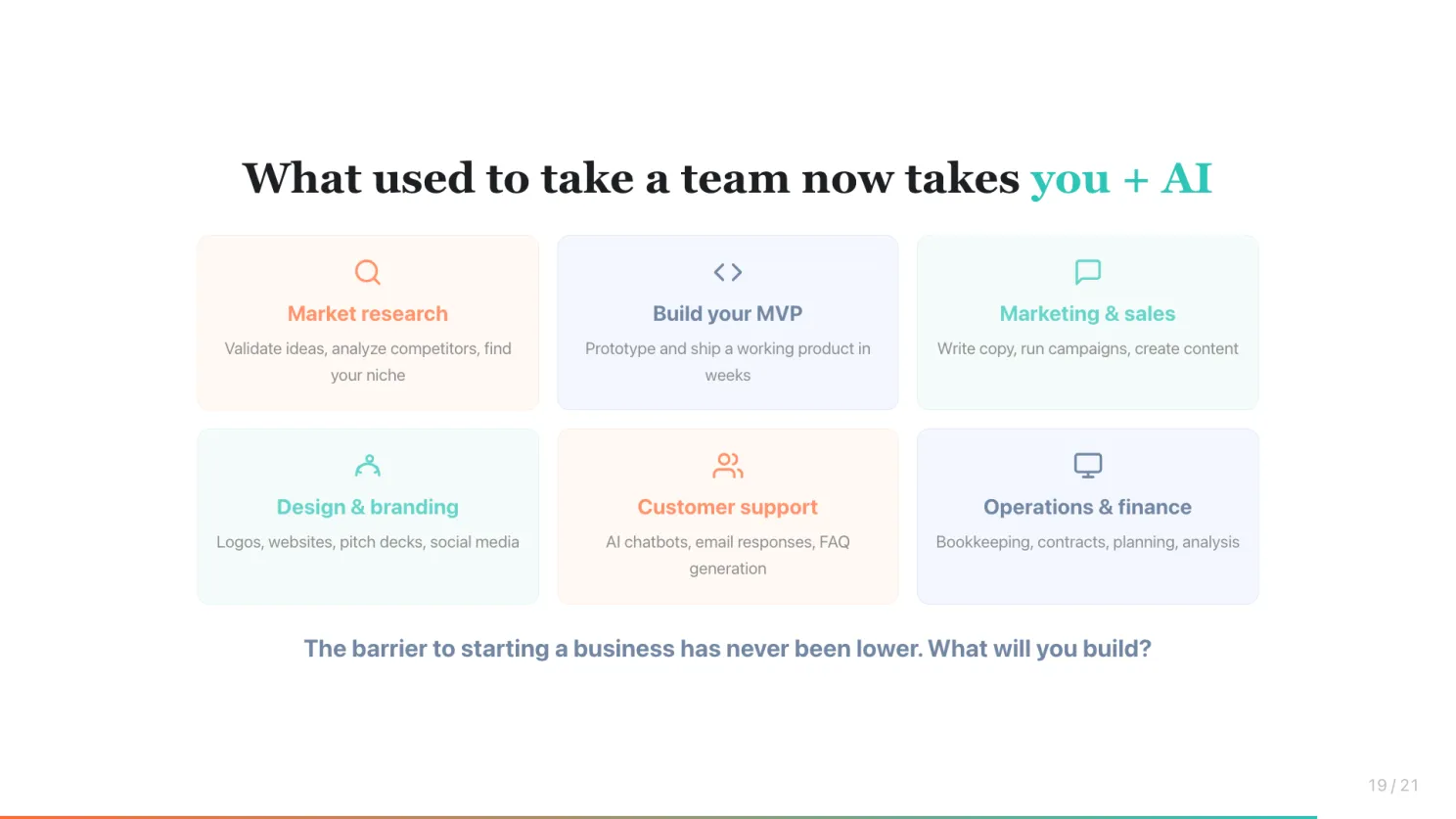
What AI can do for your startup today
- Market research and validation. Validate your idea, analyze competitors, find your niche before you spend a single dollar.
- MVP development. Go from idea to working prototype in weeks, not months.
- Marketing and sales. Write your copy, run campaigns, create content at scale.
- Design and branding. Logos, websites, pitch decks, social media graphics.
- Customer support. AI can handle customer questions 24/7 from day one.
- Operations and finance. Bookkeeping, contracts, planning, analysis.
Everything you need to start a business is now accessible with AI tools that cost a fraction of hiring. The question is not whether you can afford to start. The question is: what will you build?
Four things to remember
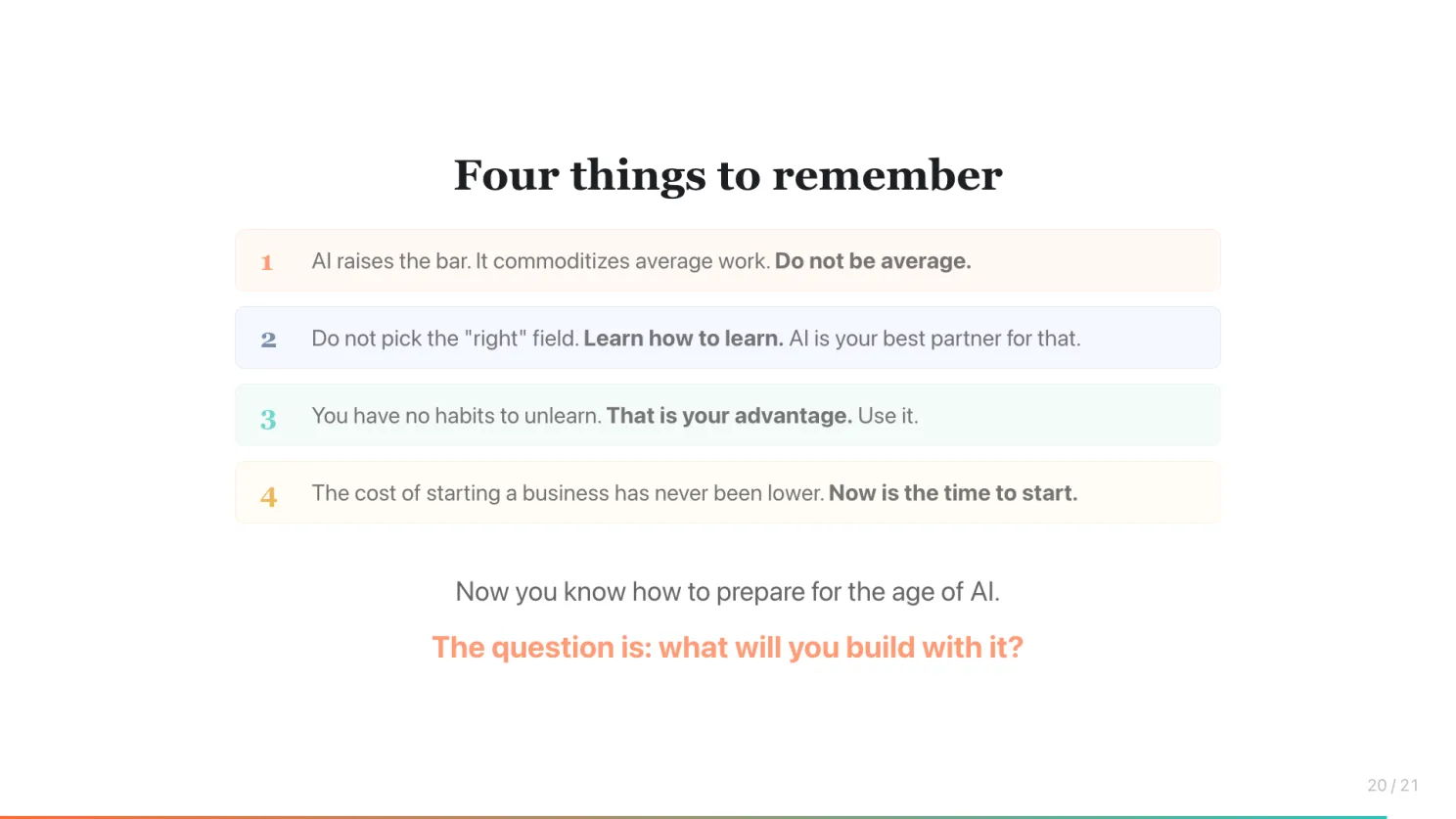
One. AI raises the bar. It commoditizes average work. Do not be average. Build expertise that is worth amplifying.
Two. Do not pick the “right” field. Learn how to learn. That is the one skill that never goes out of date.
Three. You have no habits to unlearn. That is your advantage. Use it before you lose it.
Four. The cost of starting a business has never been lower. Now is the time to start.
Same AI. Different expert. Different result.
Now you know how to prepare for the age of AI. The question is: what will you build with it?
#AI #Entrepreneurship #CareerAdvice #ArtificialIntelligence #StartupLife
Enjoyed this? Subscribe for more.
Practical insights on AI, growth, and independent learning. No spam.
More in AI Strategy
Why GenAI Pilots Need Both Strategy and Execution
In the post, I shared 5 proven strategic frameworks to apply to find high-ROI AI opportunities.
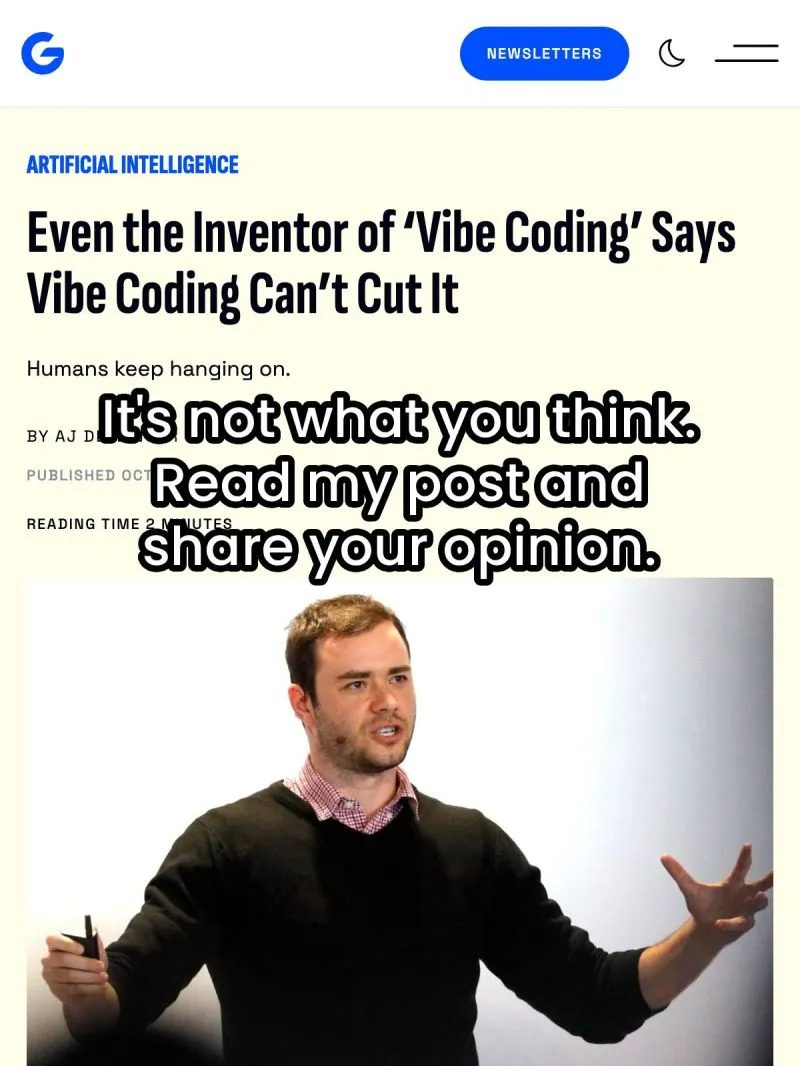
No, Karpathy Didn’t Say Vibe Coding Doesn’t Work
This starkly contrasts with my own experience.
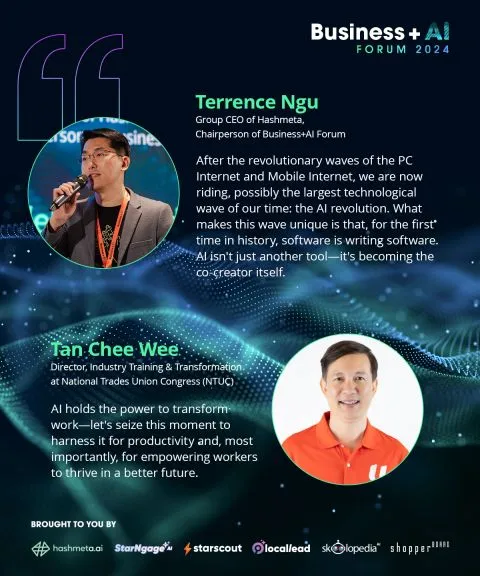
From insight to action: AI is not the future—it’s the now.
At the Business+AI Forum 2024, our speakers shared groundbreaking insights on how AI is transforming industries, creating opportunities, and solving real-wor...
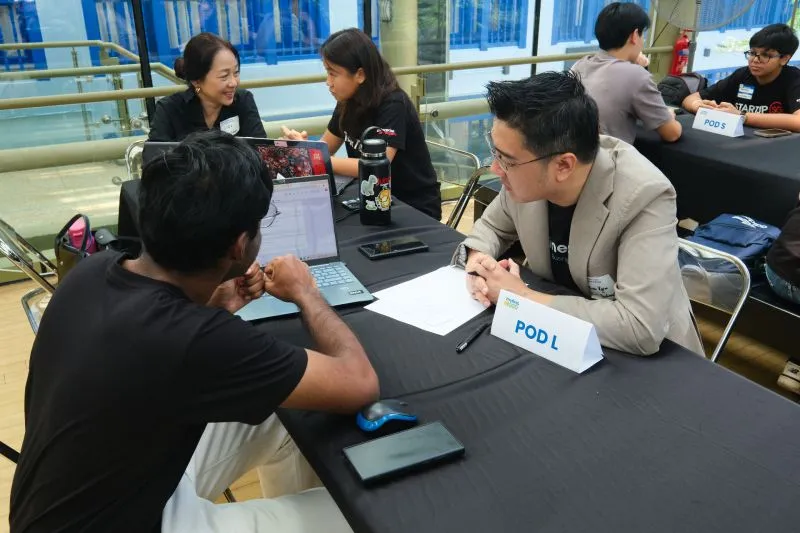
Glad to be invited by East Ventures and Temasek to mentor at @my1st1000sg last Saturday. Thanks Ong Ju Boon for the invitation.
What I like about this challenge is its focus on earning revenue, instead of building a pitch deck or a prototype.

How We Hit 5 Million Organic Search Clicks a Year
We did it. With zero ad spend. Just SEO and inbound marketing.
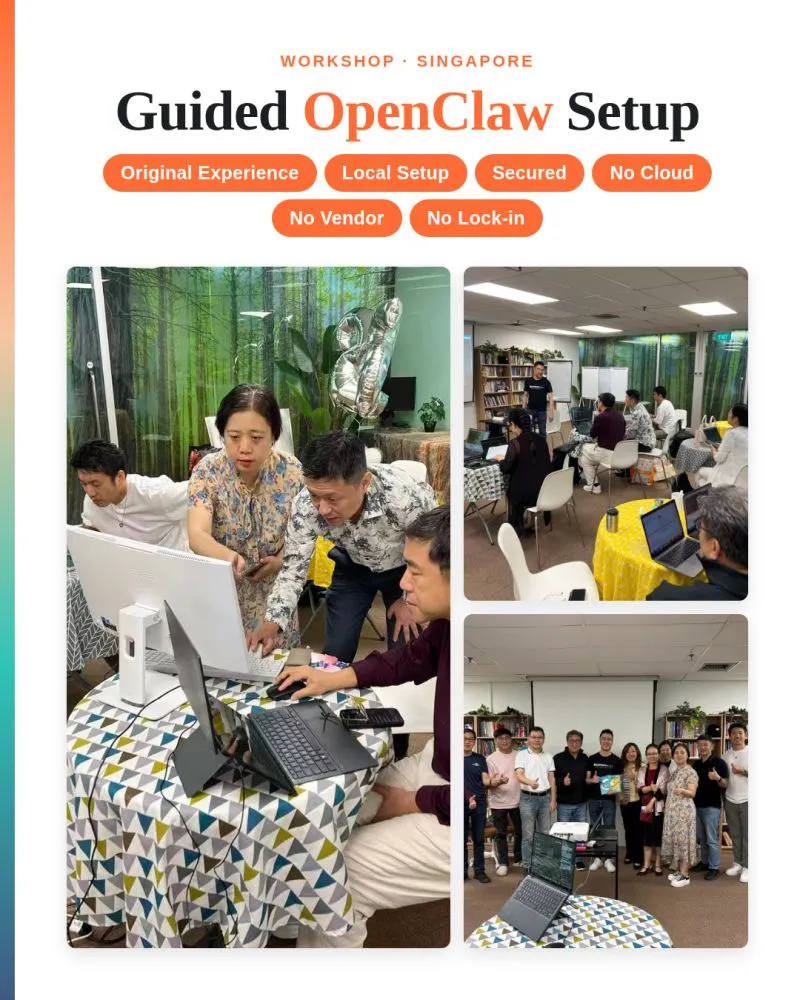
Most OpenClaw workshops skip the fundamentals and teach you 1-click setup on AI or cloud providers...
I decided to go for a different path. In my workshop, I guide learners to set up with the original experience: install it on your laptop, but with security i...
Why GenAI Pilots Need Both Strategy and Execution
In the post, I shared 5 proven strategic frameworks to apply to find high-ROI AI opportunities.
From insight to action: AI is not the future—it’s the now.
At the Business+AI Forum 2024, our speakers shared groundbreaking insights on how AI is transforming industries, creating opportunities, and solving real-wor...
Most OpenClaw workshops skip the fundamentals and teach you 1-click setup on AI or cloud providers...
I decided to go for a different path. In my workshop, I guide learners to set up with the original experience: install it on your laptop, but with security i...
No, Karpathy Didn’t Say Vibe Coding Doesn’t Work
This starkly contrasts with my own experience.
Glad to be invited by East Ventures and Temasek to mentor at @my1st1000sg last Saturday. Thanks Ong Ju Boon for the invitation.
What I like about this challenge is its focus on earning revenue, instead of building a pitch deck or a prototype.
How We Hit 5 Million Organic Search Clicks a Year
We did it. With zero ad spend. Just SEO and inbound marketing.