8 Phases of Effective Marketing
I recently ran a 2-day AI marketing workshop. On Day 1, I showed the full digital marketing pipeline and asked: "Raise your hand for each phase you currently...
Most People Think Marketing Is Creating Content. That Is 1/8 of Marketing.
I recently ran a 2-day AI marketing workshop. On Day 1, I showed the full digital marketing pipeline and asked: “Raise your hand for each phase you currently do in your business.”
Most hands went up at Phase 6 - Content Production.
Creating posts, writing ads, designing visuals. That is what most people think marketing is.
But content production is only 1 of 8 phases. The other 7 are what separate businesses that grow from businesses that stay stuck creating content nobody engages with.
After 19 years building tech companies and running AI-powered marketing at Hashmeta, I think the biggest mistake I see is businesses jumping straight to creating content without doing the thinking that comes before it. And then wondering why nothing works.
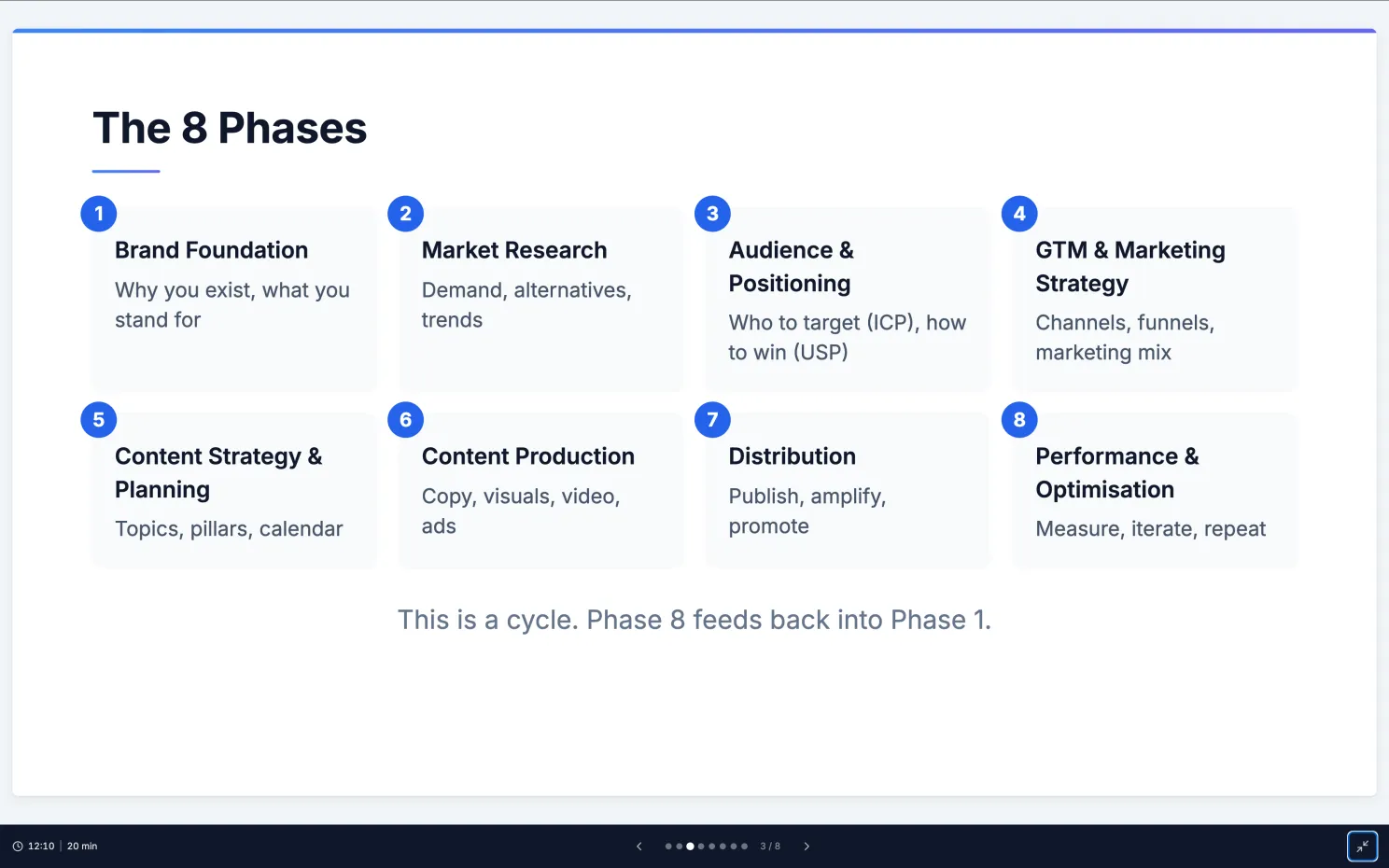
Here are the 8 phases. This is a cycle - Phase 8 feeds back into Phase 1.
Phase 1: Brand Foundation
What it is: Why your business exists, what you stand for, and how you sound.
Most businesses skip this because they think they already know their brand. But try this: ask 3 people in your company to describe what you sell, who you sell it to, and why someone should buy from you instead of a competitor. If you get 3 different answers, you do not have a brand foundation.
There are 5 questions every business should be able to answer clearly: What do you sell? Who do you sell it to? Why should they buy from you? How do you sound? What do you stand for?
If these are not written down somewhere, every piece of content your team produces will sound slightly different. And if you are using AI to help write content, it will produce generic copy because it has no brand context to work from.
Phase 2: Market Research
What it is: Understanding demand, alternatives, trends, and what customers actually want.
Most businesses research their market once - when they launch. Then never again.
The problem is markets move. A competitor launches a new offer, customer preferences shift, a new channel emerges. If you are still operating on research from 2 years ago, you are making decisions based on a market that no longer exists.
Good market research answers 4 questions: What is happening in your industry? Who are your competitors and what are they doing? What do customers actually want? Where are the gaps?
AI is useful here because it can research faster than any human. But there is a catch - AI is confident about wrong facts. Always ask for source citations. Then verify before making decisions based on AI research. Treat it as a powerful starting point, not a finished report. I recommend re-running market research at least once a quarter.
Phase 3: Audience and Positioning
What it is: Defining exactly who to target (ICP) and how to win against competitors (USP).
This is probably the most skipped phase. Most businesses market to “everyone.” That is marketing to no one.
Your Ideal Customer Profile (ICP) should describe ONE specific person - not a segment. Give them a name, an age, a daily routine. Know what platforms they use, what keeps them up at night, and what they search for online.
Your Unique Selling Proposition (USP) follows a simple formula: “For [ICP] who [pain point], [your business] is the [category] that [key benefit], unlike [competitors] who [their weakness].”
If your competitor can copy-paste your USP and it still makes sense for their business, your positioning is not specific enough.
Phase 4: GTM and Marketing Strategy
What it is: Channel selection, funnel strategy, marketing mix, and growth model.
This is the phase most businesses have never heard of. And it is probably the most important one.
Without it, you end up spreading resources thin across too many channels, burning budget on the wrong audiences, or creating TOFU content when what you actually need is BOFU content that converts. Strategy before content. Always.
Before you create any content, you need to decide: Where will you show up? What is your funnel? Are you doing inbound (content, SEO, social) or outbound (ads, cold outreach)?
A few things I have learned from running campaigns for over a decade:
- 80% of your leads will come from 20% of your channels. Find those channels and double down.
- Invest in owned media first (your website, email list), then earned media (reviews, word of mouth), then paid media (ads). Paid stops the moment you stop paying.
- Do not open 5 channels at once. Master 1 platform first, then add a second.
The marketing funnel matters too. TOFU (awareness), MOFU (consideration), BOFU (conversion) - each needs different content. Running conversion ads on a cold audience is like proposing marriage on a first date.
Phase 5: Content Strategy and Planning
What it is: Topics, pillars, formats, and editorial calendar.
This is NOT the same as content production. Strategy is what to talk about and why. Production is the actual creation.
Without a content strategy, you post whatever comes to mind. Some weeks you post daily, some weeks nothing. Your audience does not know what to expect from you, and neither does the algorithm.
A good content strategy has 3-5 content pillars - recurring themes tied to your ICP’s pain points. For each pillar, you map topics to funnel stages. TOFU topics attract strangers, MOFU topics nurture leads, BOFU topics convert buyers.
Here is a useful test: if your favorite platform disappeared tomorrow, would your strategy still work? If yes, you have a real strategy. If no, you have a distribution tactic.
Phase 6: Content Production
What it is: Copywriting, visuals, video, and ads.
This is where most people start. And it shows.
Without Phases 1-5, content production is guesswork. With Phases 1-5, you know exactly who you are writing for, what problems to address, which platform to publish on, and what action you want the reader to take.
Good content production is built on frameworks, not inspiration. There are 5 I teach - 3 for persuasion, 2 for structuring content:
- PAS (Problem, Agitate, Solution) - probably the most useful one for short-form social and ad hooks
- AIDA (Attention, Interest, Desire, Action) - works for longer pieces like sales pages and email sequences
- BAB (Before, After, Bridge) - best for transformation stories and testimonials
- WSN (What, So What, Now What) - the simplest content framework. Most generic AI posts have the What but miss the So What and Now What, which is why they feel flat
- SCQA (Situation, Complication, Question, Answer) - from McKinsey consulting. Creates narrative tension. Best for thought leadership and blog intros
AI is genuinely useful at this phase - it can generate 10 copy variants in minutes. But the frameworks and the judgment of what “sounds right” still come from you.
Phase 7: Distribution
What it is: Publishing, amplification, and promotion.
Creating content is half the job. Getting it in front of the right people is the other half.
I have seen businesses spend 20 hours producing a great piece of content, then spend 5 minutes posting it once and moving on. That is a 20-hour investment with a 5-minute distribution strategy.
Good distribution is systematic: when to post, where to cross-promote, how to repurpose one piece of content across multiple platforms, and when to put paid amplification behind organic winners.
The principle I teach: COPE - Create Once, Publish Everywhere. A LinkedIn article becomes a carousel, becomes 3 short posts, becomes an email newsletter, becomes a short video script. You are not copy-pasting. You are translating one strong idea into the language of each platform.
Phase 8: Performance and Optimisation
What it is: Measuring what works, iterating, and feeding insights back into Phase 1.
This phase closes the loop. Without it, you are guessing whether your marketing actually works. And you will keep repeating the same mistakes because you have no signal telling you what to change.
Track the right metrics for each funnel stage: awareness (reach, impressions), engagement (likes, comments, shares), leads (sign-ups, inquiries), conversions (sales, revenue). And know what each metric tells you. If your CTR is low, fix the hook or the image. If your CPA is high, fix your targeting or your offer.
Set a weekly review cadence. Even 30 minutes a week looking at what worked and what did not is better than reviewing once a quarter. The data feeds back into every other phase - your market research gets sharper, your ICP gets more accurate, your content strategy gets more focused. That is why it is a cycle.
Why This Matters
During the workshop, I asked participants to do a self-assessment: which of these 8 phases do you currently do?
The average was 2-3 phases. Almost everyone did Phase 6. A few did Phase 7. Almost nobody did Phases 2, 3, or 4.
That is the gap. And it is why so many businesses feel like they are creating content constantly but not growing. They are executing without strategy.
If you are a founder or marketer spending most of your time on content creation and wondering why growth is flat, count how many of these 8 phases you actually do. The ones with the fewest checkmarks are where your biggest untapped growth is hiding.
#Marketing #AI #DigitalMarketing #ContentStrategy #MarketingStrategy
Enjoyed this? Subscribe for more.
Practical insights on AI, growth, and independent learning. No spam.
More in Tech & Startup
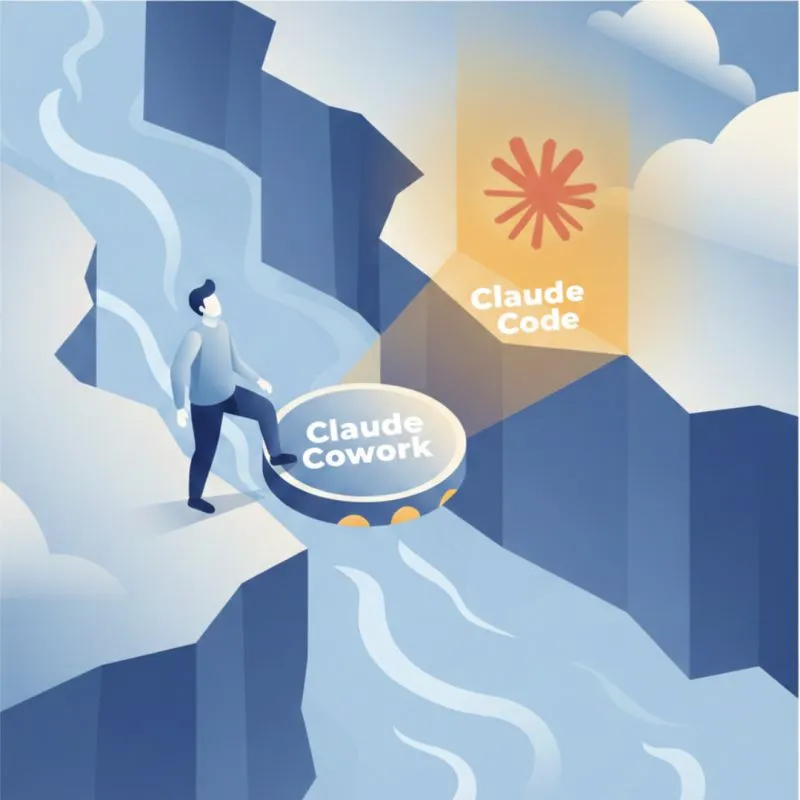
UX/UI and naming matter more than capability for adoption.
Recently, everyone on LinkedIn is talking about learning Claude after the demo of Claude Cowork.
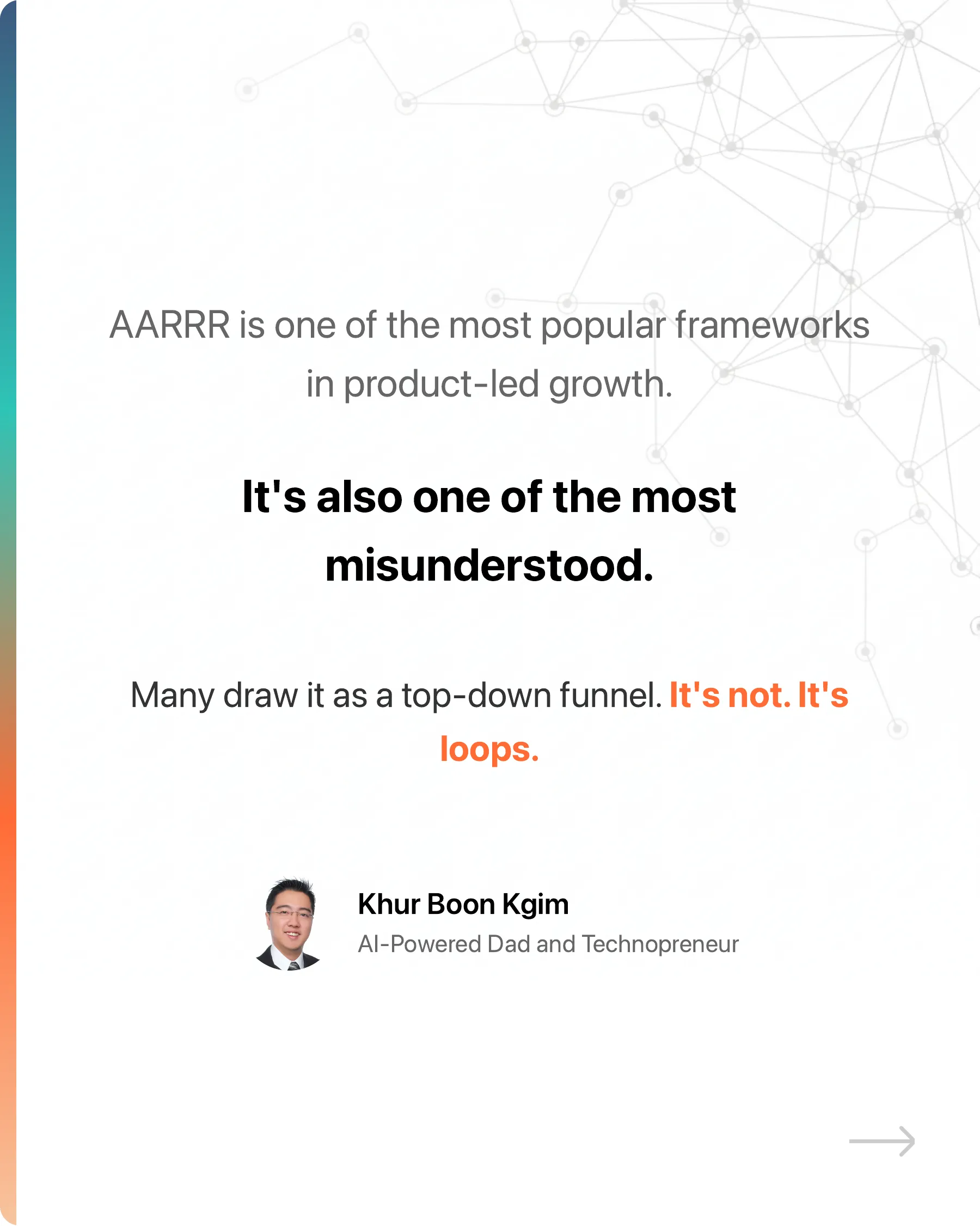
Most startups' growth stalls because they pour users into a leaky bucket.
That is why you should look at AARRR not as a funnel but as loops.

The em dash. The Inter font. Cream backgrounds. Structured SaaS layouts.
Some already get called "AI slop." Cream is probably next.
If you are building an AI startup, be aware of this existential risk.
The AI startup world is buzzing with new ideas, especially those centered around Large Language Models (LLMs). However, a significant, often overlooked, risk...

Our team is ready to kickstart the Business Plus AI Forum at CIFTIS Beijing 2025, in collaboration with Beijing Association for Trade in Services and World Trade Centers Association Beijing!
From rehearsals to the grand stage, everything is set for an exciting exchange of ideas on how AI is transforming industries and driving global collaboration...
5 Warning Signs Your Marketing Hire Is Just an Operator, Not a Strategist
Many founders make the mistake of hiring marketers who can execute… but not strategize.
UX/UI and naming matter more than capability for adoption.
Recently, everyone on LinkedIn is talking about learning Claude after the demo of Claude Cowork.
The em dash. The Inter font. Cream backgrounds. Structured SaaS layouts.
Some already get called "AI slop." Cream is probably next.
5 Warning Signs Your Marketing Hire Is Just an Operator, Not a Strategist
Many founders make the mistake of hiring marketers who can execute… but not strategize.
Most startups' growth stalls because they pour users into a leaky bucket.
That is why you should look at AARRR not as a funnel but as loops.
If you are building an AI startup, be aware of this existential risk.
The AI startup world is buzzing with new ideas, especially those centered around Large Language Models (LLMs). However, a significant, often overlooked, risk...
Our team is ready to kickstart the Business Plus AI Forum at CIFTIS Beijing 2025, in collaboration with Beijing Association for Trade in Services and World Trade Centers Association Beijing!
From rehearsals to the grand stage, everything is set for an exciting exchange of ideas on how AI is transforming industries and driving global collaboration...