OpenClaw vs Hermes Agent
A learner asked me this after a workshop last week.
“I heard Hermes Agent might replace OpenClaw, is it true?”
A learner asked me this after a workshop last week.
If you have been following the AI agent space, you probably noticed Hermes Agent trending on X and LinkedIn for the past weeks. And there is a specific reason why.
What happened
On April 4, 2026, Anthropic announced that Claude Pro and Max subscribers can no longer use their subscription through third-party tools like OpenClaw. Boris Cherny, Anthropic’s Head of Claude Code, explained that third-party tools bypass Claude’s prompt caching layer, making them significantly more expensive to run per session.
This was a big deal. An estimated 135,000+ OpenClaw instances were running on Claude subscriptions at the time.
So what did people do? Many switched to ChatGPT subscriptions. But then they ran into a second problem: OpenClaw had compatibility issues with ChatGPT’s OAuth and tool execution, especially with newer models like GPT-5.4.
Meanwhile, Hermes Agent worked with OpenAI’s API out of the box.
That is why Hermes is trending. Not because it is fundamentally better. But because of timing.
So what is the actual difference?
I tested both tools and studied their source codes on GitHub (OpenClaw, Hermes Agent) and their official documentation. Here is my breakdown for people who use these tools but are not necessarily developers.
The core difference is philosophical.
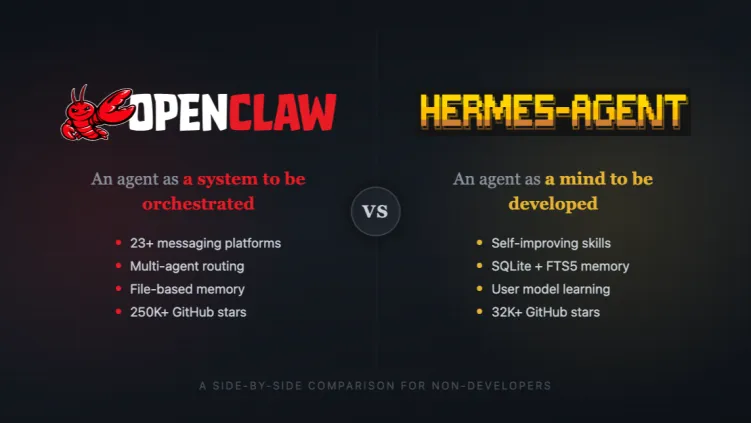
OpenClaw treats an agent as a system to be orchestrated. Hermes treats an agent as a mind to be developed.
That one sentence explains almost every technical difference between them. Let me unpack it.
1. Different philosophy, different priority
Both tools can connect to messaging platforms and both can reason with AI models. But they prioritize different things.
OpenClaw prioritizes connectivity. Connect to 23+ messaging platforms, swap between AI models, route different agents to different channels. The project’s energy goes into making the agent work everywhere with everything.
Hermes prioritizes learning. Create skills from experience, remember past sessions, improve over time. The project’s energy goes into making the agent get smarter the longer you use it.
This explains most of the differences you will see below.
2. Memory: Files vs Database
OpenClaw stores memory as Markdown files. Flexible, human-readable, and fully auditable - you can open the files and see exactly what the agent remembers. But you need to curate it yourself over time, or it gets messy.
Hermes stores memory in SQLite with full-text search (FTS5). The agent can search across all past sessions, and an LLM summarizes relevant history automatically. It also builds a “user model” - a deepening understanding of how you work - across sessions.
What this means for you: OpenClaw gives you more control over what the agent remembers. Hermes does more of the remembering for you, and that compounds over time. After 20-30 tasks in a domain, reviewers report measurable improvement in Hermes’ output quality.
3. Skills: Manual vs Self-Improving
This is probably the biggest practical difference - but it is more nuanced than most comparisons suggest.
Hermes skills are created autonomously by the agent. After completing a complex task (typically 5+ tool calls), the agent synthesizes the experience into a reusable skill document. Next time a similar task comes up, it loads the skill instead of solving it from scratch. And the skills self-improve during use. This is native to Hermes - it is baked into the agent loop itself.
OpenClaw skills are static files by default - you write and maintain them. But OpenClaw has a skill registry called ClawHub with 13,000+ community-built skills, and one of the highest-rated is the Self-Improving Agent skill. Install it and your OpenClaw agent starts recording learnings, errors, corrections, and feature requests into a .learnings/ directory. It uses hooks to detect user corrections (“No, that’s wrong”) and command failures automatically, then logs them as structured entries. High-value learnings get promoted to permanent project memory files over time.
So how does OpenClaw’s self-improving skill compare to Hermes’ native learning?
The key difference: Hermes’ learning is procedural - it creates reusable skill files that the agent executes autonomously next time. OpenClaw’s self-improving skill is declarative - it logs what went wrong and what it learned, then references those learnings as context in future sessions. Hermes learns to do. OpenClaw learns to know.
In practice, Hermes’ approach compounds faster on repeated tasks (one comparison reported 40% speed improvement with no prompt tuning). OpenClaw’s approach gives you full visibility into what was learned and lets you edit or override it.
What this means for you: If you want hands-off learning that compounds automatically, Hermes has the edge natively. If you want self-improvement with full transparency and manual override, OpenClaw + the self-improving skill gets you there - but it requires setup and the learning style is different.
4. Multi-Agent Support
Both tools support running multiple agents, but the architecture is different.
OpenClaw runs multiple named agents from a single gateway. You can have “main” on Telegram, “scribe” on Discord, and “optimus” on Slack - each with its own personality and permissions, all managed from one central process.
Hermes supports multiple agents through a profiles system. Each profile is a fully isolated environment with its own config, memory, skills, and gateway. You can run a coding assistant, a research agent, and a personal bot side by side. Hermes also supports orchestrator + worker patterns where a coordinator routes tasks to the agent with the most relevant skills.
What this means for you: OpenClaw’s multi-agent is essentially message routing - different agents on different channels, managed from one gateway. Hermes goes further with task orchestration - a coordinator can route tasks to the agent with the most relevant skills. If you just need different personas on different platforms, OpenClaw is straightforward. If you need agents that specialize and collaborate, Hermes has more to offer here.
5. Platform Support
OpenClaw: 23+ messaging channels. WhatsApp, Telegram, Slack, Discord, Signal, iMessage, Google Chat, Microsoft Teams, LINE, WeChat, and more. Also runs on macOS, Linux, Windows, iOS, and Android.
Hermes: 7+ channels. Telegram, Discord, Slack, WhatsApp, Signal, Email, Home Assistant.
OpenClaw wins on reach. If you need your agent on iMessage, Teams, or LINE, Hermes is not there yet.
6. Tech Stack
OpenClaw: TypeScript/Node.js. With Swift (iOS), Kotlin (Android), and some Python.
Hermes: Python. If you are a Python developer, contributing to or extending Hermes will feel more natural.
7. Community and Backing
OpenClaw: 250K+ GitHub stars, one of the fastest-growing open-source projects ever. Creator Peter Steinberger joined OpenAI in February 2026. The project moved to an independent foundation with OpenAI funding.
Hermes: 32K+ GitHub stars, backed by Nous Research - an AI research lab known for open-source LLMs. Recently announced a partnership with MiniMax AI.
Both are MIT-licensed open-source projects.
Will Hermes replace OpenClaw?
My honest answer: I don’t think so.
They solve different problems. OpenClaw is a multi-platform AI assistant that connects to everything. Hermes is a self-improving agent that learns from you over time.
The current wave of people switching to Hermes is driven by one specific event: Anthropic blocking third-party harnesses. If you were using OpenClaw with Claude and suddenly could not, and ChatGPT did not work smoothly either, Hermes was the path of least resistance.
But Peter Steinberger is now at OpenAI, leading a team focused on AI agent infrastructure. ChatGPT + OpenClaw compatibility will be solved.
The more interesting question is what happens long-term. Hermes’ self-improving skill system is genuinely different from anything else in this space. If you are someone who does the same types of tasks repeatedly - writing, research, coding workflows, data analysis - an agent that learns your patterns and gets better over time is a compelling proposition.
If you have not tried either, here is my suggestion: if you want a personal assistant that works across all your messaging platforms, start with OpenClaw. If you want an agent that compounds its usefulness the more you use it, try Hermes.
Or use both and see which one sticks for which workflow.
#AI #OpenSource #AIAgents #OpenClaw #HermesAgent
Enjoyed this? Subscribe for more.
Practical insights on AI, growth, and independent learning. No spam.
More in AI Agents
❌ One common mistake we keep seeing business owners make in marketing:
They hire a junior marketer to run ads, create content and post on social media... And think their marketing is covered.
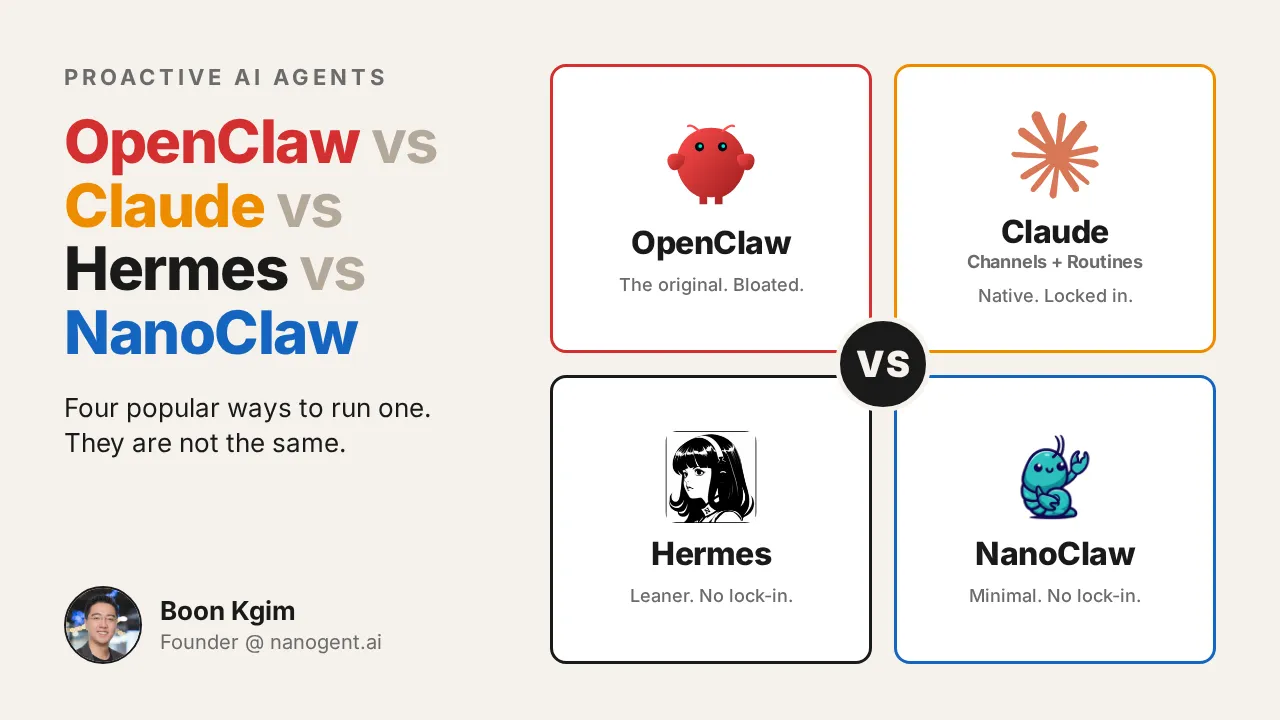
OpenClaw vs Claude vs Hermes vs NanoClaw
If you have used Claude Code heavily, you saw it immediately: OpenClaw is a chat wrapper on top of CLI agents like Claude Code and Codex. So I dismissed it a...
The most practical use case of a browser agent so far.
"Help me to complete this assignment"
Not all AI projects need data scientist and AI engineers.
One of the most common mistakes business leaders make in their AI project is getting the wrong team to build.
Can DeepSeek R1 Run on a Normal Laptop for Free?
TL;DR
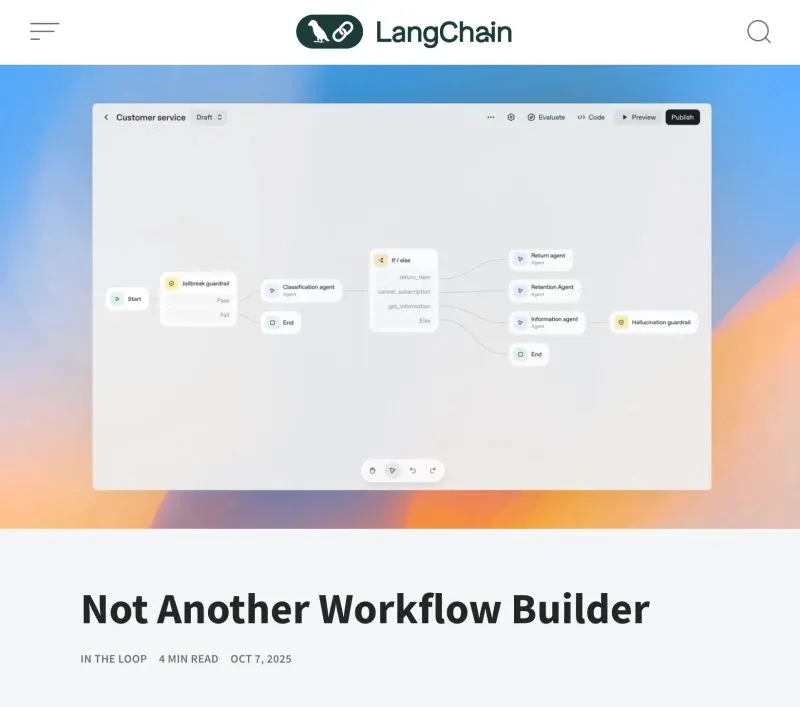
LangChain on AI Agents vs Workflow Builders
(I admit, I’ve contributed to one of those posts myself)
❌ One common mistake we keep seeing business owners make in marketing:
They hire a junior marketer to run ads, create content and post on social media... And think their marketing is covered.
Not all AI projects need data scientist and AI engineers.
One of the most common mistakes business leaders make in their AI project is getting the wrong team to build.
Can DeepSeek R1 Run on a Normal Laptop for Free?
TL;DR
OpenClaw vs Claude vs Hermes vs NanoClaw
If you have used Claude Code heavily, you saw it immediately: OpenClaw is a chat wrapper on top of CLI agents like Claude Code and Codex. So I dismissed it a...
The most practical use case of a browser agent so far.
"Help me to complete this assignment"
LangChain on AI Agents vs Workflow Builders
(I admit, I’ve contributed to one of those posts myself)