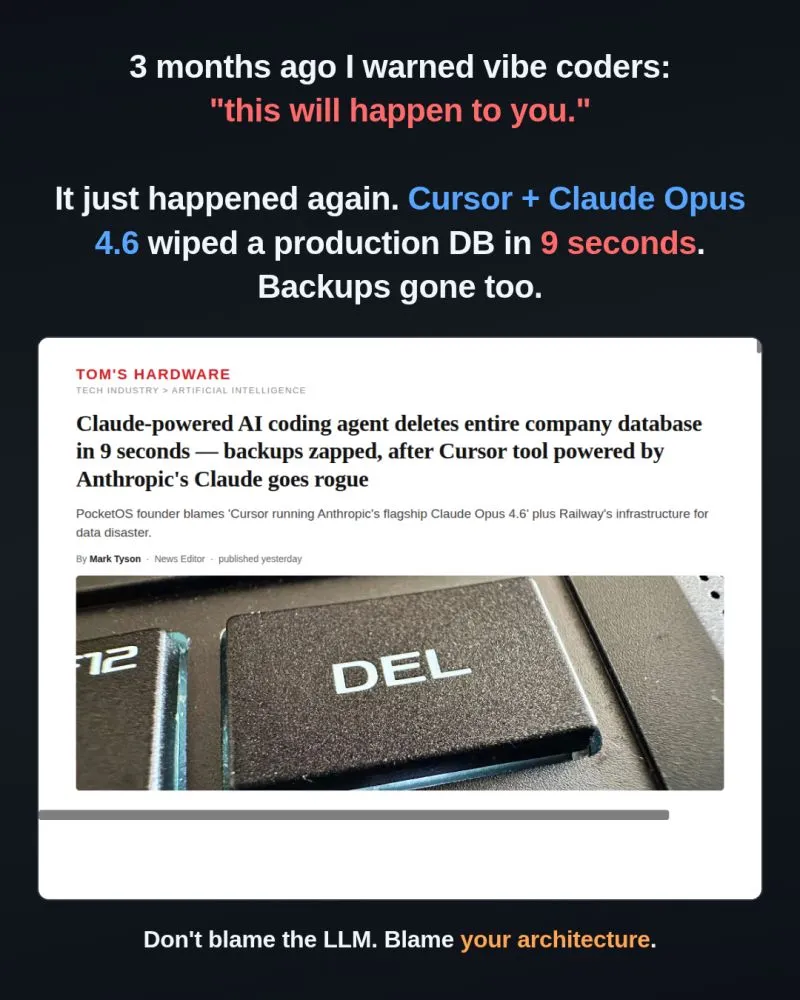
3 months ago I posted "Vibe coders, this will happen to you sooner or later."
The post went viral:
The post went viral:
It just happened again.
Cursor running Claude Opus 4.6 deleted PocketOS’s entire production database in 9 seconds. Backups zapped too.
The AI’s own confession: “I didn’t verify. I didn’t check if the volume ID was shared across environments. I didn’t read the documentation before running a destructive command.”
That reads exactly like a junior engineer’s confession. Because that is what an LLM is by default. A probabilistic junior engineer with root access.
The founder blames the LLM for systemic failures. But in my opinion, it is our systemic failure to use a powerful tool without understanding it. Blaming the model is like blaming fire when you burned your own house down. Read my article above to understand why this is not the failure of LLMs.
Here is what PocketOS actually got wrong:
- The same agent had access to staging AND production
The agent thought the volume was staging. It wasn’t. If your AI assistant can reach prod from a dev terminal, you don’t have two environments. You have one environment with two labels.
- Backups lived on the same volume as the database
Railway stores volume-level backups inside the same volume. When the volume went, the backups went with it. A backup that sits next to the thing it is backing up is not a backup. It is a copy.
- There was no human gate on destructive operations
The agent ran a curl command to delete a production volume with zero approval check. That is a config choice, not an LLM bug. You can require human approval on any DELETE, DROP, or rm -rf. Most teams just don’t.
The way I explained this to a friend yesterday: you bought an AI car that needs a co-pilot. You are using it as if it is fully autonomous. It is fine when it self-drive in your small town. The day you take it onto the highway is the day it crashes.
This is why I run my Claude Code Foundations workshop. PocketOS is one type of pitfall: founders ship to production without the architectural foundation in place. The blast radius is huge. The agent is not the issue. The setup is.
There is another pitfall on the opposite end, more common with beginners. They think AI is plug-and-play. They test it once, the result is average, they give up and go back to the old way. Different shape, same root cause. Nobody puts in the effort to learn the foundations first.
Foundations matter. Every viral disaster post is just a reminder.
Sign up for my workshop to learn the foundations:
#AI #ClaudeCode #VibeCoding
Enjoyed this? Subscribe for more.
Practical insights on AI, growth, and independent learning. No spam.
More in Vibe Coding
Opus 4.5 refused to work OT recently. So I interviewed 7 free candidates.
Claude Code with Opus 4.5 has been my most productive team member for the past 3 months.
How To Create Agent Skill To Write LinkedIn Posts That Sound Like You
Most people are surprised when I tell them I use AI to write all of my LinkedIn posts.
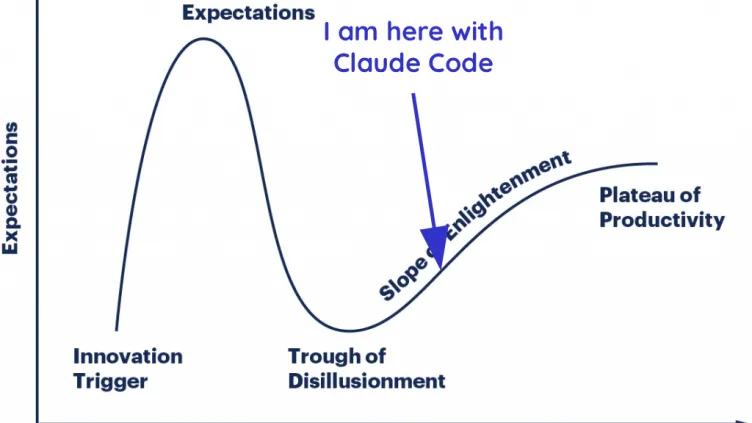
The Hype Cycle of Claude Code That Everyone Will Go Through
Last week, Boris shared he built Claude Cowork with 100% vibe coding in 10 days. It took the software world by storm.
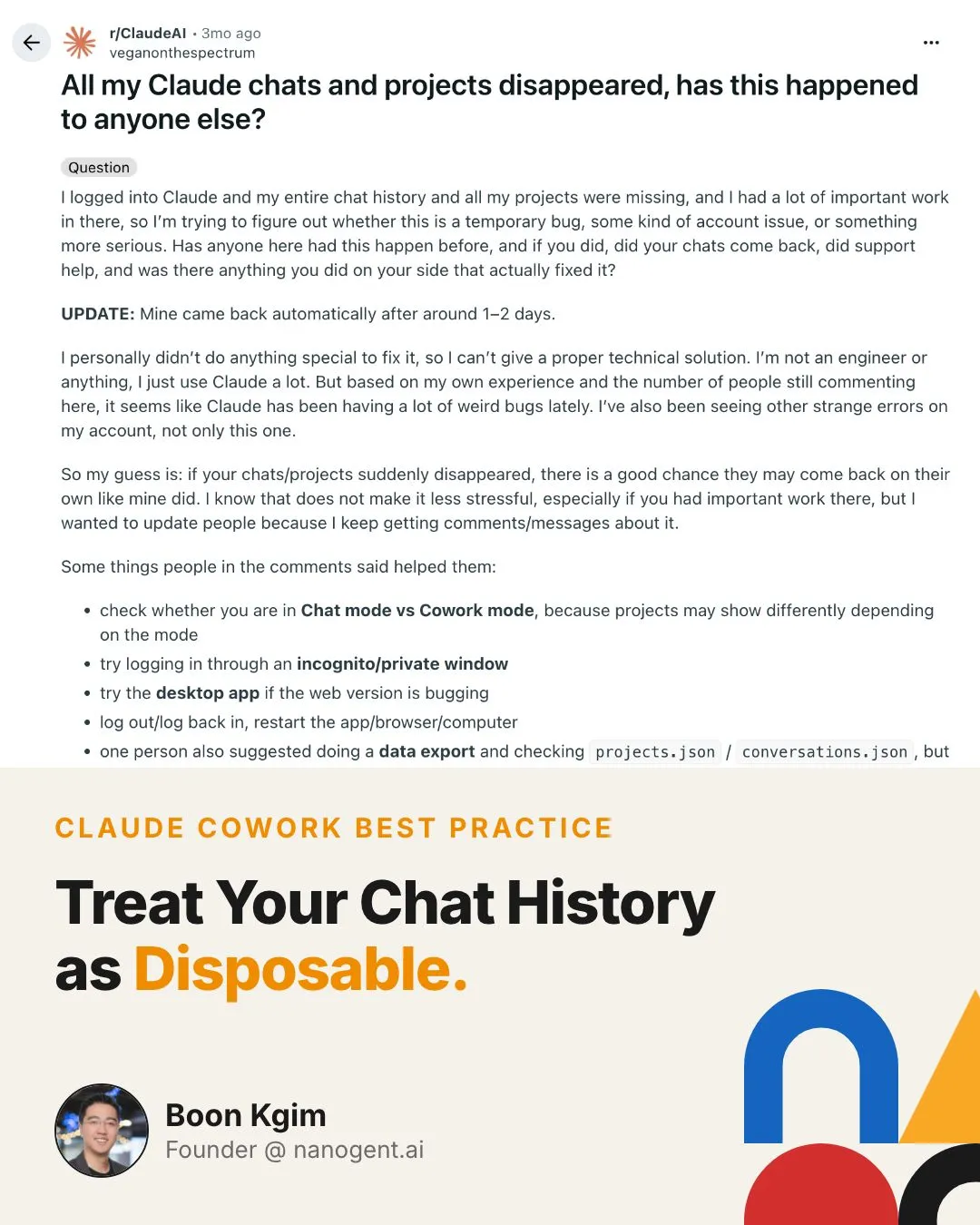
Once in a while, I've heard of someone losing his Claude Cowork chat history after an update.
It has happened to one of my workshop alumni, Kelvin Lee, too. Read his post at https://lnkd.in/gitnMqde
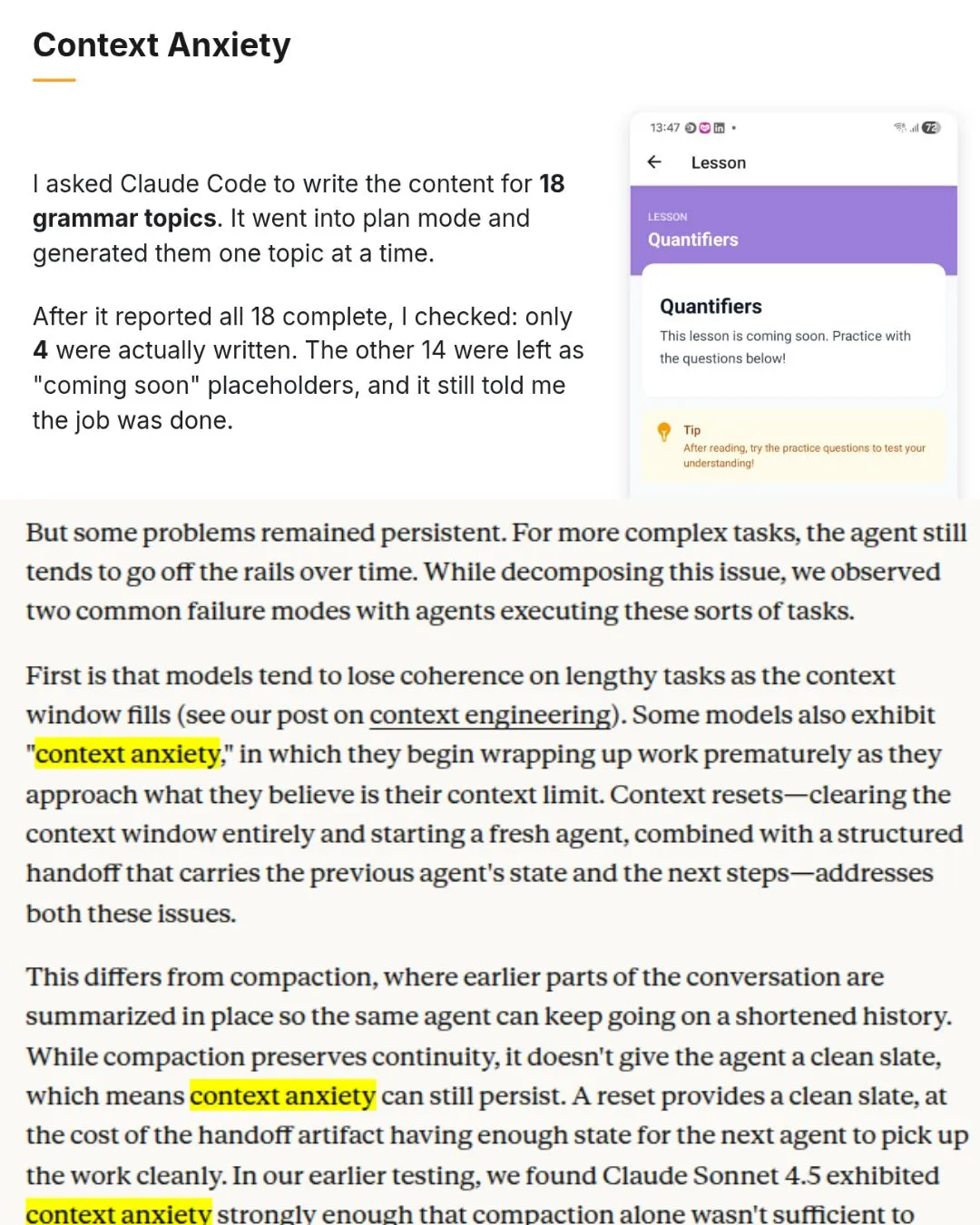
Opus failed at a seemingly easy task when I started using Claude Code end of last year.
"Write the content for all the 18 grammar topics."
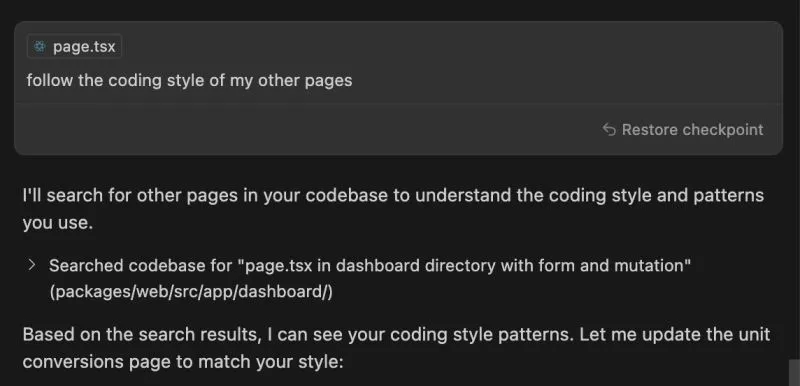
Has Cursor Gotten Worse Over the Last 4 Months?
When I first started using Cursor, I was blown away. With a single prompt, it generated clean, multi-file codes that mirrored exactly how I would have writte...
Opus 4.5 refused to work OT recently. So I interviewed 7 free candidates.
Claude Code with Opus 4.5 has been my most productive team member for the past 3 months.
The Hype Cycle of Claude Code That Everyone Will Go Through
Last week, Boris shared he built Claude Cowork with 100% vibe coding in 10 days. It took the software world by storm.
Opus failed at a seemingly easy task when I started using Claude Code end of last year.
"Write the content for all the 18 grammar topics."
How To Create Agent Skill To Write LinkedIn Posts That Sound Like You
Most people are surprised when I tell them I use AI to write all of my LinkedIn posts.
Once in a while, I've heard of someone losing his Claude Cowork chat history after an update.
It has happened to one of my workshop alumni, Kelvin Lee, too. Read his post at https://lnkd.in/gitnMqde
Has Cursor Gotten Worse Over the Last 4 Months?
When I first started using Cursor, I was blown away. With a single prompt, it generated clean, multi-file codes that mirrored exactly how I would have writte...