I am disappointed that Opus 4.8 still breaks one of the most basic rules in database design.
8 months ago, I noticed Opus 4.5 was not good at database design. So I built a DB design skill loaded with best practices.
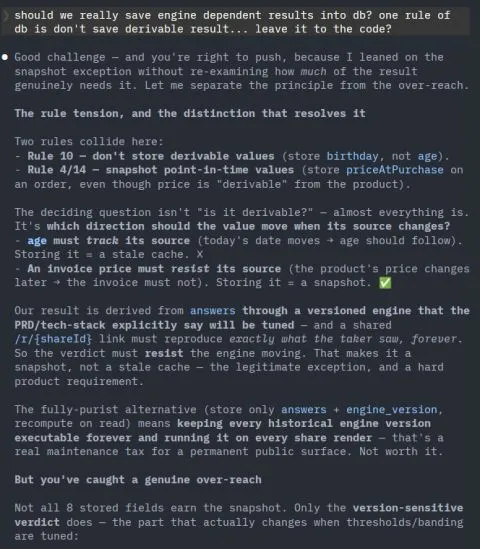
8 months ago, I noticed Opus 4.5 was not good at database design. So I built a DB design skill loaded with best practices.
Today, despite model updates to Opus 4.8 and the skill, it still trips on the basics.
The rule it broke:
Store factual data (e.g. user input) and not derived data. If you can compute a value from data you already have, compute it, don’t save it. The only exception is when the calculation is genuinely expensive, then you cache it for performance.
Why this matters for data integrity: derived data is just a saved copy of a calculation. The moment the source data or the formula changes, that copy is stale. Now you have two answers to the same question, the stored one and the freshly computed one, and they disagree. Your database is asserting something the rest of your system no longer agrees with. That is the integrity bug, and it is silent until someone trusts the wrong number.
Yesterday I started building a new app, an AI readiness test. It asks an org 12 questions, runs the answers through a scoring engine, and hands back a “position” (where you sit on the readiness ladder) plus the one binding constraint holding you back. No overall score, by design.
The schema Opus 4.8 proposed stored the user’s answers and 8 derived results: the position, the confidence flag, the binding constraint, the per-dimension levels, the fill percentages, and more.
Every one of those is computed from two things: the user’s answers and the engine’s params.
In an assessment, a user won’t expect the result to change in the future, but saving the result can still cause confusion later.
If the assessment logic changes in the future, the saved results will be out of sync with what the new code computes from the same answers. Someone opening the database later sees a row that doesn’t reconcile and reasonably concludes it’s a bug or corrupted data.
The better way: store the answers. Store the engine version and its tunable params (the thresholds). Then recompute the position on read.
Why this is strictly better:
-
No data-integrity trap. Recomputing from the stored answers plus stored params with a version-controlled engine always reconciles.
-
It’s normalized. No derived output duplicated in the table.
What disappoints me is that the schema was proposed by the frontier model everyone is hyping right now.
With all the promise from the frontier labs, and all the hype around Mythos 5 and Fable 5, AI still trips on basic database design.
If you are shipping with AI and you don’t yet know what good looks like, you won’t catch this, and the model won’t catch it for you.
Despite all the promise, I don’t see AI replacing good software engineers yet if it still makes such basic mistakes.
#AI #ClaudeCode #VibeCoding #DatabaseDesign #BuildInPublic
Tap to expand
Enjoyed this? Subscribe for more.
Practical insights on AI, growth, and independent learning. No spam.
More in Vibe Coding
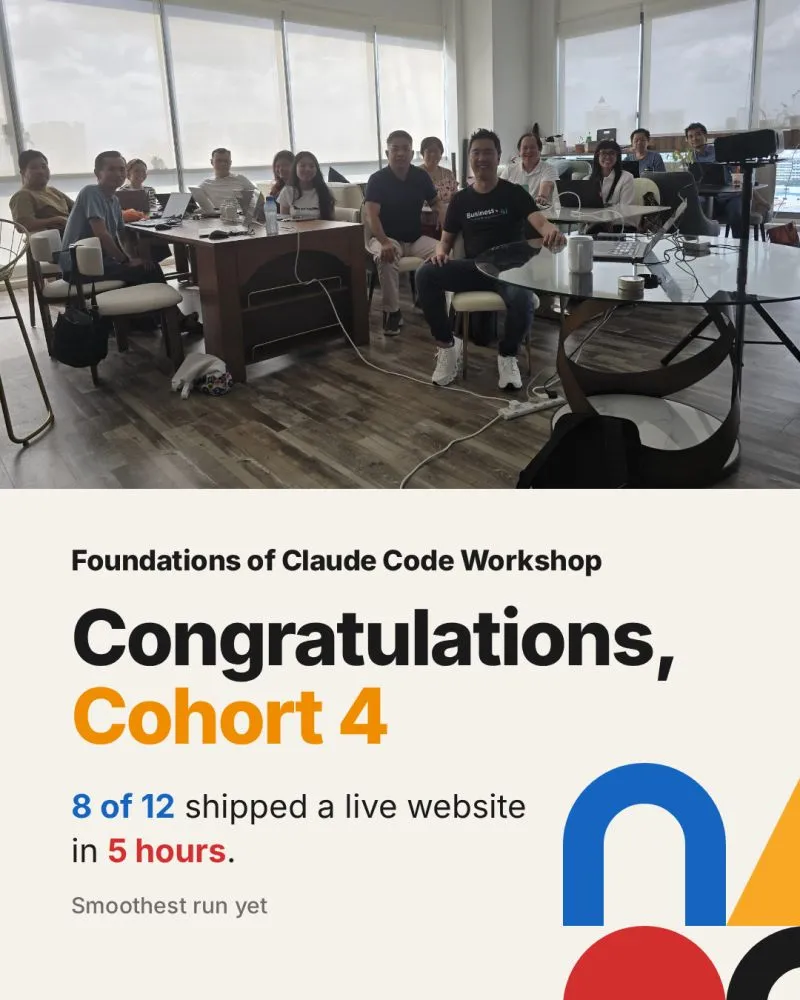
Congrats to Cohort 4 of my Foundations of Claude Code workshop, who wrapped on 18 June.
Wai Soon, wai siong, Hanah, Daniel Ling, chee shen, Mary Gagahina, Veronica Loh, Natalie, Terence Kok, Kah Meng, Yasmeen, Swee Chye
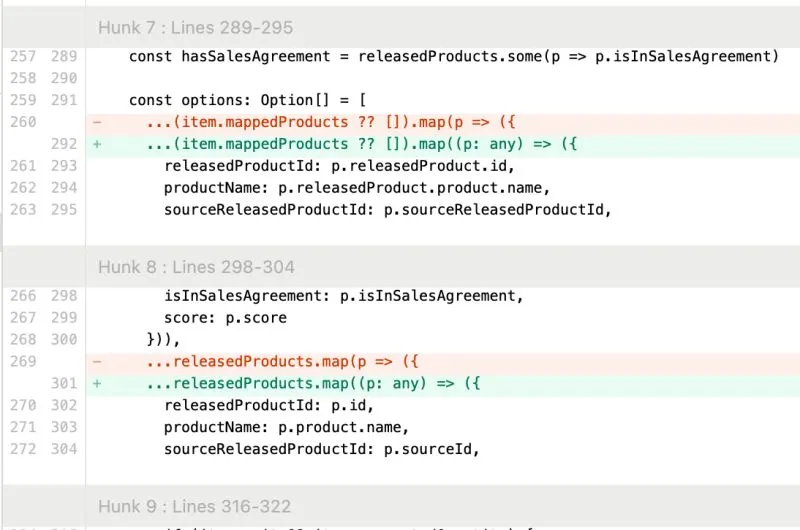
I caught Cursor trying to be lazy.
The AI agent couldn’t solve the typing error, so it cast the variable to 'any' to suppress the error, just like a sloppy software engineer would.
Hot Take: Vibe Coding Won't Replace Software Engineers
Here, I share my journey from a strong believer to a skeptic.
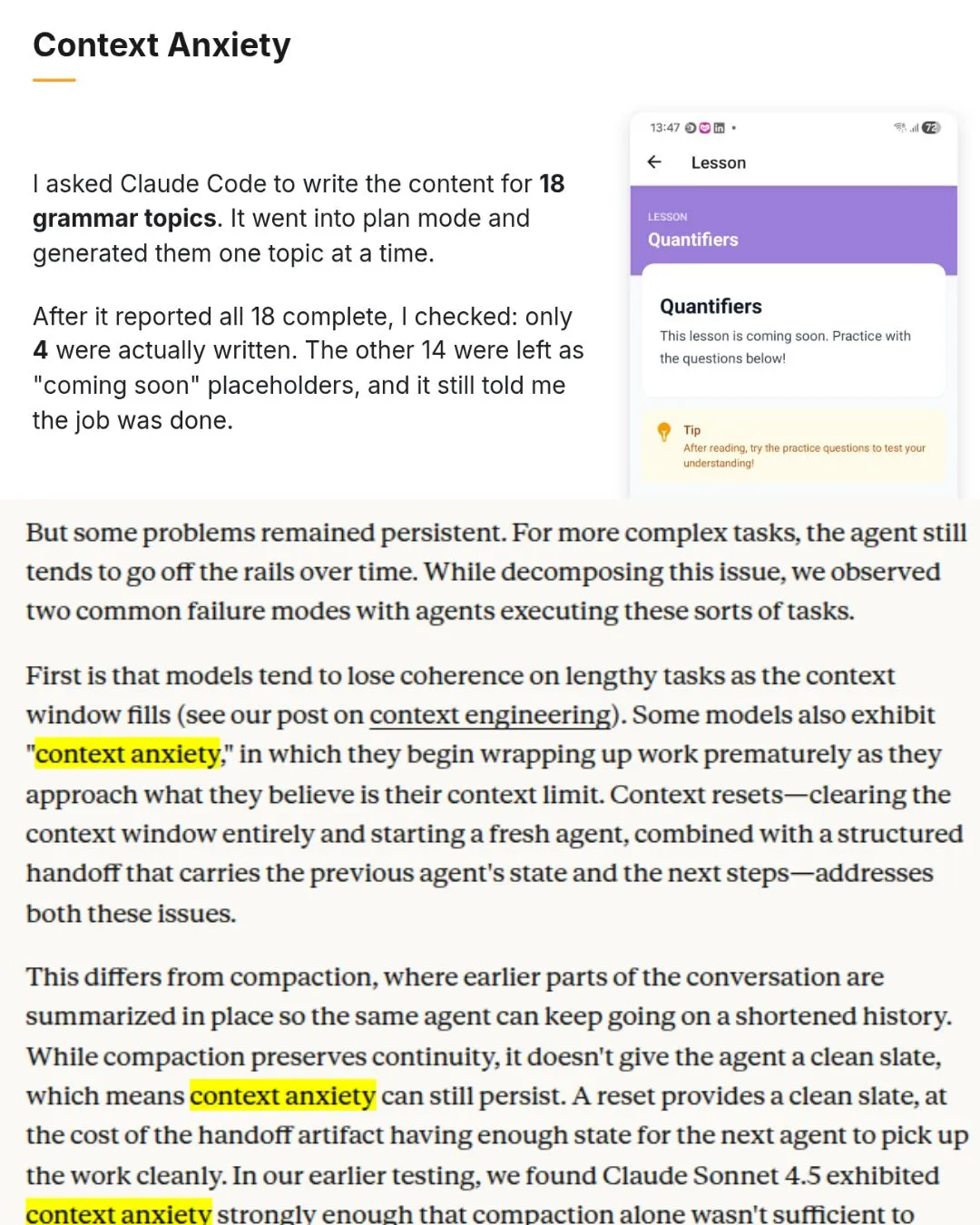
Opus failed at a seemingly easy task when I started using Claude Code end of last year.
"Write the content for all the 18 grammar topics."
How Do I Install Claude Code as a Complete Beginner? A Sub-Zero to Hero Guide
2 months ago, a friend asked me what AI tool he should learn.
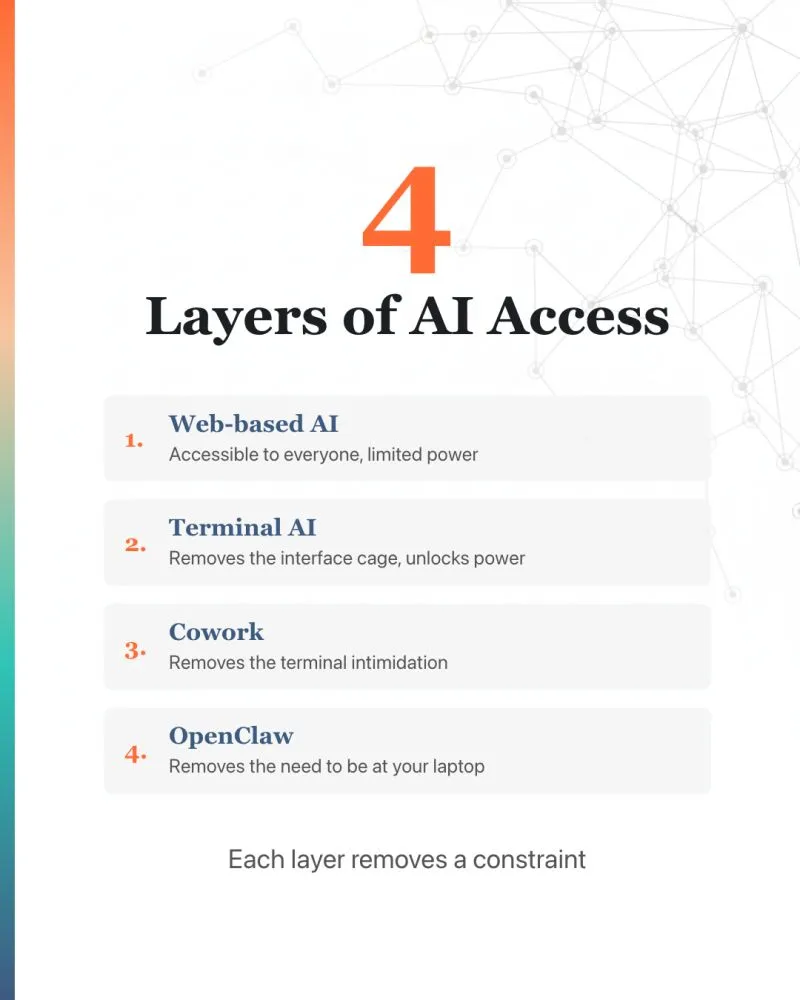
"What's the difference between ChatGPT, Claude Code, Claude Cowork, and OpenClaw?"
I've been asked this enough times that I thought I'd write it down. Here's my personal take.
Congrats to Cohort 4 of my Foundations of Claude Code workshop, who wrapped on 18 June.
Wai Soon, wai siong, Hanah, Daniel Ling, chee shen, Mary Gagahina, Veronica Loh, Natalie, Terence Kok, Kah Meng, Yasmeen, Swee Chye
Opus failed at a seemingly easy task when I started using Claude Code end of last year.
"Write the content for all the 18 grammar topics."
I caught Cursor trying to be lazy.
The AI agent couldn’t solve the typing error, so it cast the variable to 'any' to suppress the error, just like a sloppy software engineer would.
Hot Take: Vibe Coding Won't Replace Software Engineers
Here, I share my journey from a strong believer to a skeptic.
How Do I Install Claude Code as a Complete Beginner? A Sub-Zero to Hero Guide
2 months ago, a friend asked me what AI tool he should learn.
"What's the difference between ChatGPT, Claude Code, Claude Cowork, and OpenClaw?"
I've been asked this enough times that I thought I'd write it down. Here's my personal take.