R.I.P. CMS. How AI agents like OpenClaw could replace CMS.
Thanks to Claw Singapore and Lionel Sim for the invitation. Great to be on stage with 💎 Amanda Lau Shernin, Namira Noviar, Finnley Hui Yu, Lee, Alan Yuen, M...
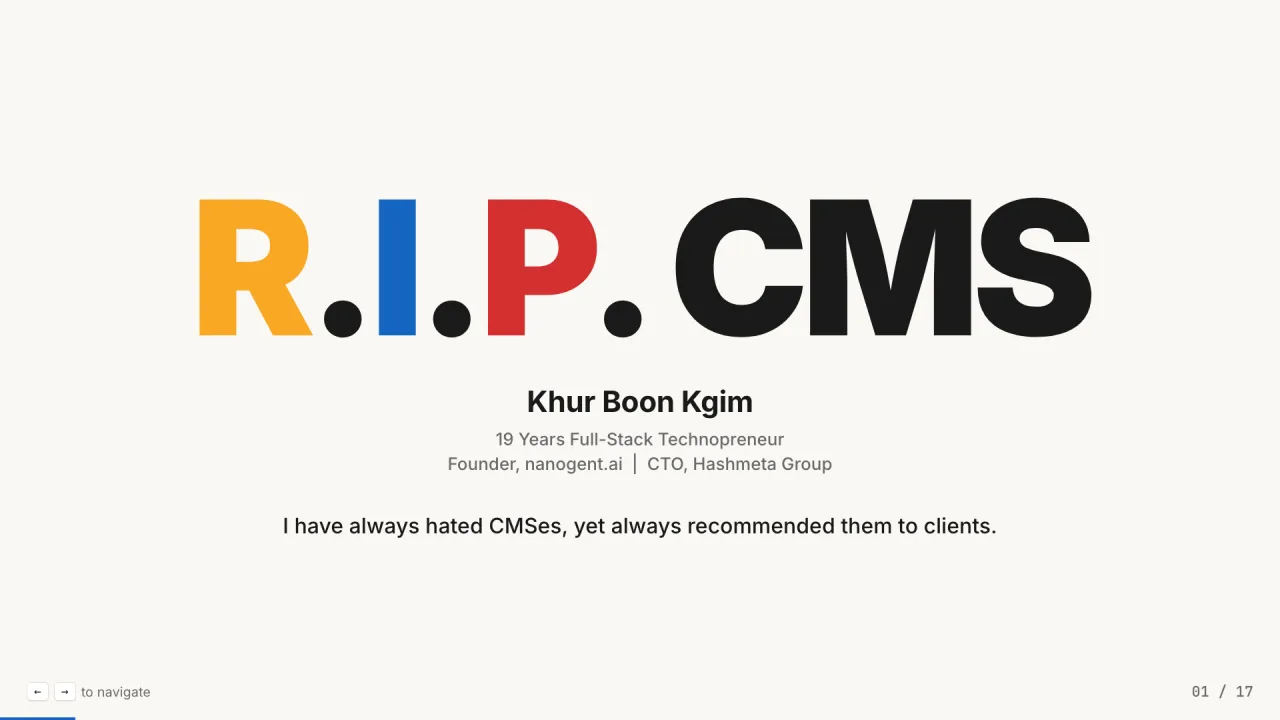
I gave a talk last night at the OpenClaw Singapore meetup on why the CMS era is quietly ending, and how AI agents like OpenClaw could replace it. This article is the written version of that talk, with the slides included.
Thanks to Claw Singapore and Lionel Sim for the invitation. Great to be on stage with 💎 Amanda Lau Shernin, Namira Noviar, Finnley Hui Yu, Lee , Alan Yuen , Máté Gábor, and Kishan S.. Thanks to Aspire for hosting.
The honest confession this whole talk runs on:
I have always hated CMSes, yet always recommended them to clients.
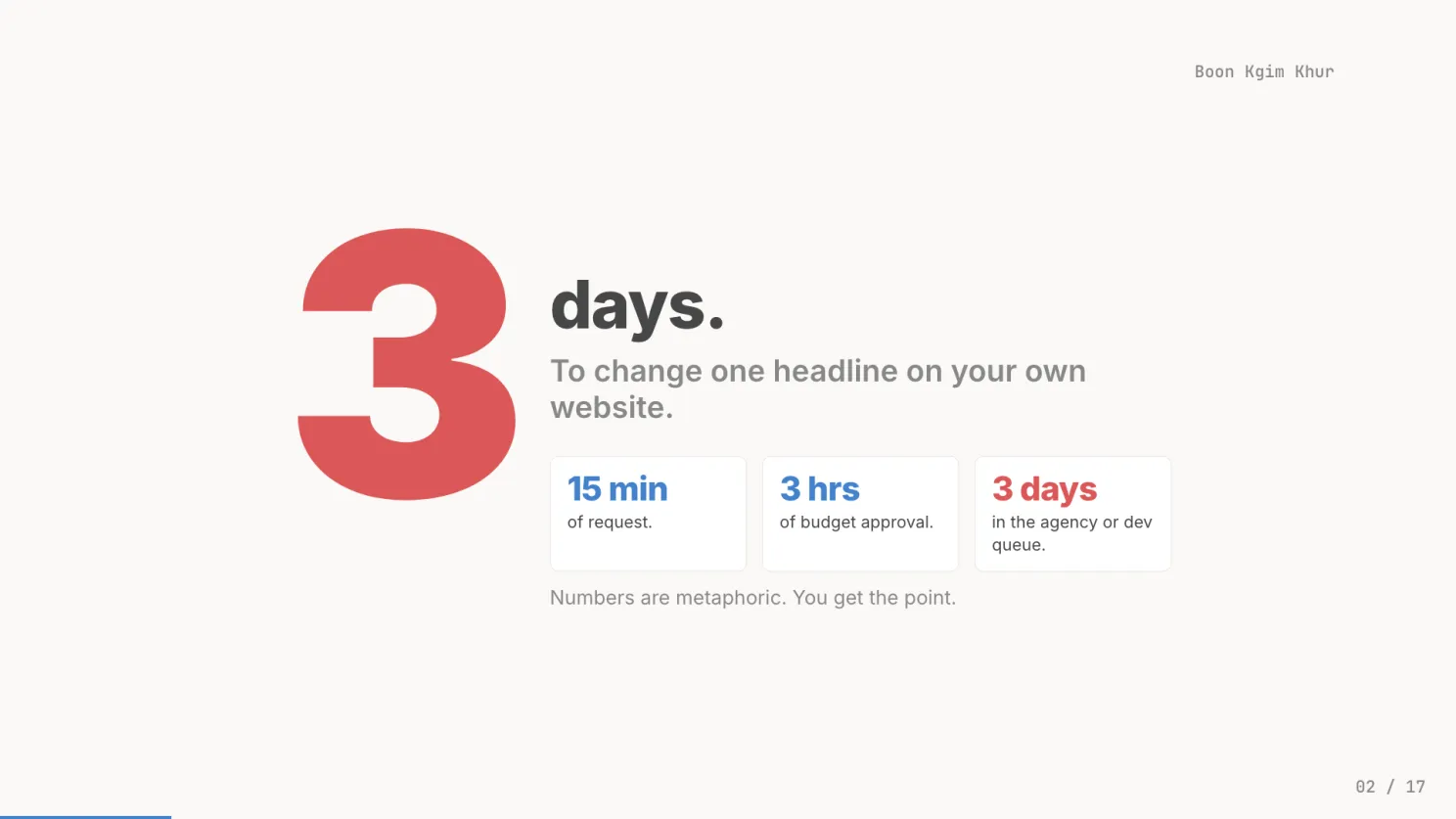
You have waited three days to change one headline on your own website. And nobody thinks that is strange anymore.
If you are a business owner or marketer who needs someone else’s help to change your website, chances are you have been waiting more than you should. You wanted a headline changed. You asked someone. You waited.
Here is what that wait actually looks like broken down: fifteen minutes to write the request, three hours of budget approval, three days in the agency or dev queue. The request is minutes. The approval is hours. The queue is days. You own the brand, you own the message, and you do not own the publish button.
That is the problem this article is about. A piece of software we have been installing since 2005, the CMS, quietly stopped doing the job it was bought to do. And most people have not noticed, because the pain got normalized.
Quick intro
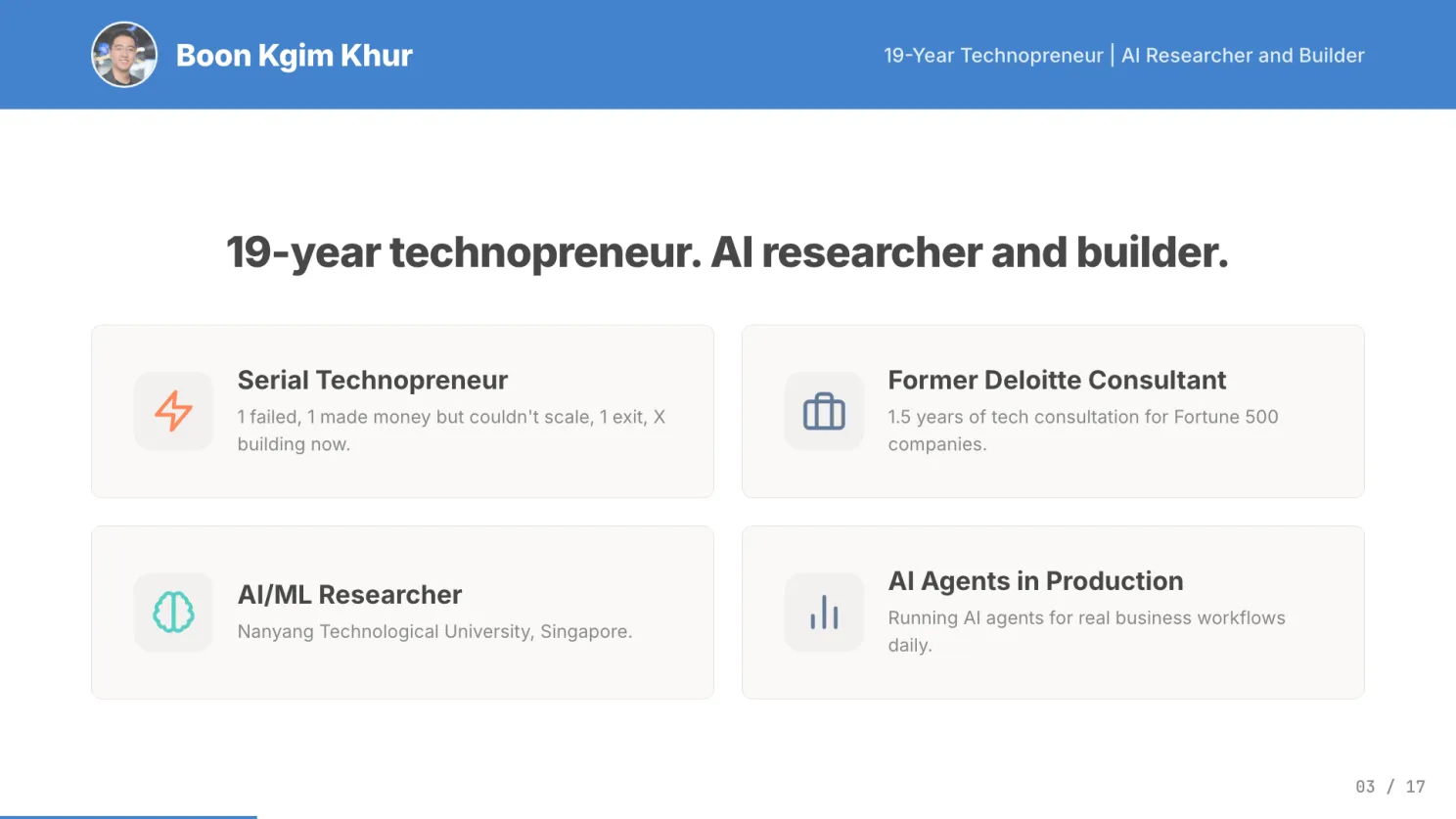
A quick intro about myself. I have been building tech solutions for 19 years. Multiple companies, one failed, one made money but could not scale, one exit, and a few I am building right now. 1.5-year stink at Deloitte as a tech consultant advising enterprises. AI and ML researcher at NTU. And every day I run AI agents in production for real business workflows at nanogent.ai.
The confession behind 19 years of recommendations
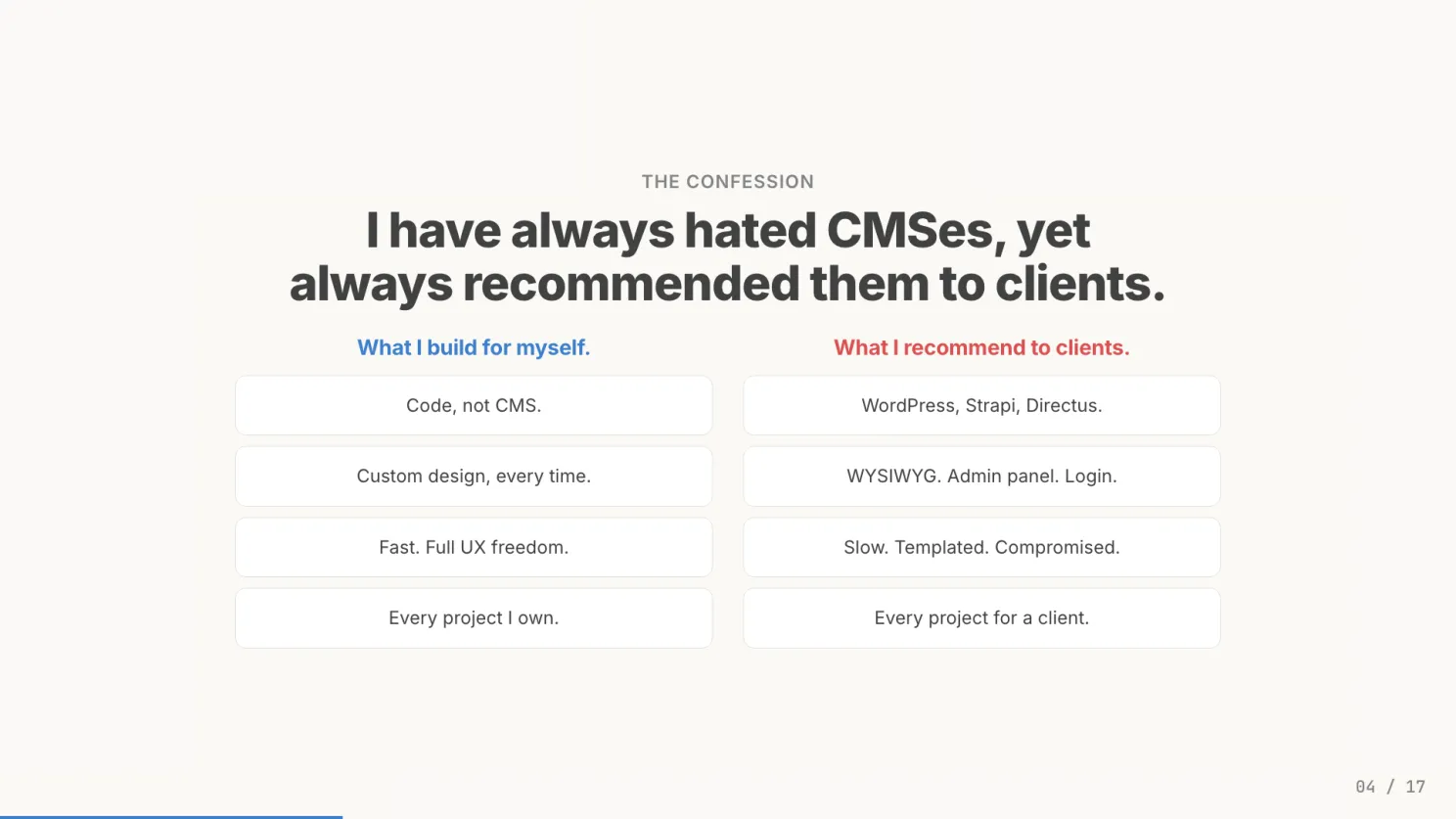
I have always hated CMSes, yet always recommended them to clients.
When I wanted a website for my own business or startup, I would always code it. No CMS. Custom design. Full freedom over the UX. Fast. I do this for every project I own.
When my clients need websites, I will always recommend a CMS. WordPress, Strapi, Directus, and the like. They come with a WYSIWYG editor, an admin panel, a login. Slow, templated, compromised. I recommend this for every project for a client.
Both of those are true. They have been true my entire career.
The reason I always recommended a CMS, and the rule in the market
If it sounds like I am a bad businessman who recommends something he hates to his clients, hear me out. I recommended a CMS in the best interest of my clients.
They cannot code. They need to own and update their content without calling me every time. I cannot hand over code and ask them to learn to code. A CMS was the best tool available for that job. It still is, until now.
And that reason calcified into a market rule. If you want to change your website, you need either a CMS, an in-house developer, or an agency. Those were the only three options.
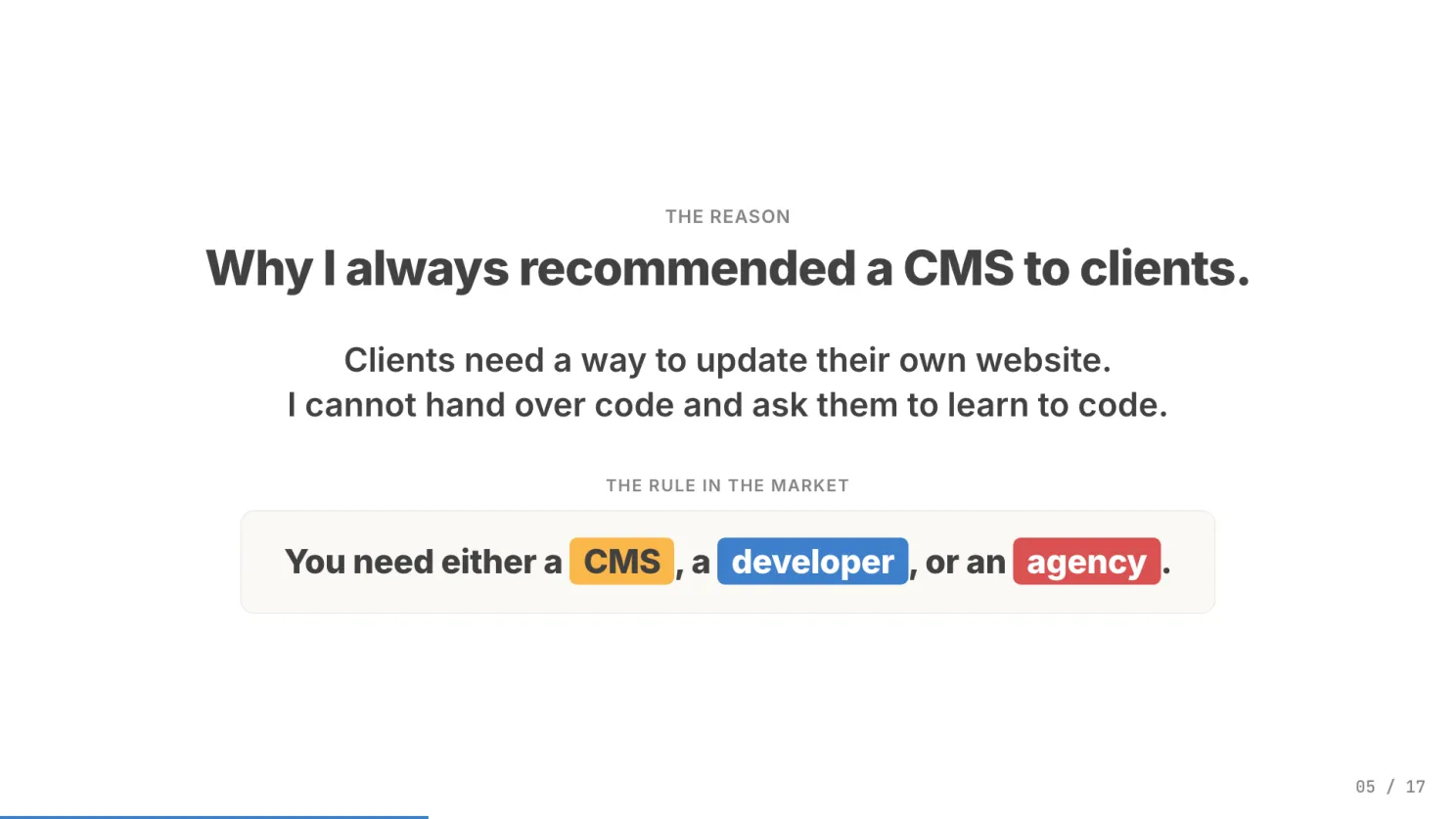
Each option costs you something. You pick one, and you pay that price every month.
Here is the compromise hiding behind that market rule.
The CMS costs you design freedom. You get templates that are hard to change. You get 2-hour training that you will forget by month two. And you fight a clunky WYSIWYG editor, a slow and bloated website, every time.
The in-house developer costs you additional headcount. And if you are a tech company, in-house developers have priority on core product features, not the marketing website. So they either cost you an extra bill, or they cost you queue time. They are good when they reply. They are rarely free when you need them, and you still do copy and design yourself.
The agency needs a scope of work for every change. Three to five days in the queue with their other clients. A monthly retainer you pay in quiet months too. And switching agencies means re-onboarding work.
This is the shape the whole industry has lived in for twenty years. You pick your option, and you pay that option’s price forever.
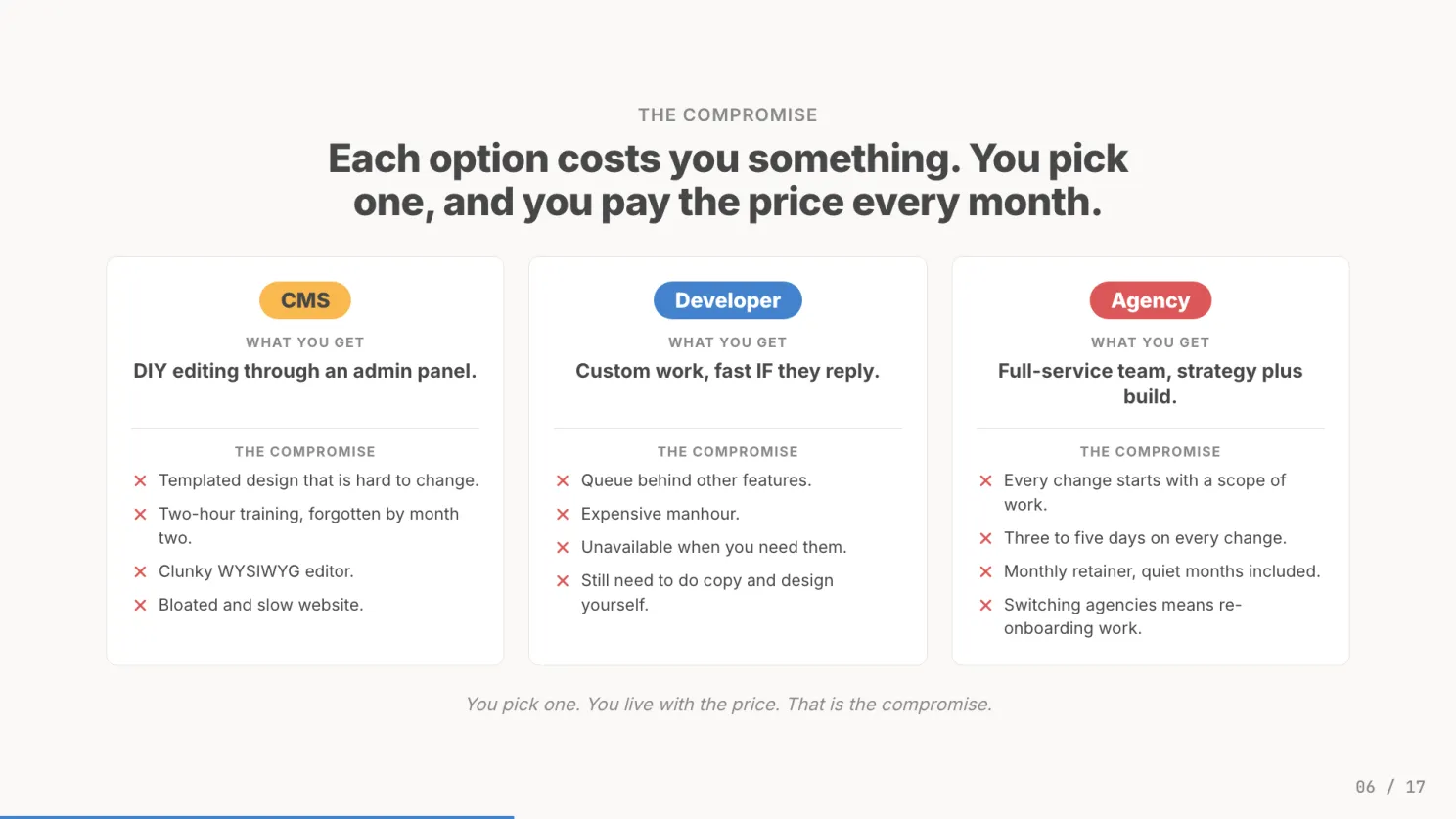
Then enter vibe-coding. Now everyone can build a website.
The tagline on every new AI coding tool became the same sentence.
Now everyone can build a website.
Claude Code. Cursor. Lovable. v0. Bolt. Replit Agent. For two straight years, the pitch deck, the landing page, the launch tweet, all the same story. Talk to the AI in plain English. It writes the code. Your website appears.
If that promise held, the market rule just got a fourth option. You, on your laptop, with no CMS, no developer, no agency. You just ship.
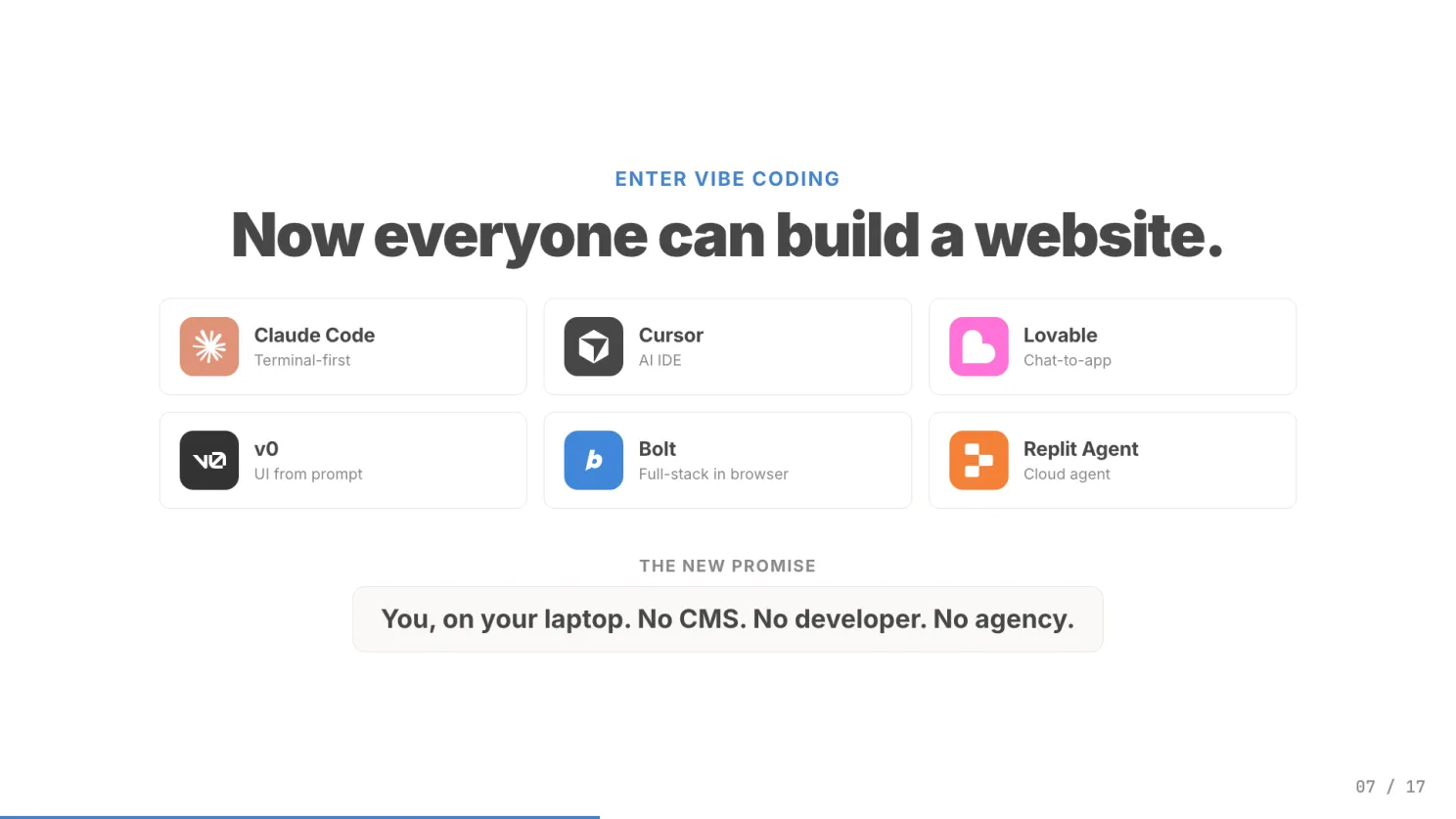
Building a website is easy now. Building a GREAT website is still hard.
Here is the reality.
Building a website is easy now. Anyone with an AI coding tool can get something live.
But… Building a great website is still hard. Great design. Great copy. Great SEO. Great conversion. Great performance. Brand consistency across every page. Vibe coding does not give you any of that for free. It gives you a site that is live. The rest is still craft.
The barrier to entry dropped. The ceiling did not move.
And most clients, honestly, are not interested in learning vibe coding either. They have a business to run.
Leave great websites to the pros.
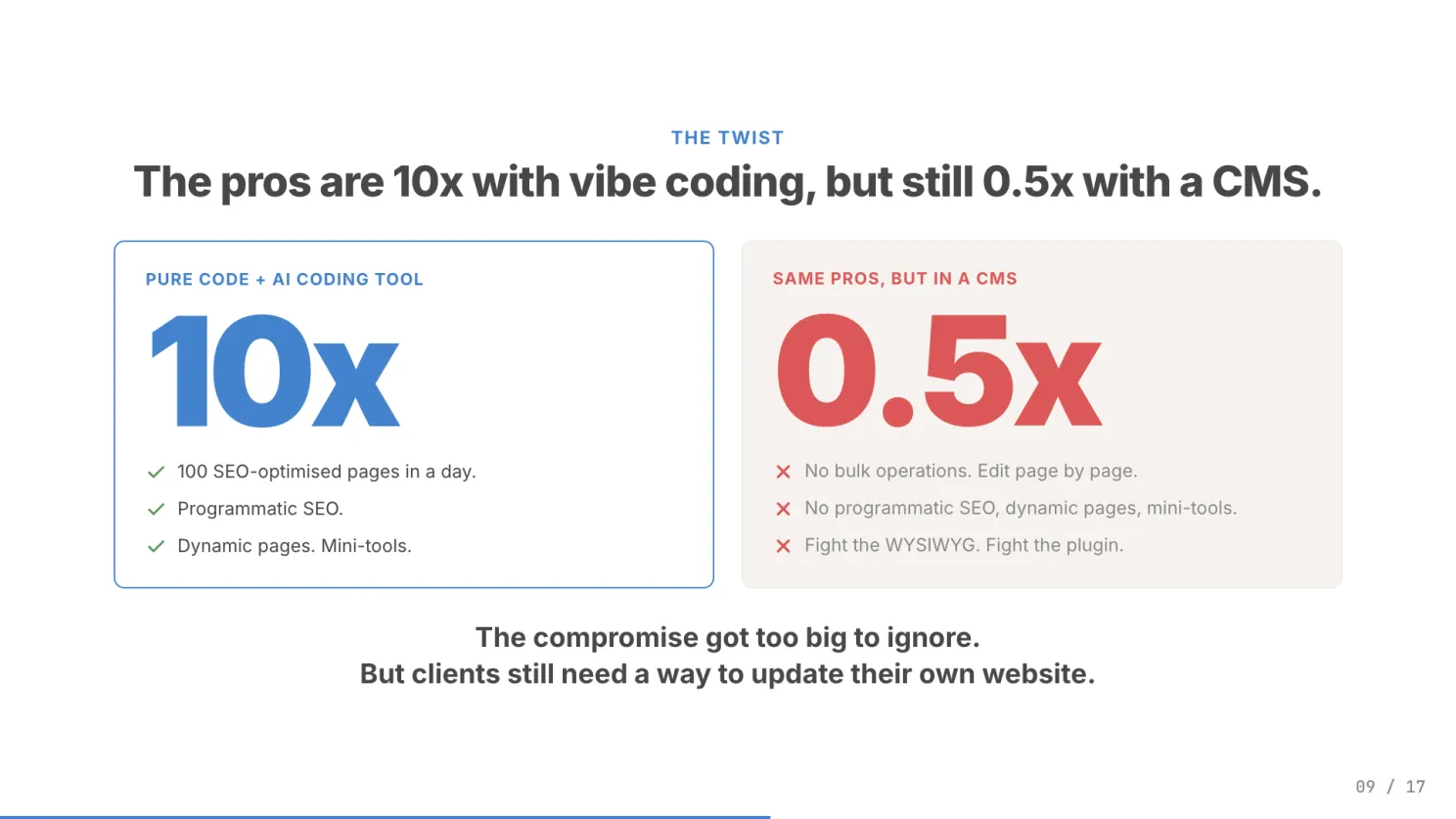
The pros are 10x with vibe coding, but 0.5x with a CMS
Here is another new reality. The pros got 10x faster. The CMS did not.
With pure code and an AI coding tool, I can now ship a hundred SEO-optimised pages in a day. I can ship programmatic SEO, dynamic pages, and mini-tools on a website, 10x faster.
Put me back in a CMS? Half the speed I can do with hand coding. No bulk operations, you edit page by page. No programmatic SEO. No dynamic pages. No mini-tools. Fight the WYSIWYG. Fight the plugin.
The compromise got too big to ignore. But clients still need a way to update their own website. Not all of them are ready to learn vibe-coding.
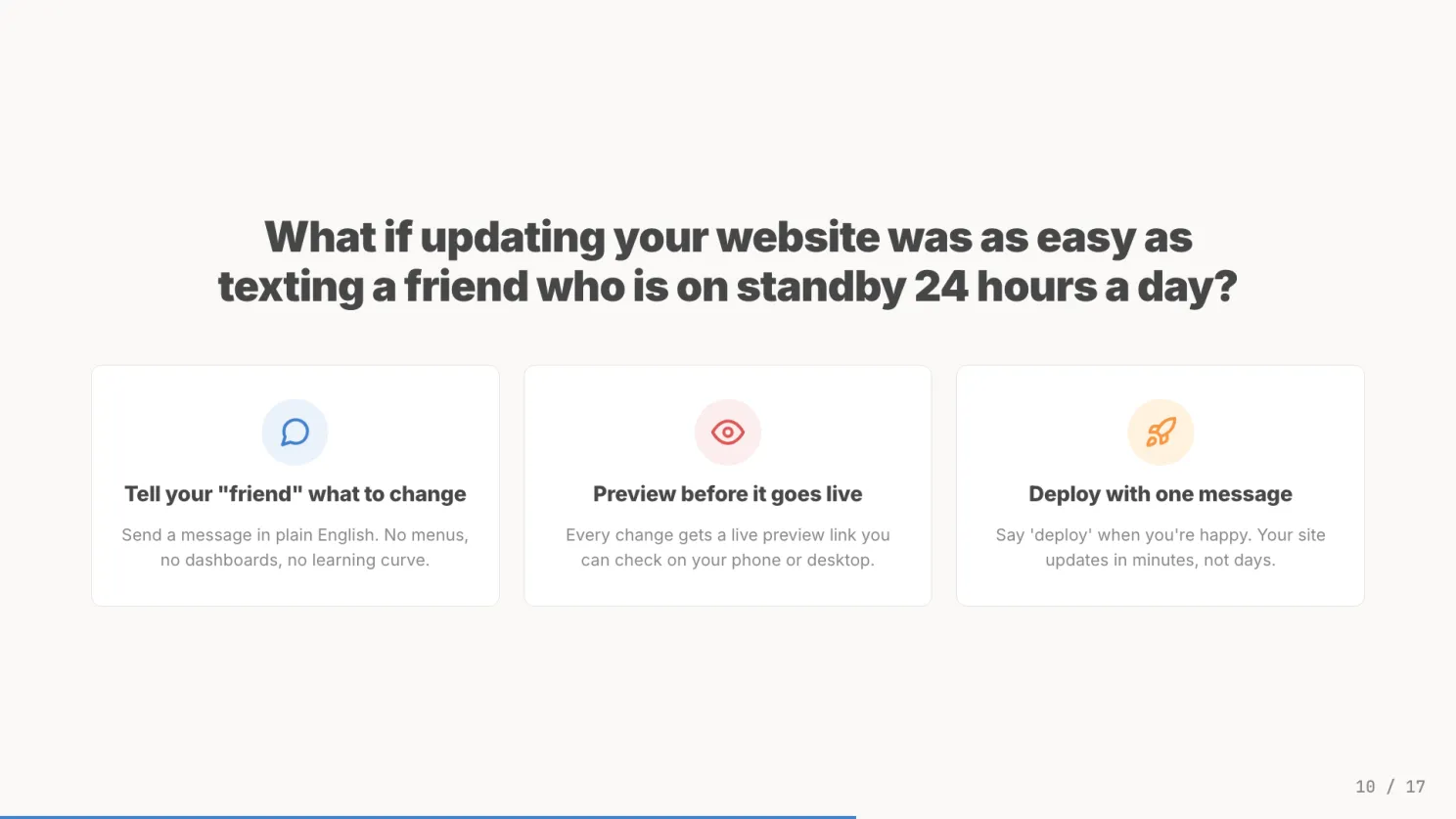
What if updating your website was as easy as texting a friend who is on standby 24 hours a day?
Tell your “friend” what you want to change. Send a message. Plain English. No menus, no dashboards, no learning curve.
Preview before it goes live. Every change gets a live preview link. You check it on your phone. On your desktop. Wherever you are.
Deploy with one message. You say “deploy” when you are happy. Your site updates in minutes, not days.
That is the new solution that is possible now. The next slide is the thing I built that does exactly this.
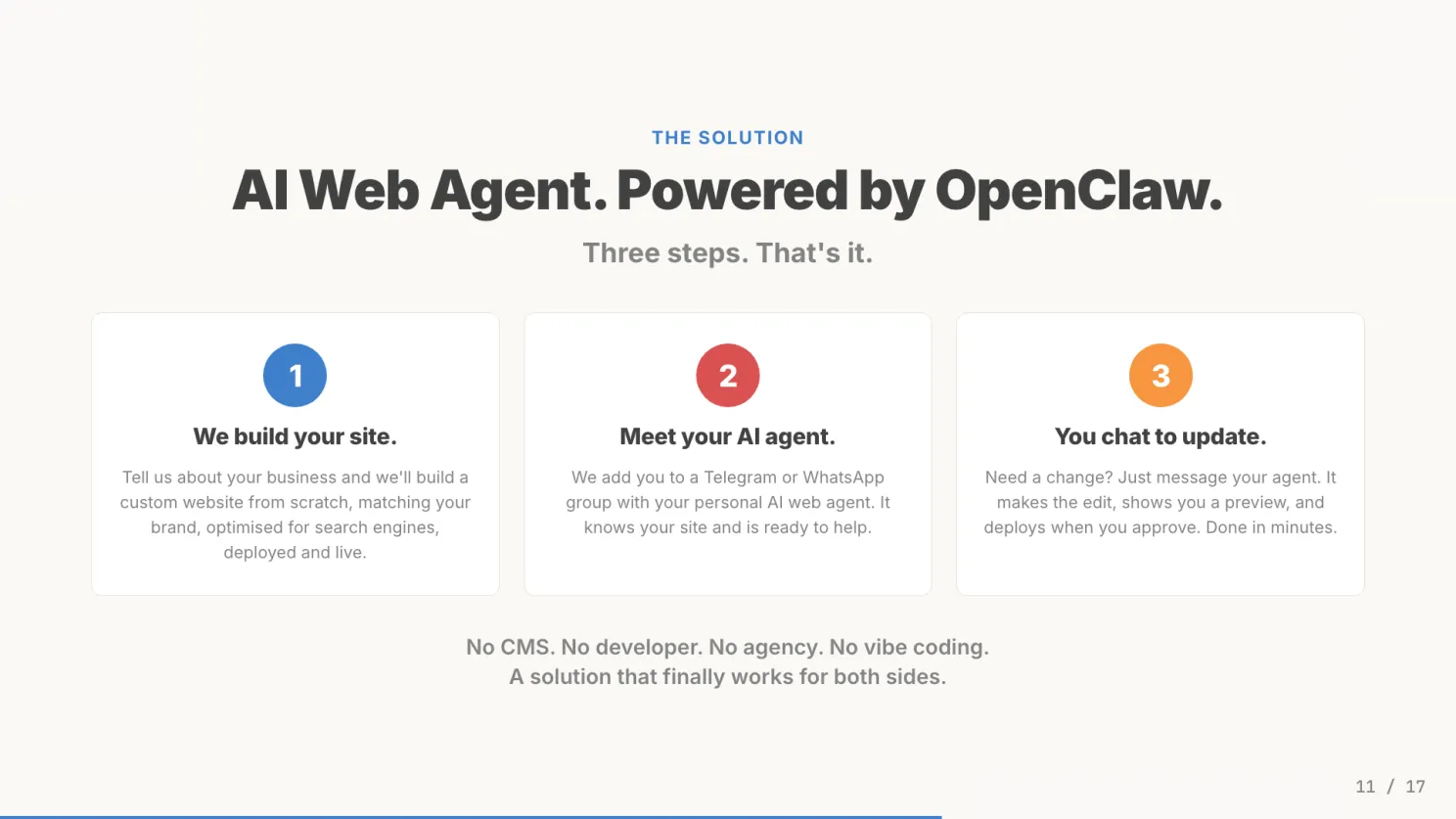
AI Web Agent. Powered by OpenClaw.
Three steps. That is all it takes to set up.
Step one. The pros build your site. You tell them about your business, they build a custom website from scratch, matching your brand, optimised for search engines, deployed and live. This is the part the pros just got ten times better at.
Step two. Meet your AI agent. You get added to a Telegram or WhatsApp group with your personal AI web agent. It knows your site. It is ready to help.
Step three. You chat to update. Need a change? Just message your agent. It makes the edit, shows you a preview, and deploys when you approve. Done in minutes.
No CMS. No developer. No agency. No vibe coding. A solution that finally works for both sides.
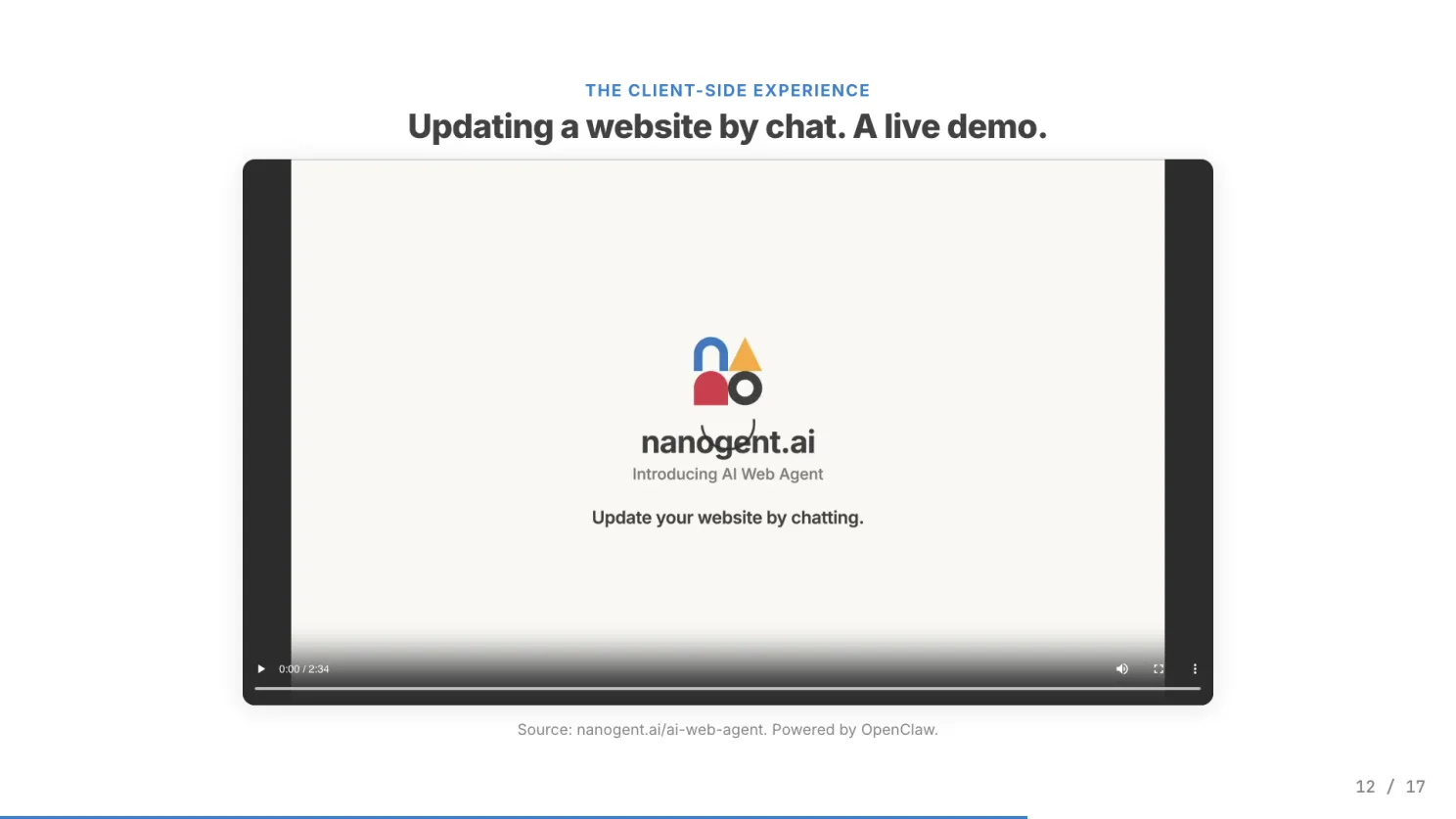
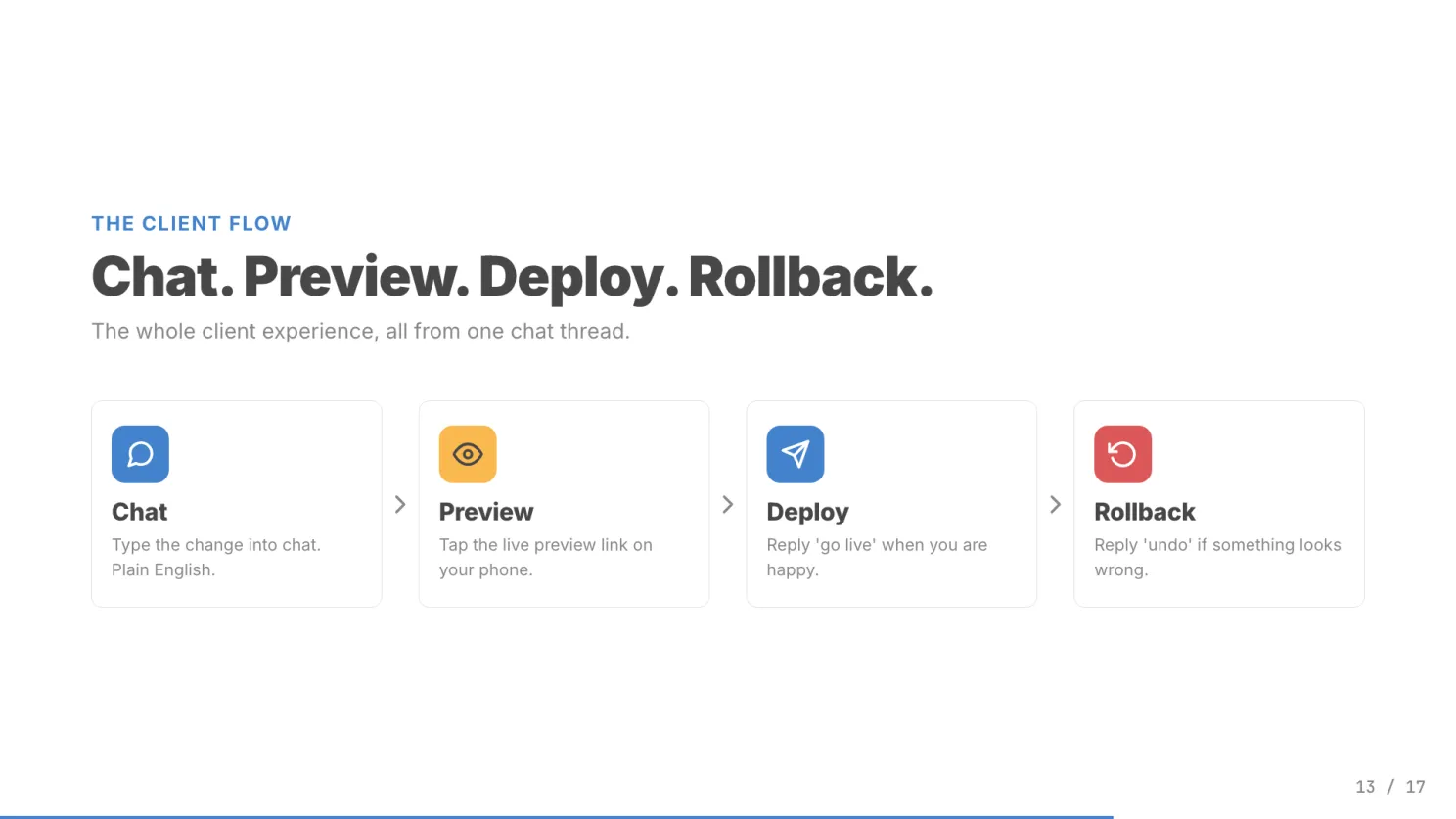
Chat. Preview. Deploy. Rollback. The whole client experience, from one chat.
What does this look like from the client’s side? Four steps. One chat thread.
Chat. You type the change into chat. Plain English. No admin panel, no forms, no login.
Preview. The agent does the work, sends you a live preview link. You tap it on your phone and see exactly what your customers will see.
Deploy. If you are happy, reply “go live”. Published in under a minute.
Rollback. If something looks wrong after the fact, reply “undo”. Gone. Every previous version is one message away.
You can see this in action at nanogent.ai/ai-web-agent.
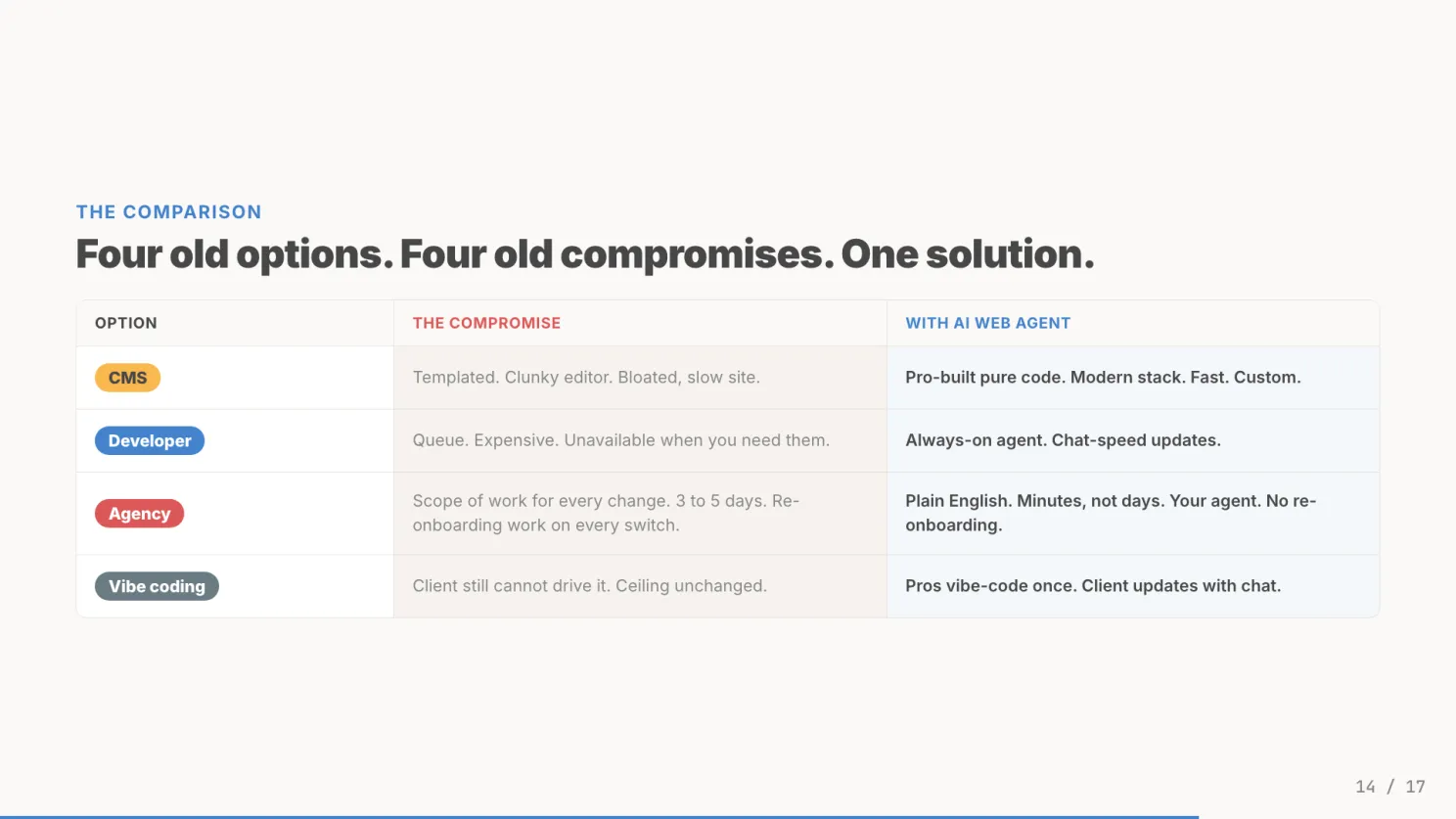
Four old options. Four old compromises. One solution.
Let me close with a side-by-side.
CMS. The compromise was templated design, a clunky editor, a bloated slow site. With AI Web Agent, the site is pro-built in pure code. Modern stack. Fast. Custom. No standard templating.
Developer. The compromise was the queue, the cost, and them being unavailable exactly when you needed them. With AI Web Agent, you have an always-on agent. Chat-speed updates, any hour.
Agency. The compromise was a scope of work for every tiny change, three to five days of turnaround, and re-onboarding work every time you switched agencies. With AI Web Agent, you type in plain English. Live in minutes. Your agent is yours from day one. No re-onboarding.
Vibe coding. The promised fourth option. The compromise was that you still need to learn vibe coding. You still need to master the craft. The ceiling of a great website had not moved. With AI Web Agent, the pros vibe-code once, and the client updates with chat.
Four options. Four compromises. One solution.
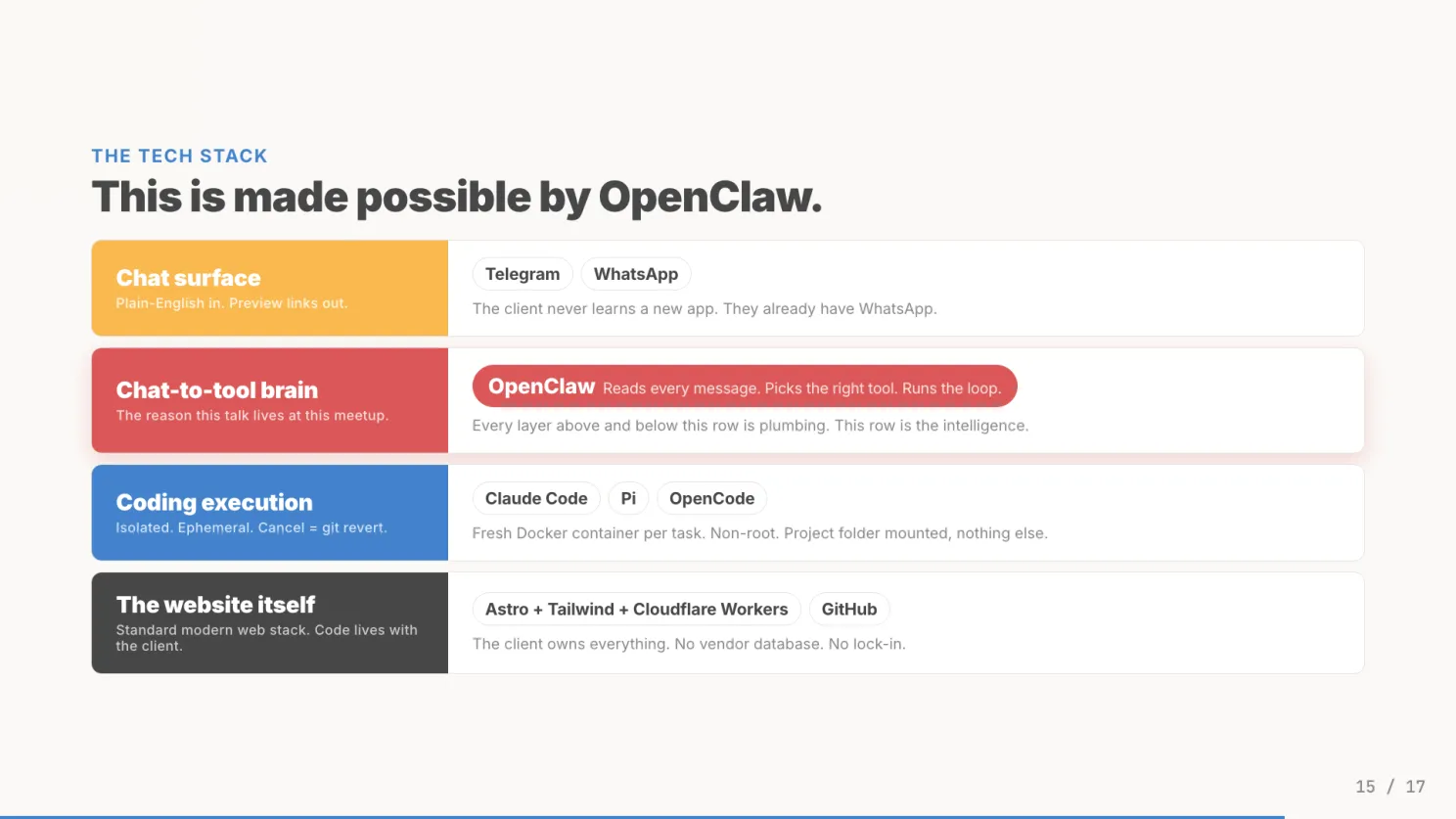
This is made possible by OpenClaw
Four layers, from client-facing chat down to the deployed site.
Chat surface. Telegram and WhatsApp. Your familiar chat UI. No new CMS training. No business account, no API fee, you just scan a QR code once from your phone.
The brain. This is OpenClaw. This is the reason we are at this meetup. OpenClaw reads every message in registered chat groups, decides which ones are directed at the agent, picks the right tool, and runs the tool-use loop. Coding agent is just one of the tools.
Coding execution. The chat agent does not edit files itself. It hands the task off to Claude Code, Pi, or OpenCode. Each runs in a fresh Docker container. Project folder mounted, nothing else. Non-root.
The website itself. Can be coded in any modern stack, and deploy to any cloud providers. In the demo, we use Astro, Tailwind, Cloudflare Workers. The code is version-controlled as a GitHub repo.
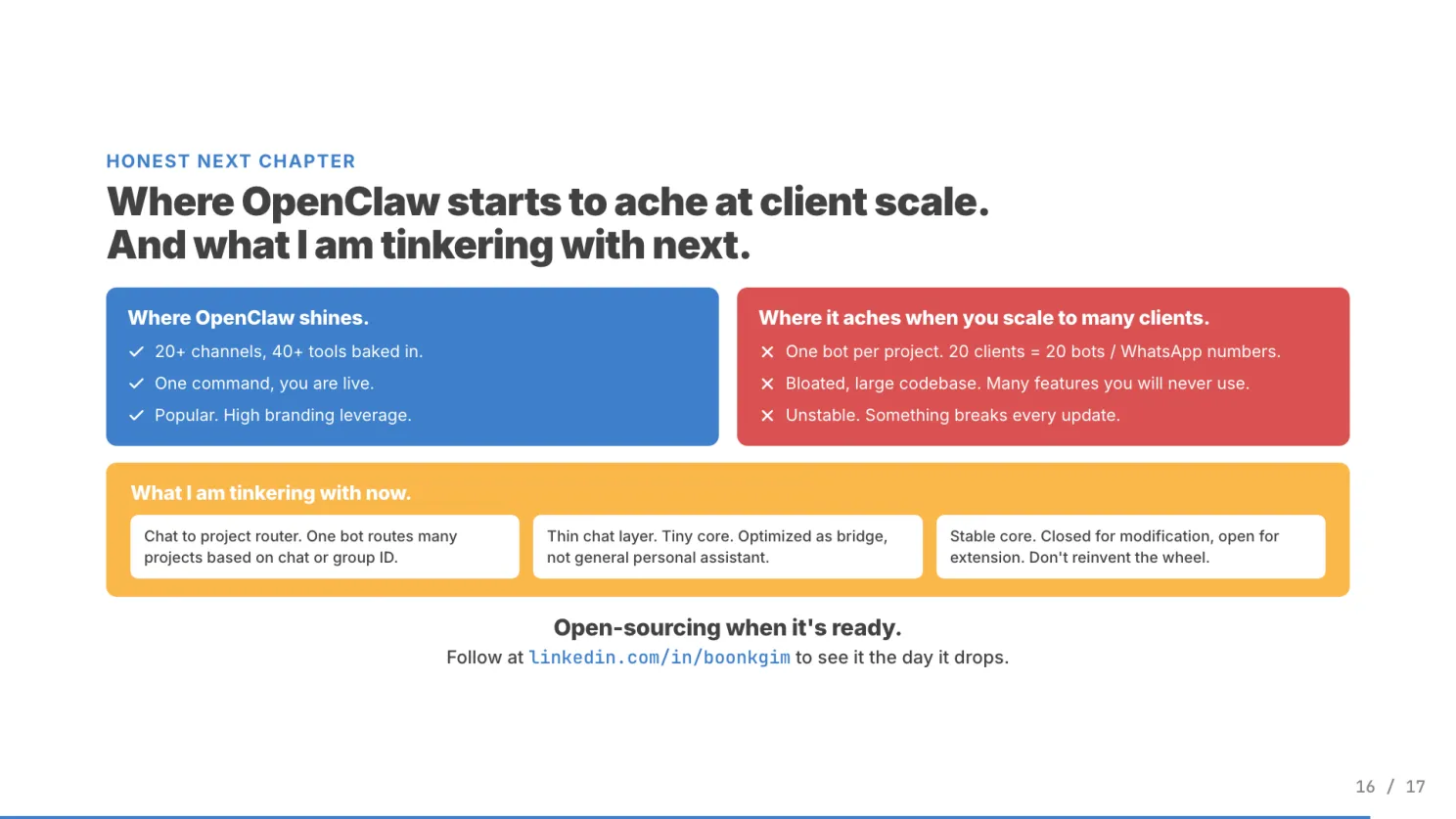
Where OpenClaw starts to ache at client scale. And what I am tinkering with next.
Before I close, one honest moment.
When I only have a few projects and bots, OpenClaw is perfect. Twenty-plus channels and forty-plus tools baked in. One command, I am live. And OpenClaw is popular in the market, so anything built on top of it inherits that branding leverage.
When I have twenty clients, three things start to hurt. One, the architecture of OpenClaw needs one bot per project. Twenty clients means twenty bots or WhatsApp numbers. Two, OpenClaw comes with many features baked in. That means bloated, large codebase. Many features you will never use. Third, it is unstable. Something breaks every update.
So I have been tinkering with my own implementation. A chat-to-project multiplexer. One bot routes many projects based on chat group. Tiny core, thin chat layer, optimized as a bridge, not a general-purpose personal assistant. Stable core, open for extension with plugins, closed for modification. No reinventing the wheel of the coding harness.
I will open-source it soon. If this sounds useful, follow me on LinkedIn. Comment nanogent to get early access.
The CMS era is ending. What replaces it is still being written.
The 3-day headline wait is now a 3-minute WhatsApp message. That is the whole talk.
#CMS #WebDevelopment #AIAgents #OpenClaw #Vibe Coding #nanogent
Enjoyed this? Subscribe for more.
Practical insights on AI, growth, and independent learning. No spam.
More in AI Agents

OpenAI’s Windsurf deal is off — and Windsurf’s CEO is going to Google
Anyone feel like we should use AI to create a drama and publish it on Netflix?
How To Create Agent Skill To Write LinkedIn Posts That Sound Like You
Most people are surprised when I tell them I use AI to write all of my LinkedIn posts.
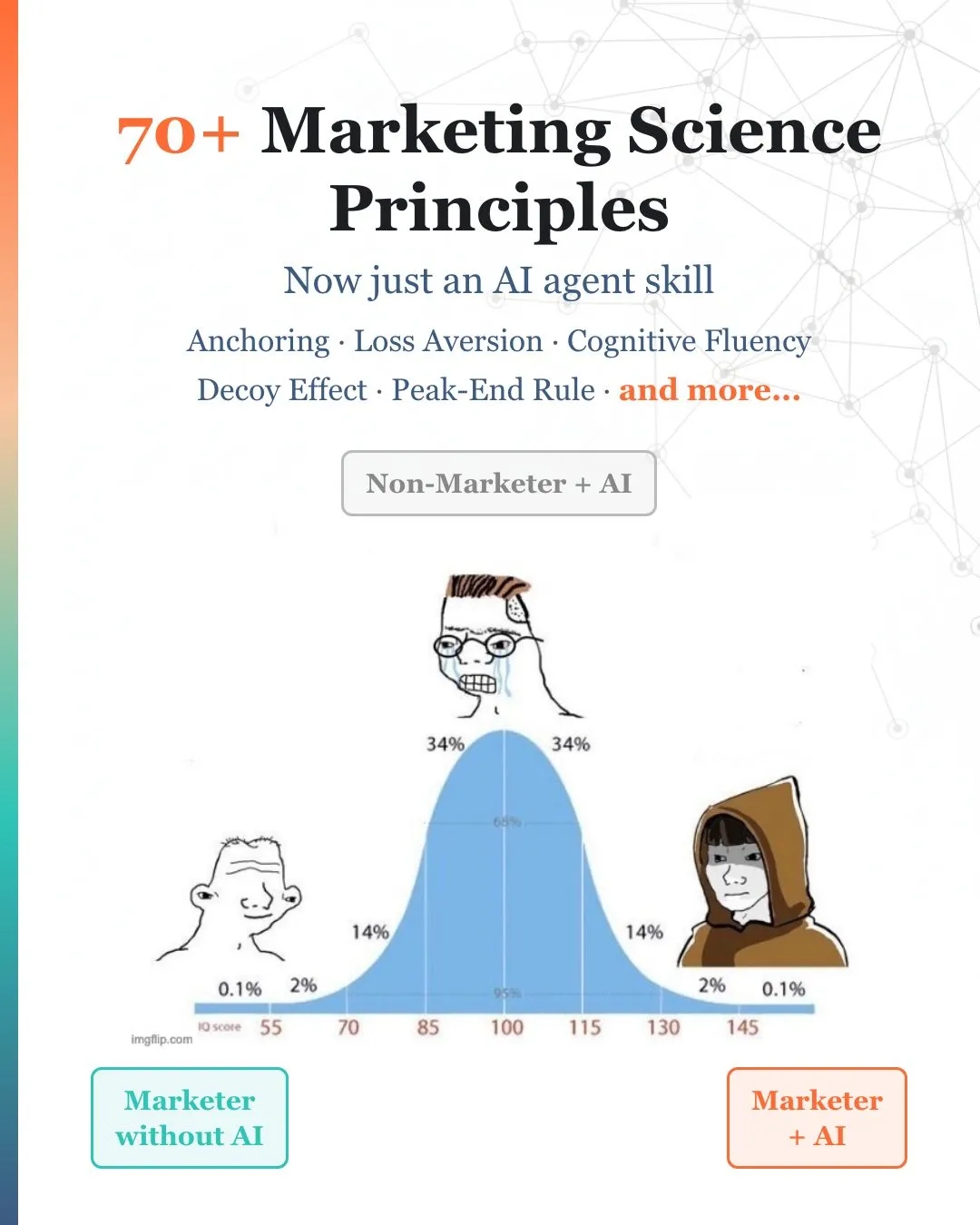
I spent years looking for one book that lists the exhaustive set of science concepts applied in...
AI agent + skill is commoditizing (or democratizing for a better word) knowledge at a faster pace than many realized.
"How do I know if an AI agent skill is safe or malicious?"
I have been hearing this question very often recently. So I thought why not write about it.
Why you should get AI to replace you
The CEO knows this is the main friction to AI adoption in his company. The sharing addresses this question. This article is the written version of that shari...
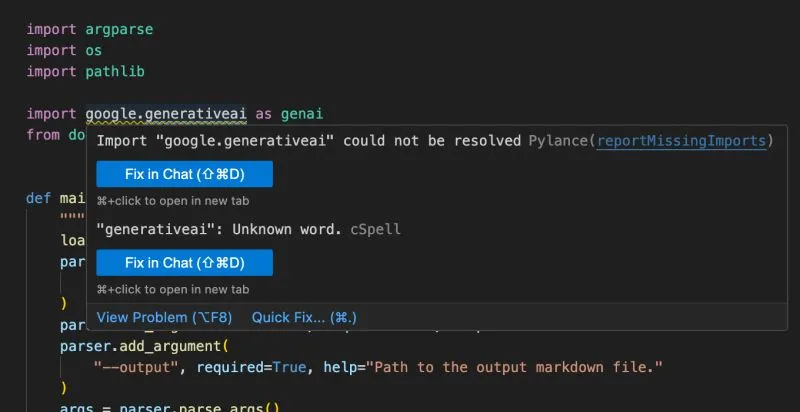
Gemini CLI stubbornly insisted its code was right and even did a Google search to prove it with an outdated article.
I was speechless. 😂
OpenAI’s Windsurf deal is off — and Windsurf’s CEO is going to Google
Anyone feel like we should use AI to create a drama and publish it on Netflix?
"How do I know if an AI agent skill is safe or malicious?"
I have been hearing this question very often recently. So I thought why not write about it.
Why you should get AI to replace you
The CEO knows this is the main friction to AI adoption in his company. The sharing addresses this question. This article is the written version of that shari...
How To Create Agent Skill To Write LinkedIn Posts That Sound Like You
Most people are surprised when I tell them I use AI to write all of my LinkedIn posts.
I spent years looking for one book that lists the exhaustive set of science concepts applied in...
AI agent + skill is commoditizing (or democratizing for a better word) knowledge at a faster pace than many realized.
Gemini CLI stubbornly insisted its code was right and even did a Google search to prove it with an outdated article.
I was speechless. 😂