We were promised autonomous AI agents. But got Workflow Automation 2.0 instead.
2025: The Year of AI Agents 😄
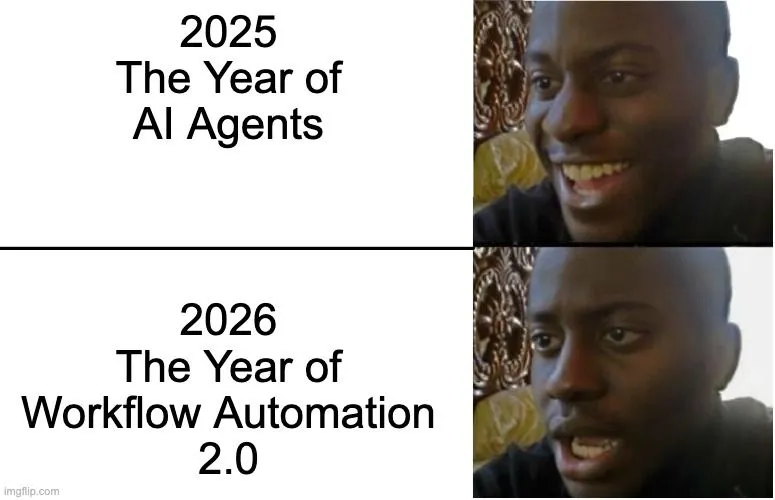
2025: The Year of AI Agents 😄 2026: The Year of Workflow Automation 2.0 😐
In early 2025, I was buzzing with excitement.
I built workflows in n8n that could do prospect research and send personalized emails as if they were from me. I saw the possibility of automating entire knowledge jobs with AI agents.
“2025 is the year of AI agents”, I believed it. With a 200k to 1m token context window, models can process 500+ to 2500+ pages of text. More than enough to give them any complex instruction to follow.
Fast forward to 2026. After using Claude Code with Opus 4.5 (one of the best models available) heavily for a few months, I’ve since lowered my expectations.
At 80k token context, we got poor instruction-following, hallucinations, Claude Code telling me a task is completed when it clearly isn’t.
Here’s what I’ve learned:
What DOESN’T work: Giving AI a detailed plan and a long-running task, then expecting it to finish reliably.
What ACTUALLY works:
- Break tasks into VERY SMALL sub-tasks
- Create specialized skills for how to DO each task
- Create specialized skills for how to REVIEW each task
- Create master skills with a step-by-step workflow that spawn agents to repeat do + review cycles
Each skill? Best kept within 40k tokens.
That doesn’t sound like autonomous AI agents as promised. It increasingly feels like I’m doing workflow automation 2.0.
So what’s the difference?
Workflow Automation 1.0: → Steps drawn as flowcharts → Code written to process data at each node → Structured input required → Deterministic output guaranteed
Workflow Automation 2.0: → Steps written in natural language, as skills → Data processing described in natural language, as skills → Input can be less structured → Output is non-deterministic
We’re trading determinism and accuracy for robustness and flexibility.
That’s the real state of AI right now.
Don’t get me wrong. Workflow Automation 2.0 is still very useful. It’s just that it is a far cry from “intelligence” as claimed.
I think we’ve hit the ceiling of what LLMs can do.
I am looking forward to the next release of frontier models to prove me wrong.
What do you think? Are we in the age of AI agents, or just workflow automation 2.0?
Enjoyed this? Subscribe for more.
Practical insights on AI, growth, and independent learning. No spam.
More in AI Agents
Will AI replace marketing agencies (or any professional services)?
This is one of the most common questions being asked since the rise of AI agents.
Claude Code vs Codex vs Gemini CLI vs Qwen: My Results
The winner is still Claude Code...
"My Claude Code performance has tanked and I'm not sure why"
This is one of the most common posts in Reddit's Claude Code community.
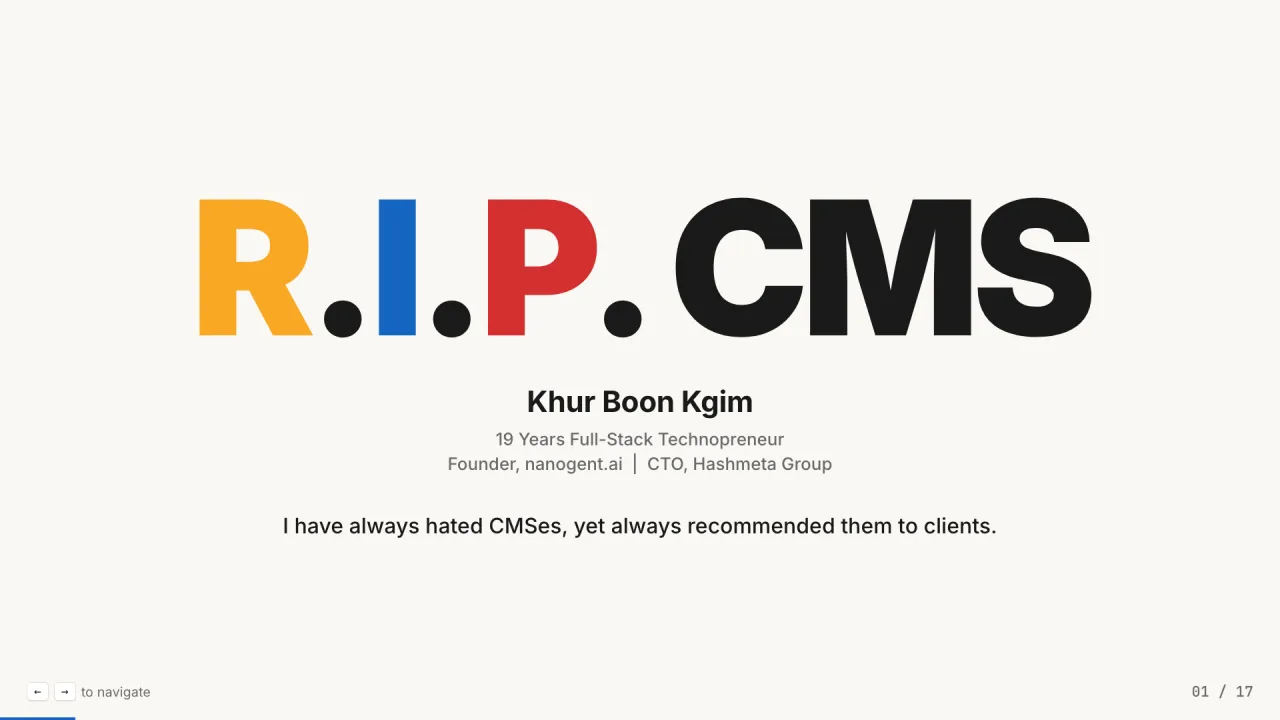
R.I.P. CMS. How AI agents like OpenClaw could replace CMS.
Thanks to Claw Singapore and Lionel Sim for the invitation. Great to be on stage with 💎 Amanda Lau Shernin, Namira Noviar, Finnley Hui Yu, Lee, Alan Yuen, M...
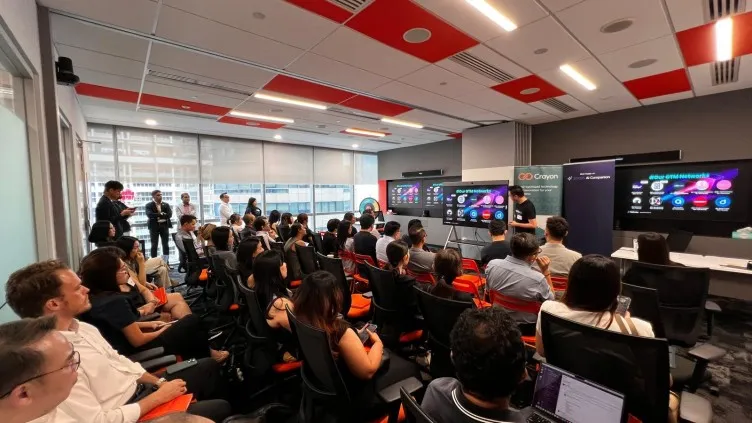
Future-Proofing Your Digital Marketing in The Age of AI
I thought, why not turn my presentation into a LinkedIn article? Rather than let the ideas stay in the slides, I wanted to share them here so more people can...
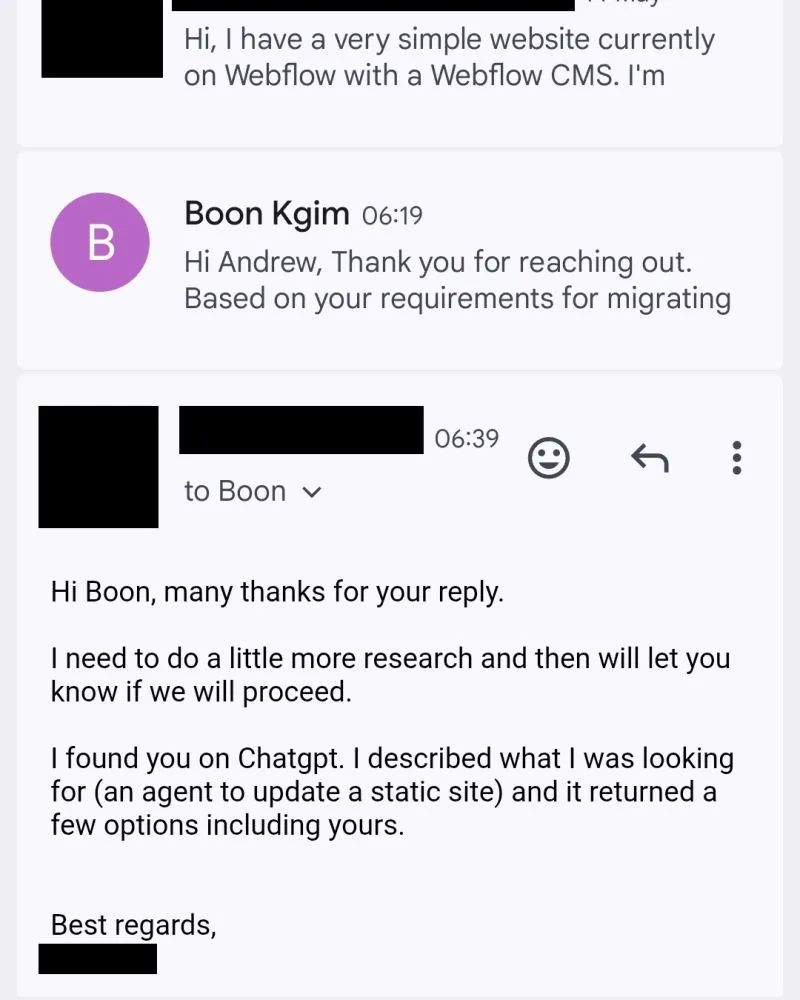
80% of GEO is still SEO.
This is what I always tell people. And the screenshot is the proof.
Will AI replace marketing agencies (or any professional services)?
This is one of the most common questions being asked since the rise of AI agents.
R.I.P. CMS. How AI agents like OpenClaw could replace CMS.
Thanks to Claw Singapore and Lionel Sim for the invitation. Great to be on stage with 💎 Amanda Lau Shernin, Namira Noviar, Finnley Hui Yu, Lee, Alan Yuen, M...
Future-Proofing Your Digital Marketing in The Age of AI
I thought, why not turn my presentation into a LinkedIn article? Rather than let the ideas stay in the slides, I wanted to share them here so more people can...
Claude Code vs Codex vs Gemini CLI vs Qwen: My Results
The winner is still Claude Code...
"My Claude Code performance has tanked and I'm not sure why"
This is one of the most common posts in Reddit's Claude Code community.
80% of GEO is still SEO.
This is what I always tell people. And the screenshot is the proof.