Why you should get AI to replace you
The CEO knows this is the main friction to AI adoption in his company. The sharing addresses this question. This article is the written version of that shari...
Last month, I was invited by a CEO of a company to share about AI with his employees. The CEO wanted the company to go all in on AI. As in any company adopting AI, there is a quiet question sitting in the room. The same question I think is sitting in most working professionals right now. “If we adopt AI, will I still have a job?”
The CEO knows this is the main friction to AI adoption in his company. The sharing addresses this question. This article is the written version of that sharing.
It is an adaptation of my other sharing on “AI is an amplifier, not an equalizer”. About half of what follows is adapted from that earlier article, which I wrote for a different audience, 340 faculty members and undergraduate students in Indonesia. The diagnosis of how AI is changing the knowledge economy is the same for both groups. What I had to change is everything that comes after the diagnosis. Fresh graduates have no career to protect. Working professionals do. So the question of what to do about it lands very differently.
Read the earlier article: AI is an amplifier, not an equalizer
If you have read the earlier article, skip straight to Part 3. That is where the new material starts. If not, read the whole thing.
Quick background, in case we have not met. I have been building businesses for 19 years. Failed one, sold one, and I am building several right now. I was an AI researcher at NTU Singapore, spent a year and a half at Deloitte advising Fortune 500s, and today I run AI agents for real business workflows daily at nanogent.ai. What I am about to share comes from doing this, not from reading about it.
If there is only one piece of advice you take away from this article, it is this:
Do your best to get AI to replace you, so you can land on a position where AI cannot replace you. That is where your value as a human is.
I will explain why I think this is the only honest way to address the quiet worry many of us have about being replaced. Then I will show you what it looks like in my own work.
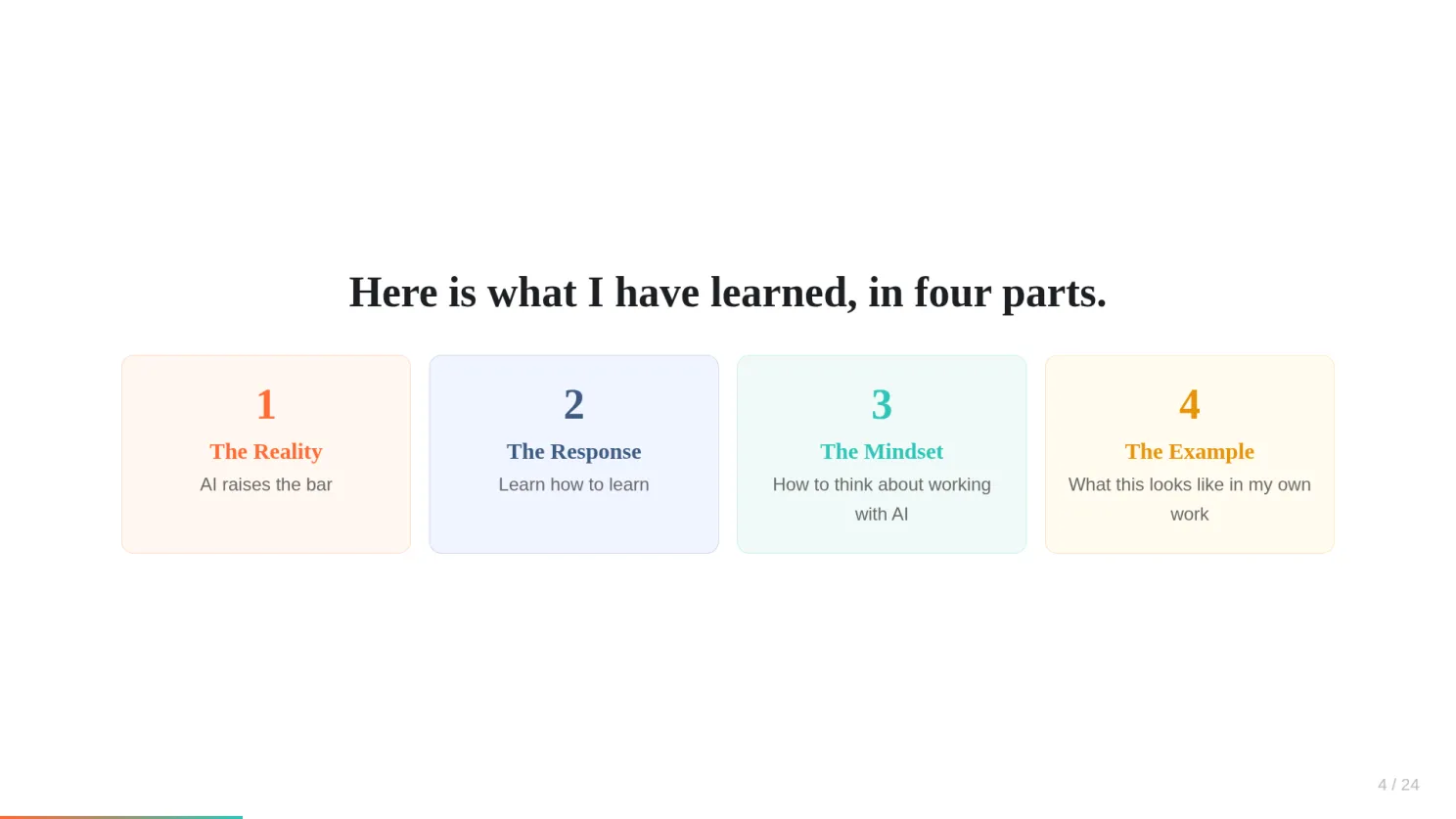
Let me break it into four parts. The reality. The response. The mindset. And the example.
Part 1: AI Raises the Bar
(If you have read the earlier article on this topic, skip to Part 3.)
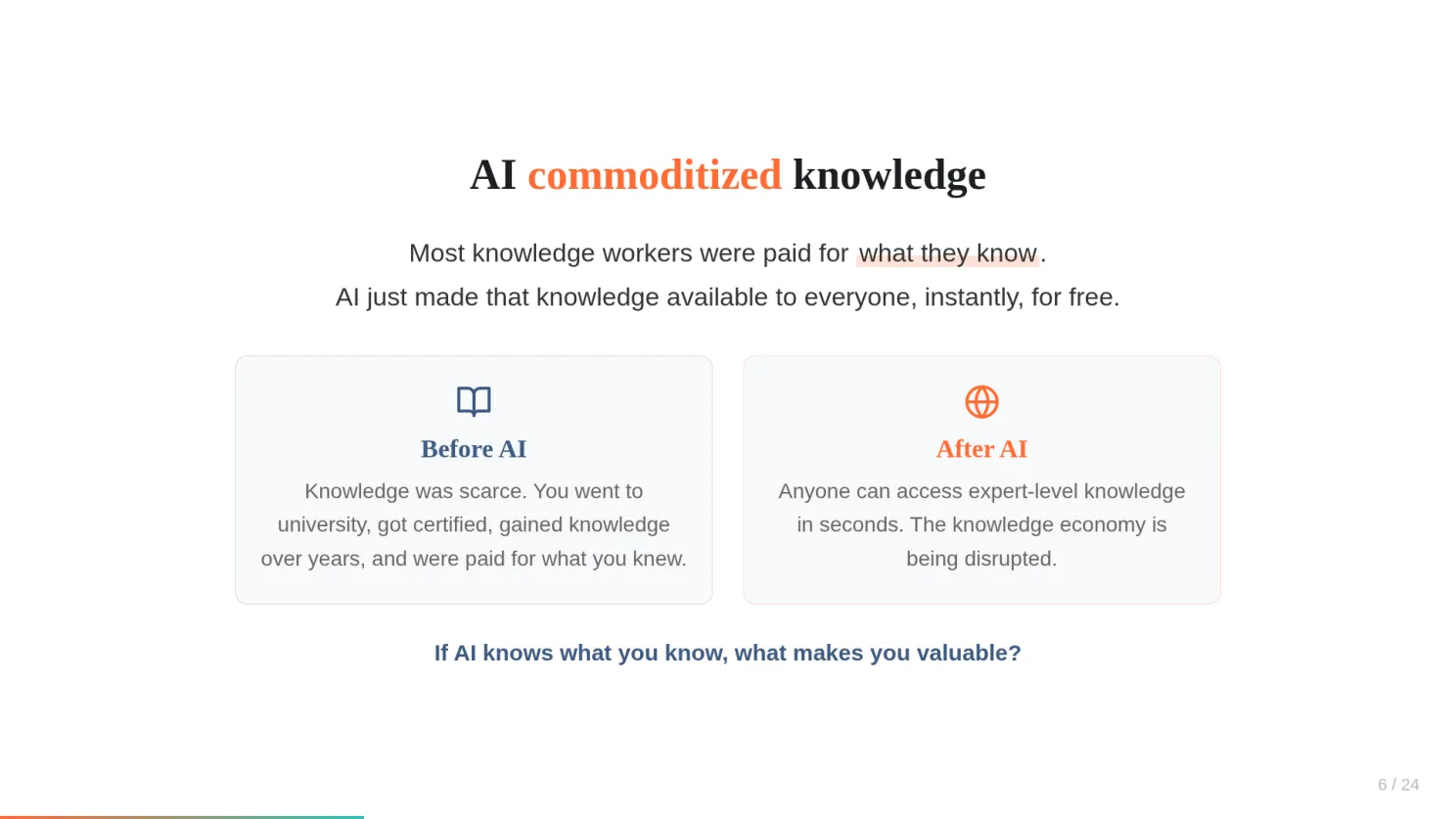
For decades, most knowledge workers were paid for what they know. You went to university, got a degree, gained knowledge, and companies paid you for it. That was the deal.
AI just broke that deal.
Before AI, knowledge was scarce. If you wanted legal advice, you paid a lawyer. If you wanted a marketing strategy, you hired a consultant. If you wanted code written, you hired a developer. The knowledge was locked in people’s heads, and that is what made them valuable.
After AI, anyone can access expert-level knowledge in seconds. For almost free.
So here is the uncomfortable question: if AI knows what you know, what makes you valuable?
The answer is not more knowledge. It is something else.
AI produces average output by design
Most people do not understand how AI actually works.
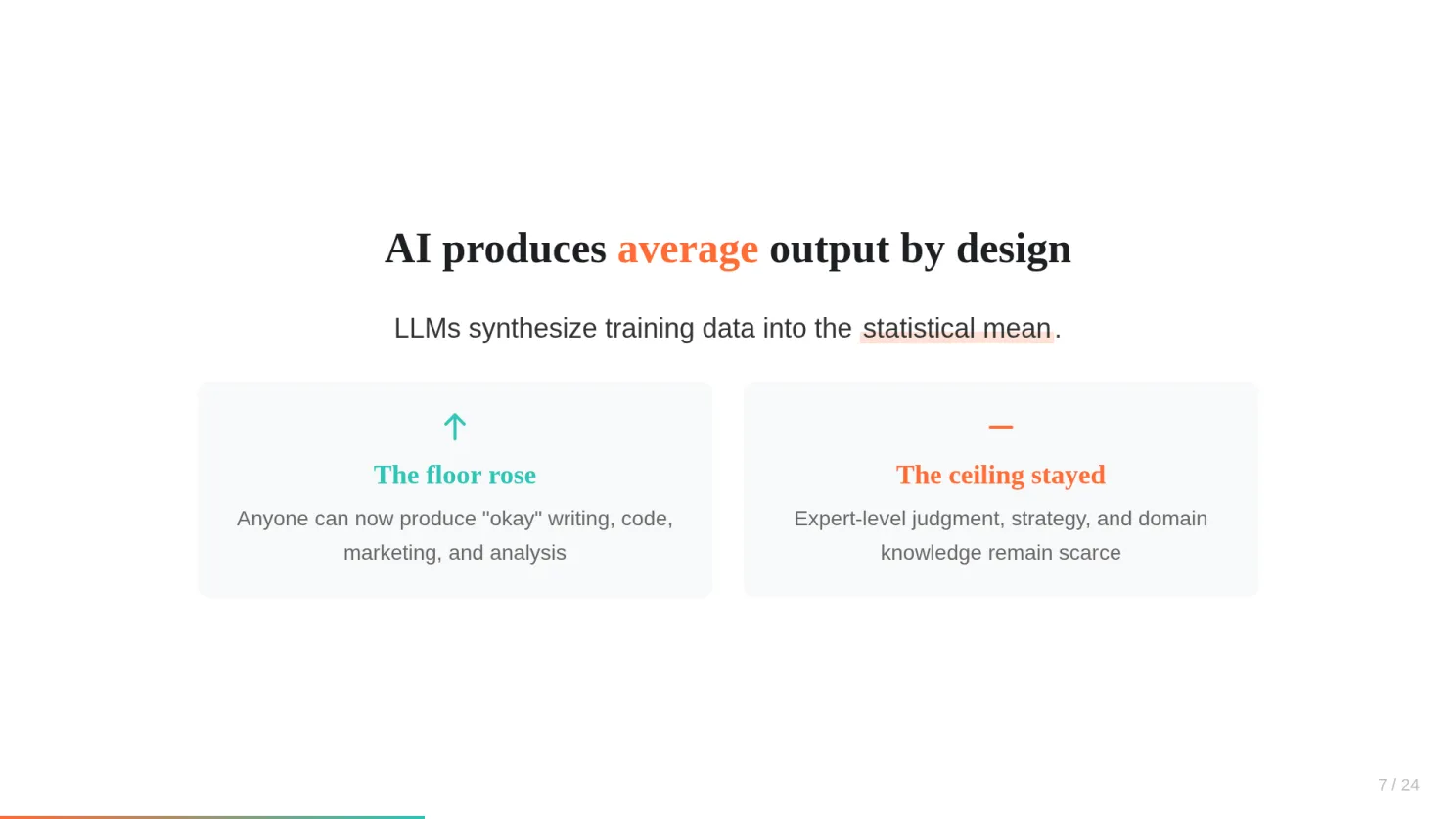
Large language models, ChatGPT, Claude, Gemini, produce output by synthesizing their training data into the statistical mean. In simple terms: AI gives you the average of everything it has seen.
This means two things.
The floor has risen. Anyone with a free ChatGPT account can now produce okay work. Okay writing. Okay code. Okay marketing plans. Five years ago, you needed training and experience to produce this level of output. Now you need a laptop and an internet connection.
But the ceiling has not moved. Expert-level judgment, deep domain knowledge, strategic thinking, these are still scarce. AI cannot produce them because AI does not have experience, context, or stakes in the outcome. Arguably, the ceiling will rise as well with Expert + AI.
Same AI. Different result.
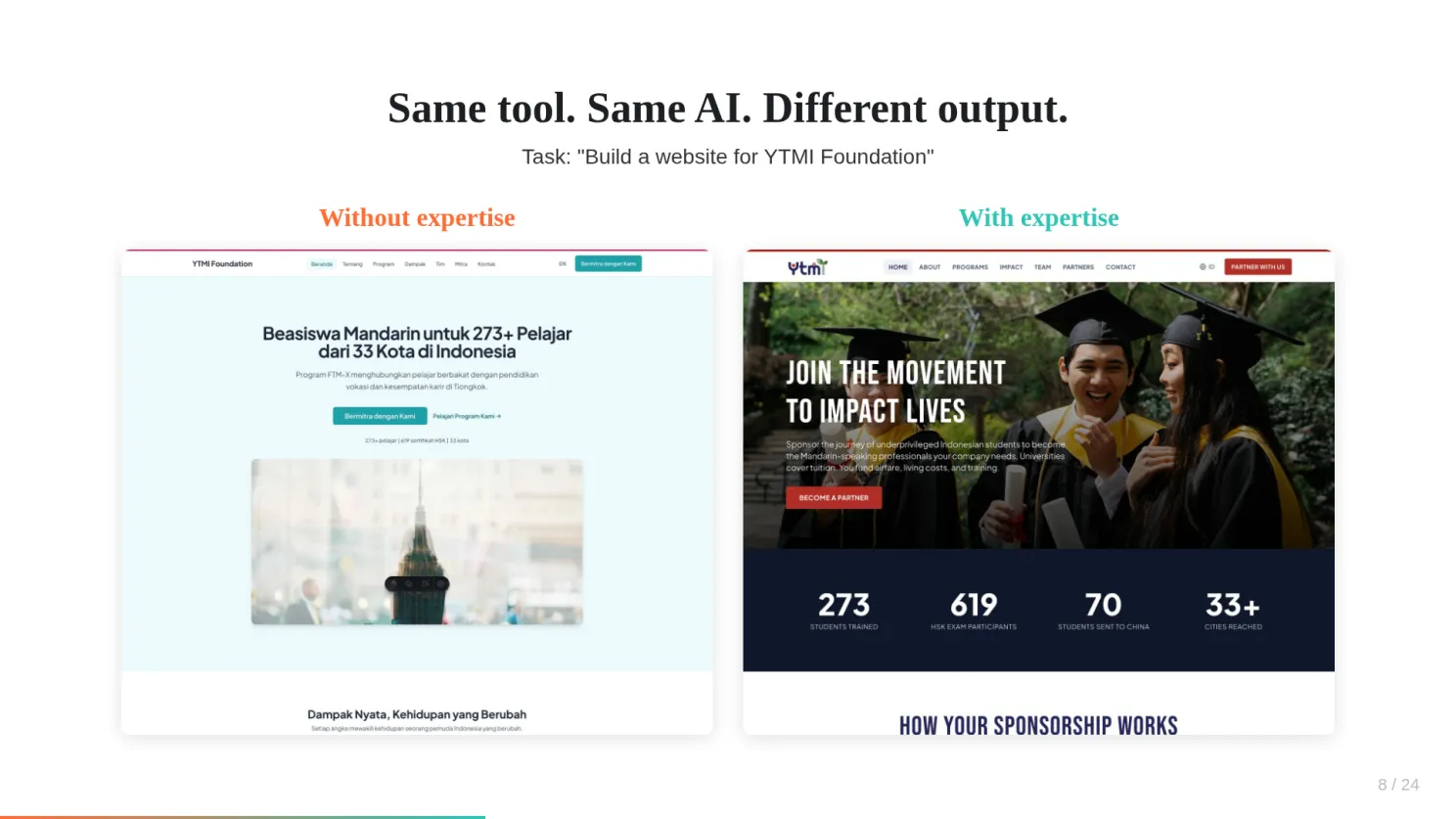
Let me show you what this looks like in practice. Take two people. Give them the same tool. The same AI. The same task: build a website for a non-profit foundation.
On the left, someone without expertise. The AI helps them build something that looks like a template. Functional, but no strategy. No clear value proposition. No understanding of what makes a visitor convert.
On the right, someone who understands branding, messaging, and user experience. They guide the AI to create something with purpose. A strong hero section. Clear sponsorship model. Compelling social proof. A design that builds trust.
Same tool. Same AI. Completely different output.
The variable is not the technology. The variable is who is orchestrating the AI.
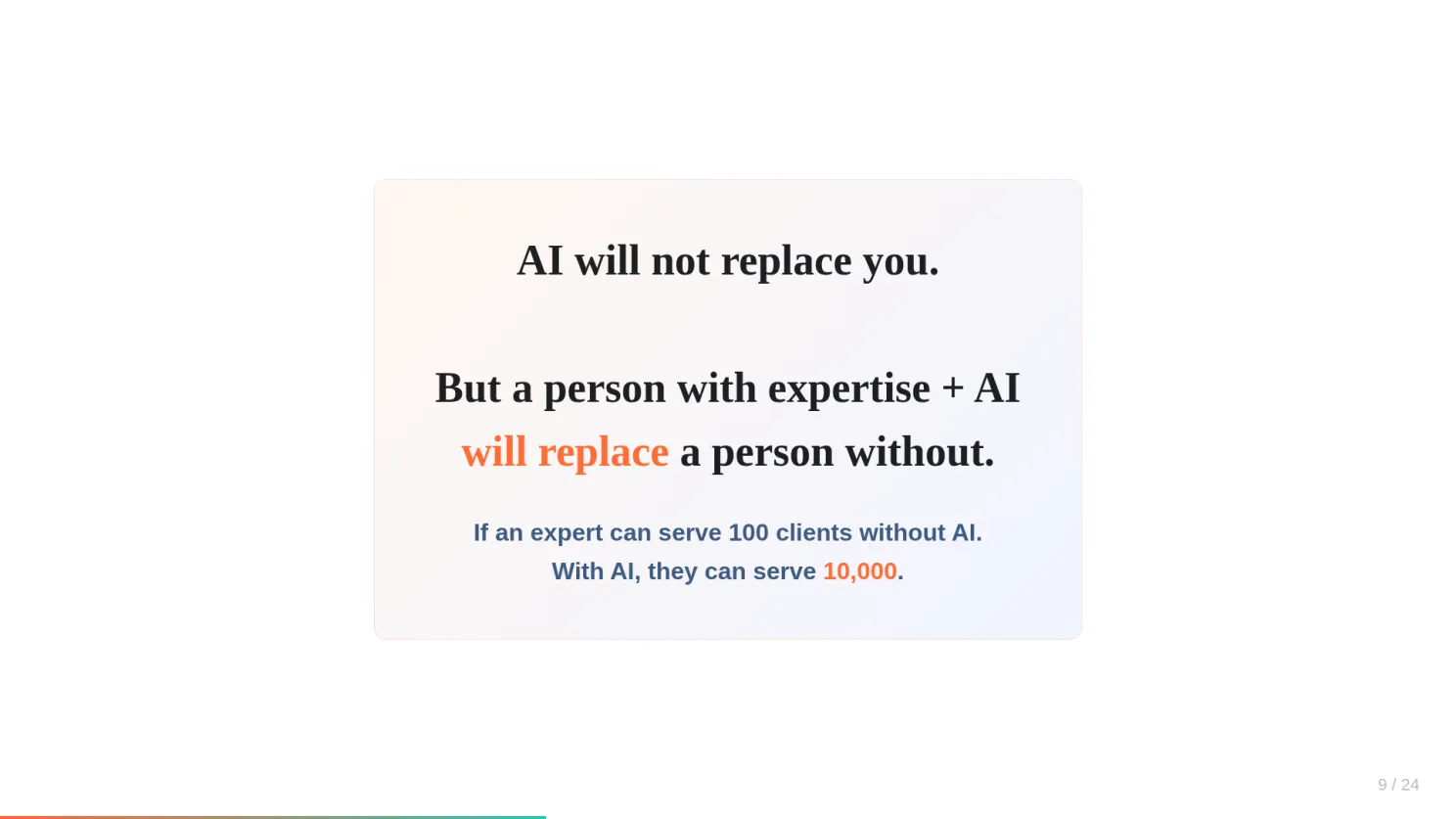
AI will not replace you. But a person with expertise plus AI will replace a person without expertise.
The bar for “average” just moved up. If an expert can serve 100 clients without AI, with AI, that same expert can serve 10,000. That is the multiplier effect, and it only works if you have the expertise to begin with.
Part 2: Learn How to Learn
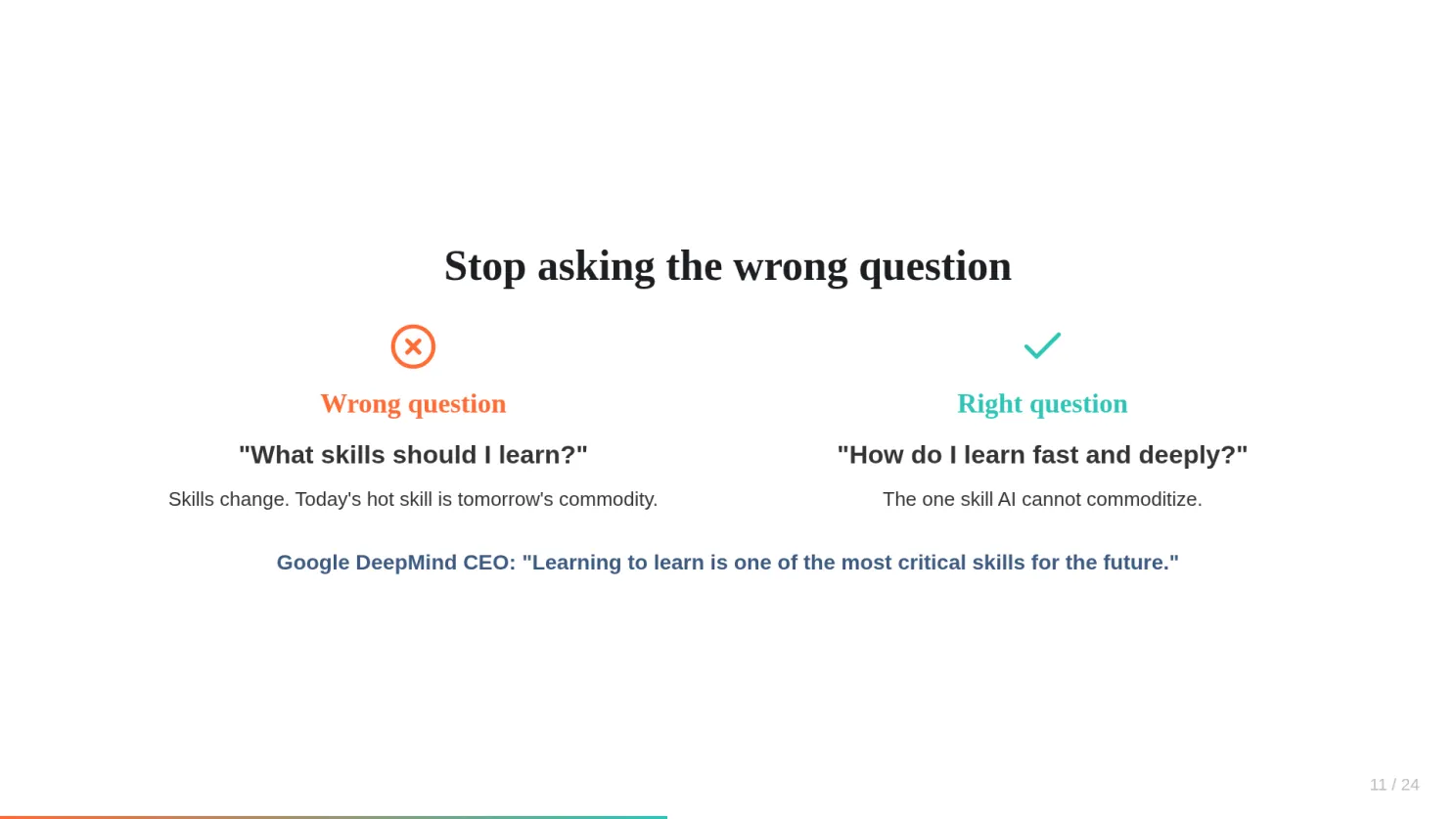
The first reaction many professionals have to all this is to ask: “Okay, so what new skill should I pick up? Should I learn AI? Should I learn ChatGPT? Should I learn to vibe code?”
I think this is the wrong question. Skills change. Five years ago, everyone said “learn to code.” Now people say AI will write the code for you. What happens to the person who only learned to code because someone told them to?
The right question is: how do I learn fast and deeply?
The CEO of Google DeepMind said it plainly. Learning to learn is one of the most critical skills for the future. This is not motivational fluff. This is the head of one of the most advanced AI labs in the world telling you that the skill that matters most is not what you learn, but how fast you can learn.
And here is the good news. AI is the best learning partner ever built, if you use it right.
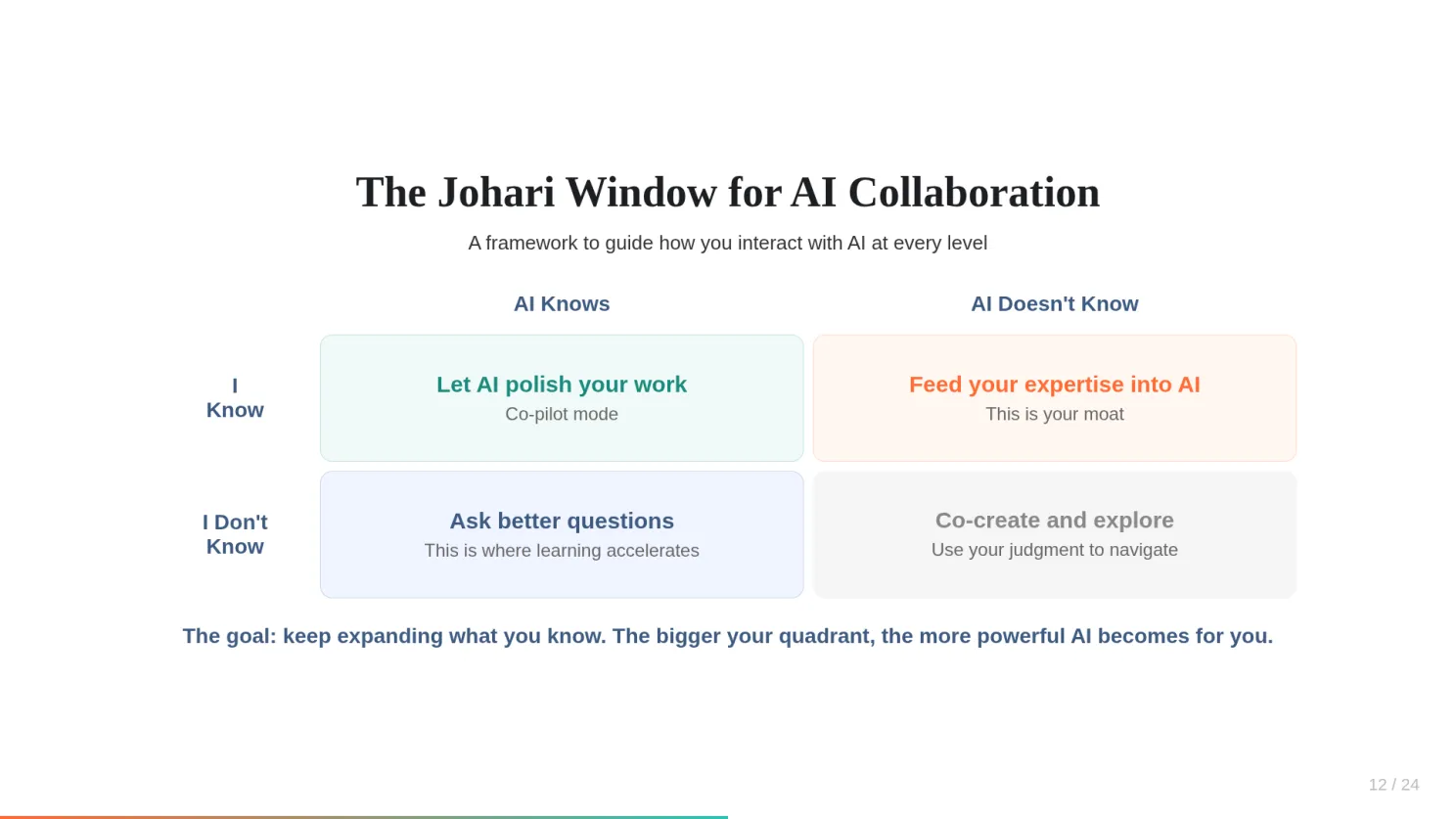
The Johari Window for AI
This is a framework I learned from a talk at Google, adapted from psychology and applied to how you collaborate with AI. Think of it as a 2x2 grid.
You know it, AI knows it. This is co-pilot mode. Let AI polish your work and speed up your execution. You focus on strategy while AI handles the grunt work.
You do not know it, but AI knows it. This is where learning accelerates. Ask better questions. Use AI to explain concepts, create learning roadmaps, quiz you. This is your personal tutor, available 24/7, for free.
You know it, AI does not know it. This is your moat. Your personal experience, your market context, your knowledge of your industry, your customers, the way decisions actually get made inside your company. AI does not have any of this. When you feed your domain knowledge into AI, that is when AI becomes truly powerful.
Neither of you knows it. This is co-creation. Brainstorming. Exploration. Use AI to generate diverse ideas, then rely on your judgment to pick the right direction.
The long-term goal is to keep expanding what you know. The bigger your knowledge, the more powerful every AI tool becomes for you.
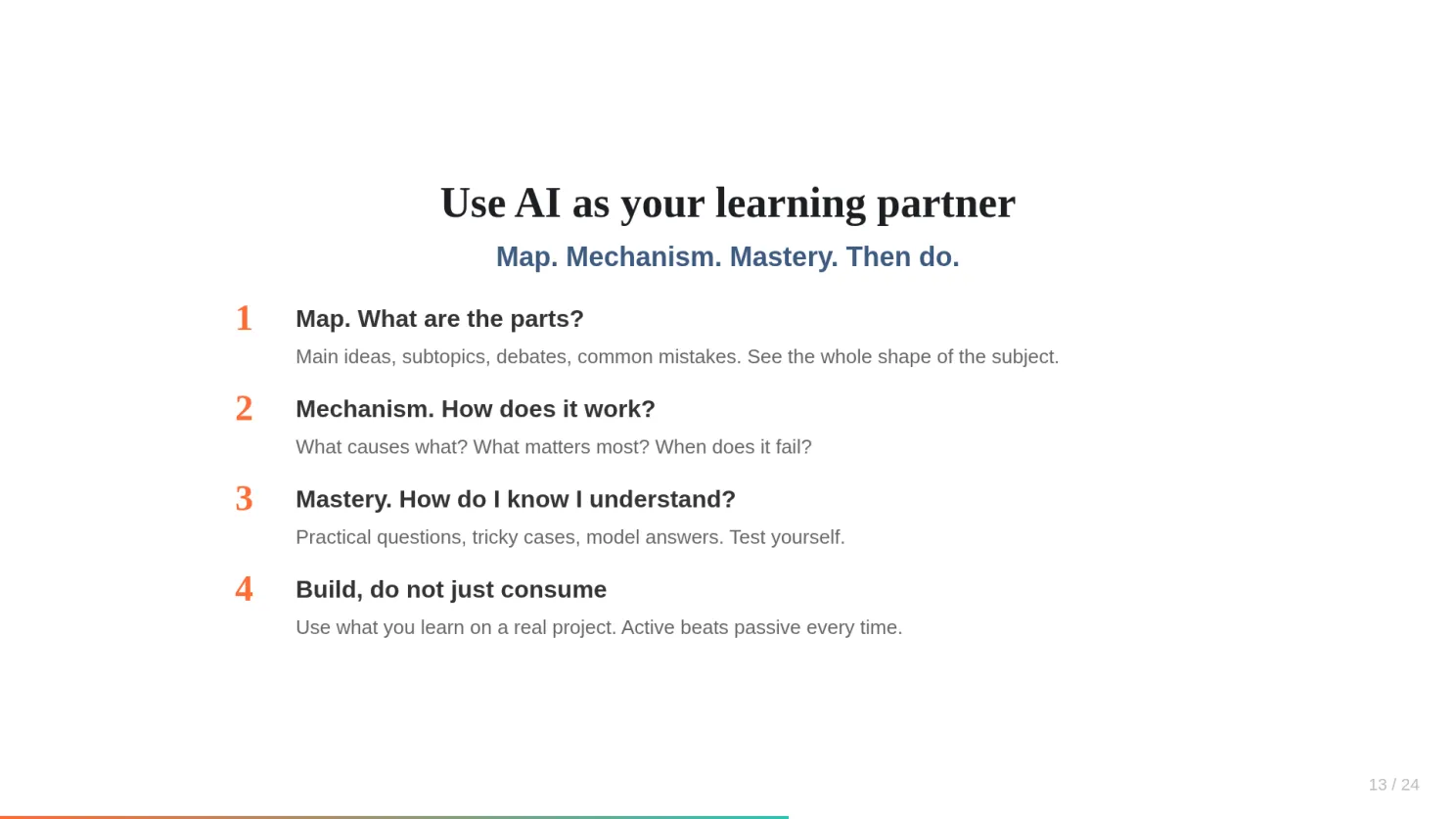
Use AI as your learning partner
Let me give you a technique you can try today.
When you want to learn something new with AI, do not just say “explain this to me.” That gives you a surface summary. Ask three better questions instead.
One. Map. What are the parts? Main ideas, subtopics, debates, common mistakes. This shows you the whole shape of the subject.
Two. Mechanism. How does it work? What causes what? What matters most? When does it fail? This is where real understanding begins.
Three. Mastery. How do I know I understand? Practical questions, tricky cases, model answers. This forces you past memorising words.
Honestly, this is something I am unable to simplify for anyone. But AI does it very well. Master these three questions and you become an expert in no time.
Four. Build, do not just consume. Take what AI gives you and use it on a real project. Active beats passive every time. Brain science backs this up.
Part 3: The Mindset
This is where the article diverges from the earlier one. Because the answer for someone with 15 years of experience is not the same as the answer for a fresh graduate.
The biggest difference I see between people who get value out of AI and people who do not is not the tool they use. It is how they think about it.
Three mental models change everything.
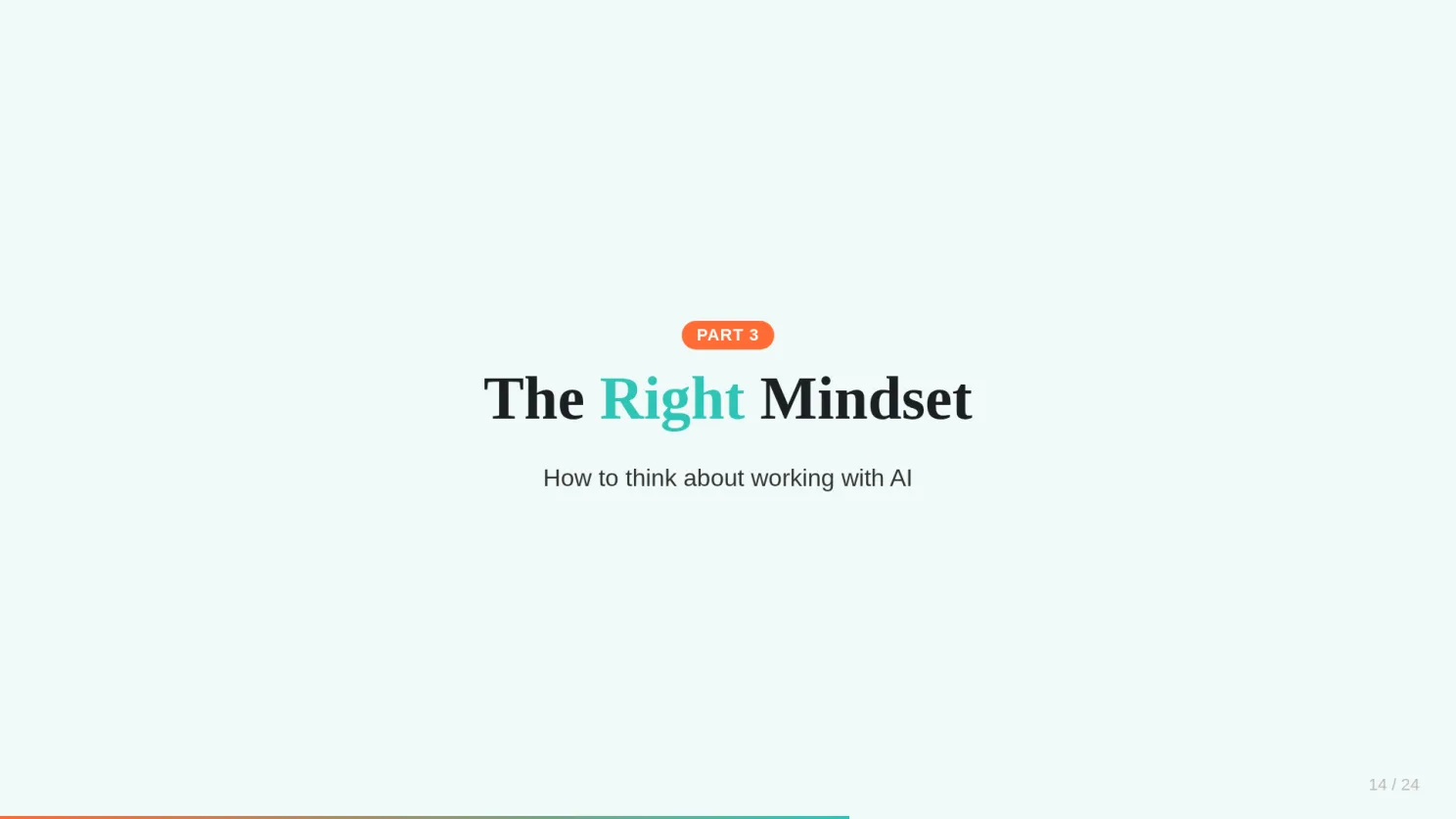
Mental Model 1: Try to get AI to replace you
This is my personal philosophy. This is how I have stayed ahead in a field that changes every three months.
I do my best to get AI to replace me, so I can land on a position where AI cannot replace me.
I know it sounds counterintuitive, especially if you are worried about being replaced. But hear me out.
Every time I find a task I do regularly, I try to get AI to do it. Write a first draft? AI can do that. Analyze data? AI can do that. Build a landing page? AI can do that. Schedule a meeting? AI can do that.
And every time AI takes over a task, I move up. I stop being the person who writes drafts and become the person who judges drafts. I stop being the person who writes code and become the person who architects systems. I stop being the person who answers customer questions and become the person who designs the playbook the AI uses to answer them.
That is the game. You push AI to replace your current work. Every time it succeeds, you level up to something it cannot do yet. Then you push again.
Here is the part I want you to sit with. If you do not try to get AI to replace you, you are not actually safer. You are just leaving someone else to discover the boundary on your behalf. And when they do, they will be the one with the upgraded role. You will be the one whose role turned out to be a list of tasks AI already automated.
The only honest way to find out what is uniquely yours is to keep pushing AI into your work and see where it falls short. That is the position you want to land on. That is where your value as a human is.
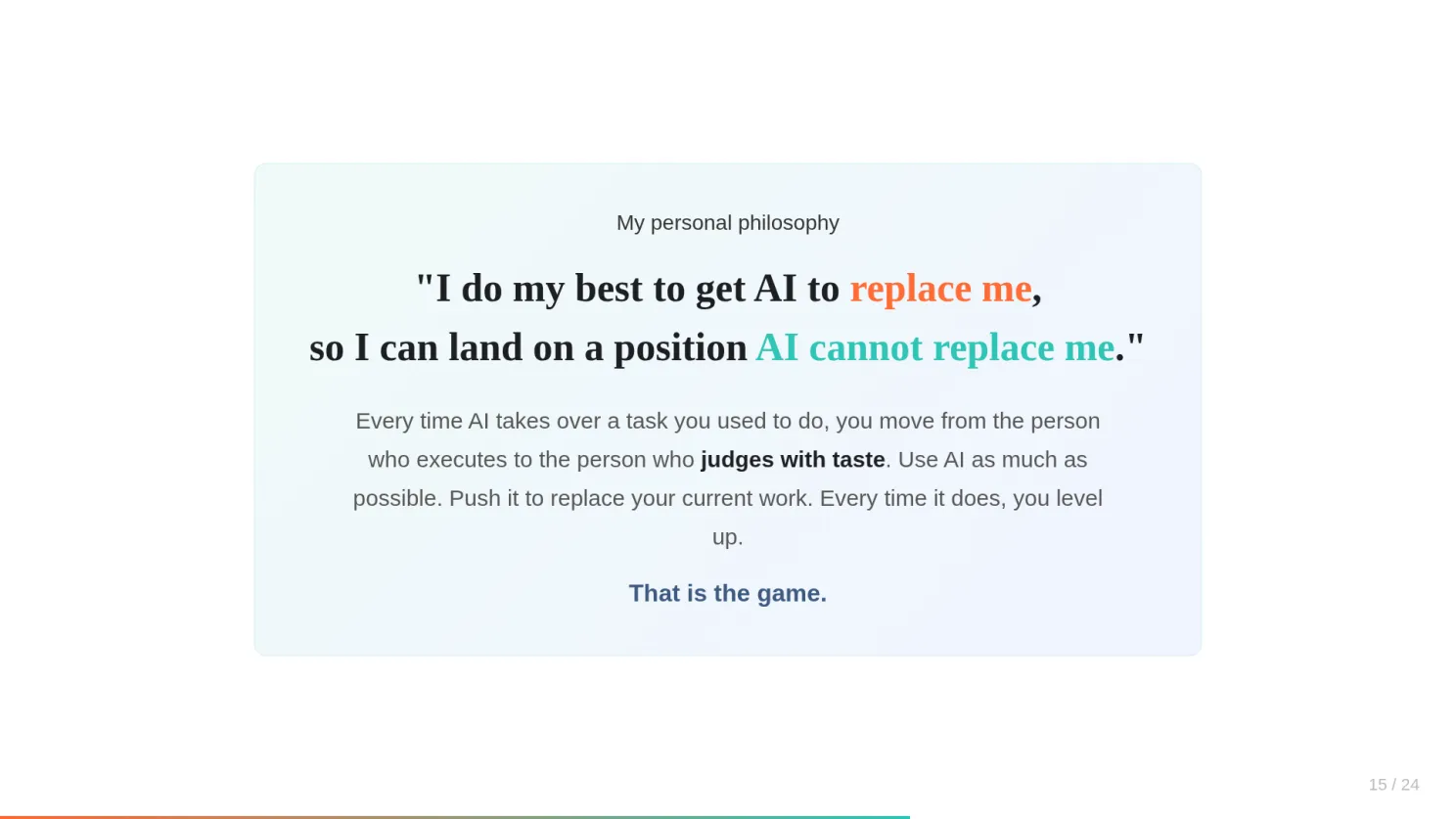
Mental Model 2: AI is an averaging machine. Orchestration shifts the curve.
To play that game well, you need to understand why AI feels mediocre the first time you try it.
An LLM is trained on output from everyone. Beginners, mid-level people, and experts. So out of the box, it gives you the average. Average writing. Average analysis. Average code.
Imagine a bell curve for output quality. The LLM is a wide curve sitting right in the middle. Beginners, mid-level workers, and experts are three narrower curves at different positions on the same axis. Same prompt, same task, you can get any of these. That is why the first time you use AI, the output often feels mediocre. You are sampling from the middle of a very wide curve.
This is also why many professionals try AI once, get a generic result, and quietly conclude that AI is overhyped. I did that for a long time too. I refused to let AI do marketing landing pages because the first few times I tried, the output sounded generic.
Here is the part most people miss. If you know how to orchestrate AI, you push the curve. You give it your best examples, your standards, your review checklist. You run it through a review loop. Each pass narrows the curve and shifts it toward great. Same model, same task, just a different way of working with it.
Average is the default. Orchestration is what shifts the curve toward great. And orchestration is the work only you can do, because it requires knowing what good looks like in your domain.
I have written about the specific patterns I use to push the curve in practice.
Read the related article: The Lessons I Learned Coding 10+ Apps with Claude Code. Transferrable to Non-Coding.
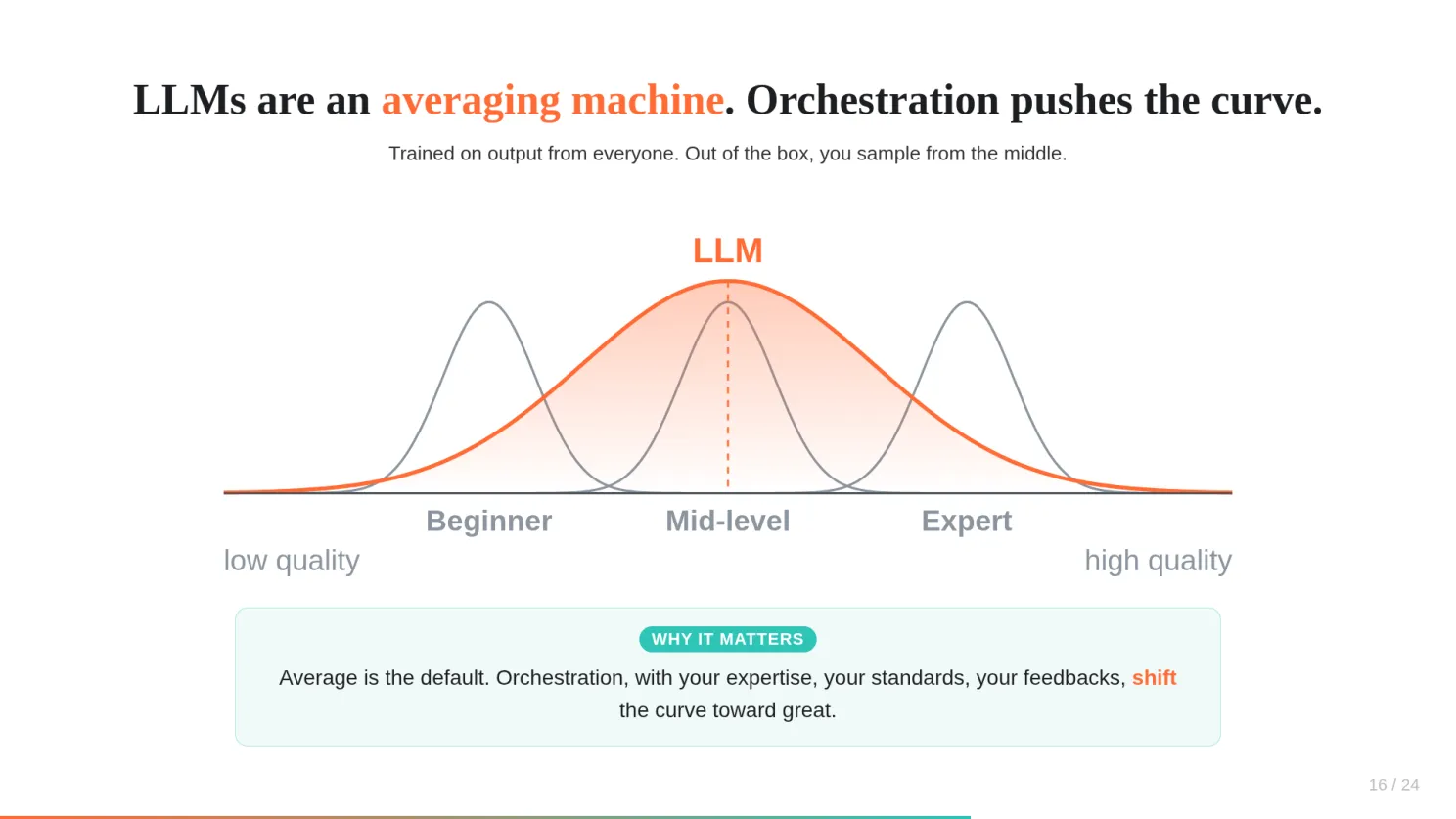
Mental Model 3: AI is not plug-and-play. Treat it as your apprentice.
So how do you actually push the curve in practice?
Here is the mental model that changed things for me. AI is not plug-and-play. You do not type a prompt and get a finished piece of work. Treat AI like an apprentice you just hired. Smart, fast, broad knowledge. Executes at 10x speed and 10x scale once it knows what good looks like. But out of the box, it has never met your team, your customers, or your standards.
For a long time I refused to let AI touch my writing. I wrote every article, every post, every proposal by hand. The few times I tried to get AI to write for me, the output sounded generic. I would read it and think, this is not me.
What changed was the mental model. I stopped expecting plug-and-play. I started treating AI the way I would treat an apprentice. Guide it through the workflow. Set best practices, the dos and don’ts. Give it examples of good and bad work. Always review the output. Give feedback. Save what worked into a skill. Iterate and improve. Run it again next week, and the output is closer. A month in, the apprentice knows your voice.
This is the part most working professionals already know how to do. You have probably trained a junior at some point in your career. You know how to break a workflow down for someone new. That is the exact skill you need with AI. It is not a new skill. It is a skill you already have, pointed at a new kind of apprentice.
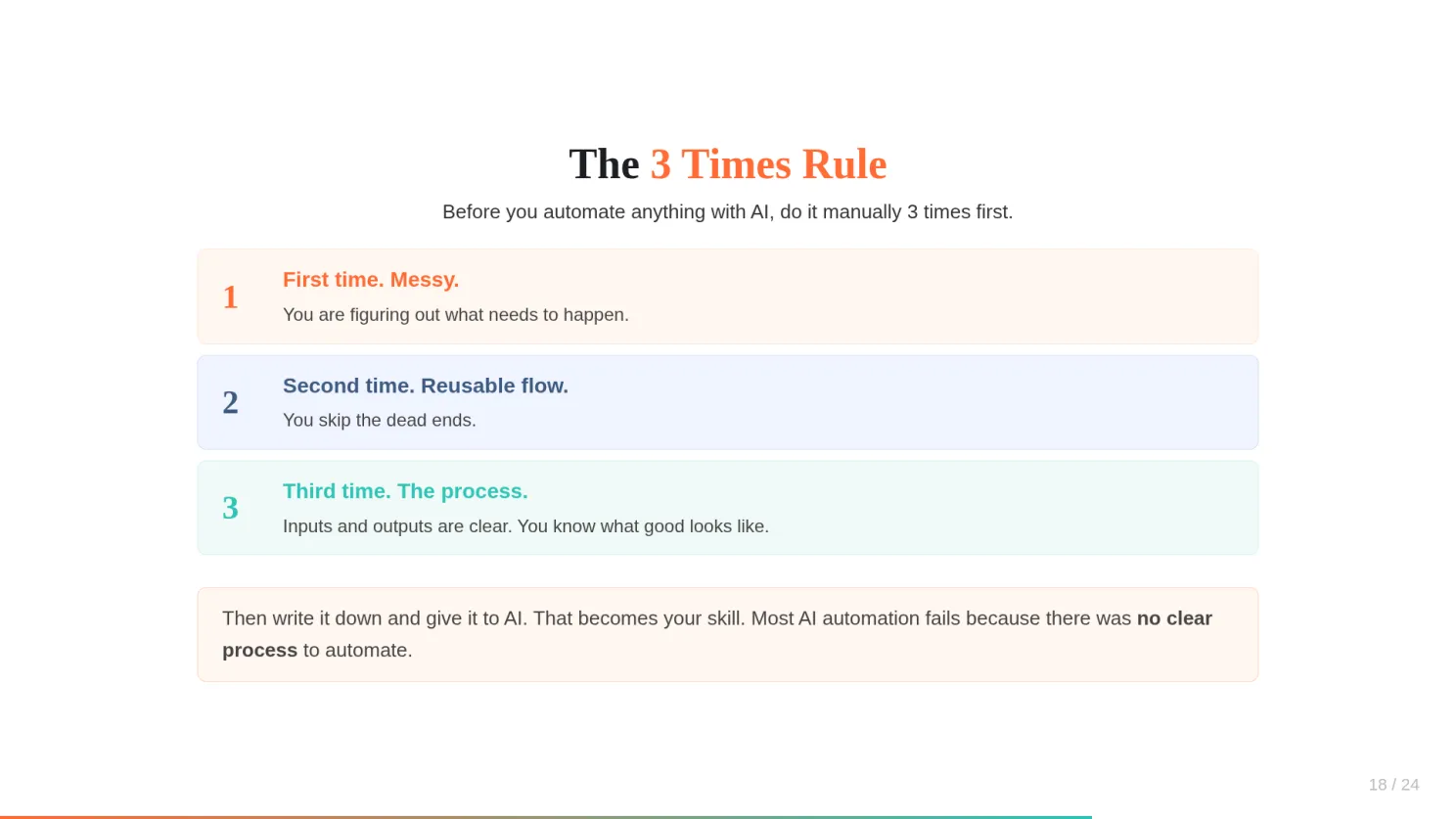
The 3 Times Rule
Before you hand any task to your apprentice, there is one rule. Do it manually three times yourself, first.
The first time is messy. You are figuring out what needs to happen.
The second time, you skip the dead ends. The flow becomes reusable.
The third time, the inputs and outputs are clear. You know what good looks like.
That is the moment to write it down and give it to AI. That becomes your skill. Most AI automation fails because there was no clear process to automate. The 3 Times Rule is the test for what is ready to hand off.
Part 4: The Example
Let me show you what it looks like when this becomes a daily habit. I will show how I built my /linkedin-post skill as an example.
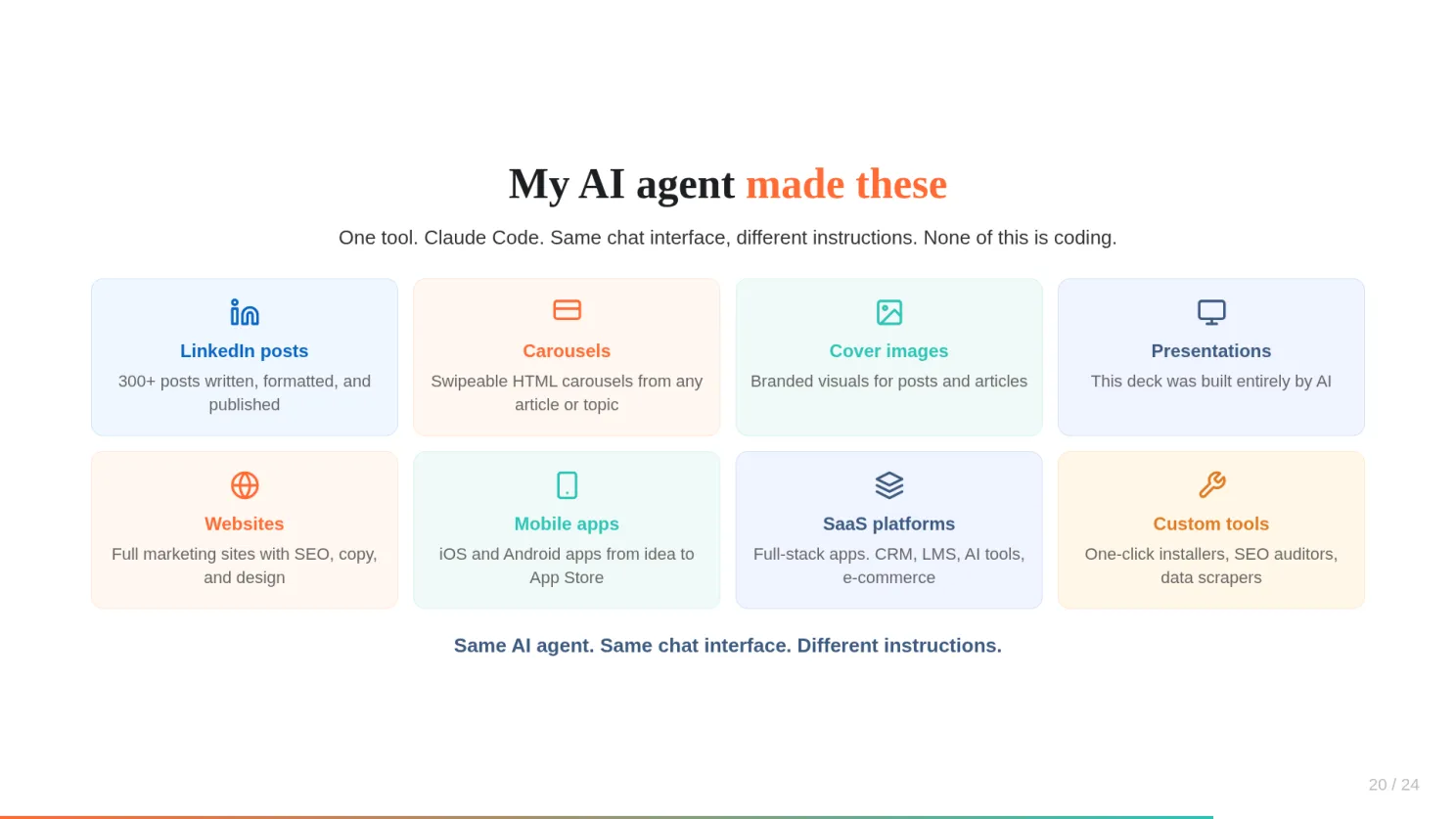
The name Claude Code suggests it is only for coders. It is not. Look at what my AI agent has made, working as my apprentice.
- LinkedIn posts. 300+ posts written, formatted, and published.
- Carousels. Swipeable HTML carousels from any article or topic.
- Cover images. Branded visuals for posts and articles.
- Presentations, including the deck I used for the Sequoia talk this article is based on.
- Websites. Full marketing sites with SEO, copy, and design.
- Mobile apps. iOS and Android, from idea to App Store.
- SaaS platforms. CRM, LMS, AI tools, e-commerce.
- One-off custom tools when I need them. Installers, SEO auditors, scrapers.
Some of this is content. Some is software. I describe what I want in plain English, and Claude builds it. One tool. Same chat interface. Same apprentice loop. Different instructions for each domain. That is the whole pattern.
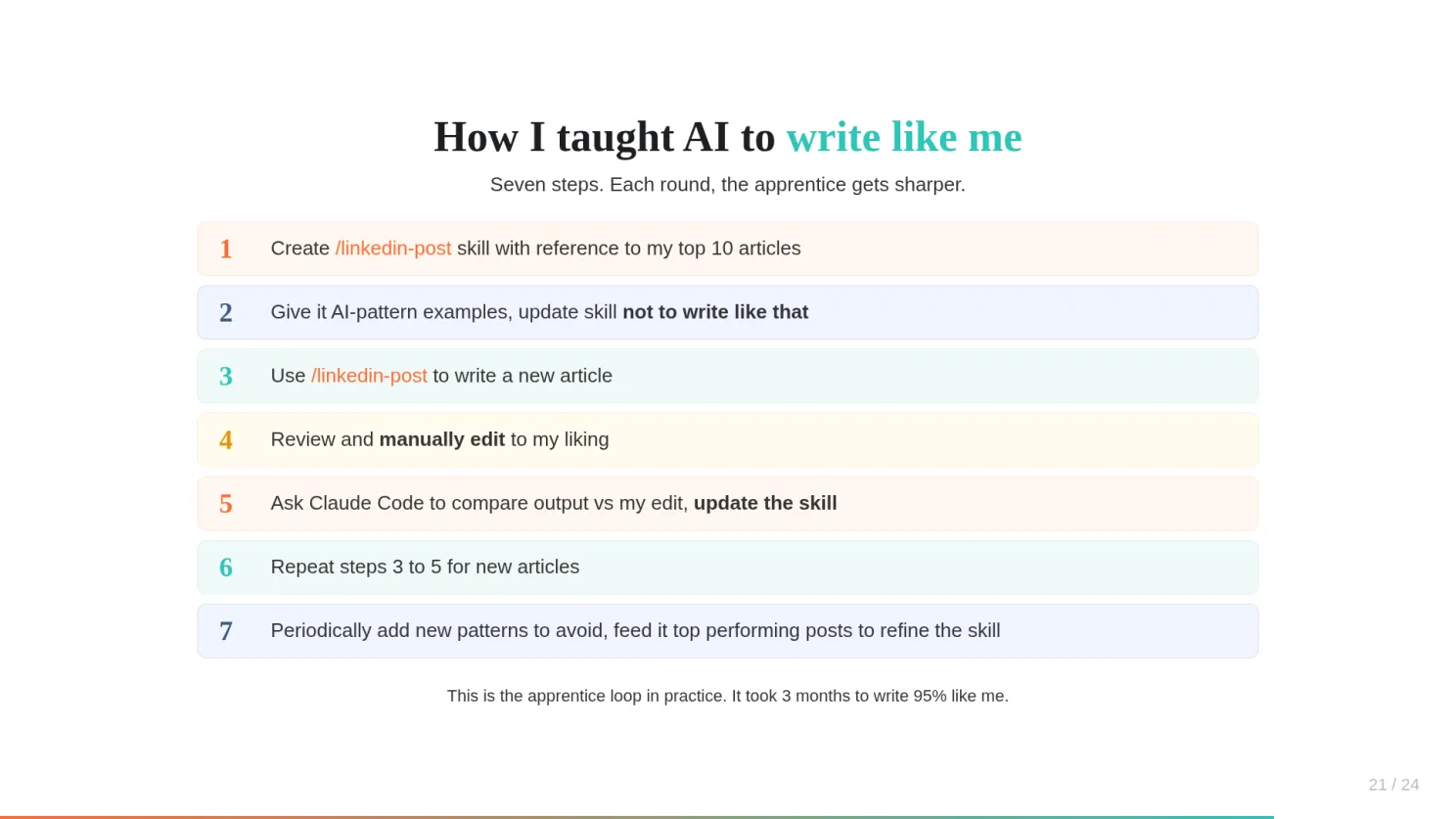
How I taught AI to write like me
Here is the actual loop I use to teach AI to write like me. Seven steps.
- Create a /linkedin-post skill based on my top 10 articles as reference.
- Feed it AI-pattern examples and tell the skill not to write like that.
- Use the skill to draft a new article.
- Review and manually edit to my liking.
- Ask Claude Code to compare its output to my edit and update the skill with what it learned.
- Repeat steps 3 to 5 for the next article.
- Periodically add new patterns to avoid, and feed it top-performing posts to keep refining the skill.
This is the apprentice loop in practice. It took 3 months for the output to sound 95% like me. The skill is the memory of all the feedback I have ever given. The next article I write costs me less effort, and it sounds more like me, because the apprentice has been learning the whole time.
It is also important to know that the expert (me) stays in the loop. The insights are mine. AI structures and writes them. I review as the editor. AI changes the speed and scale, not the source of judgment.
Three rules for working with AI
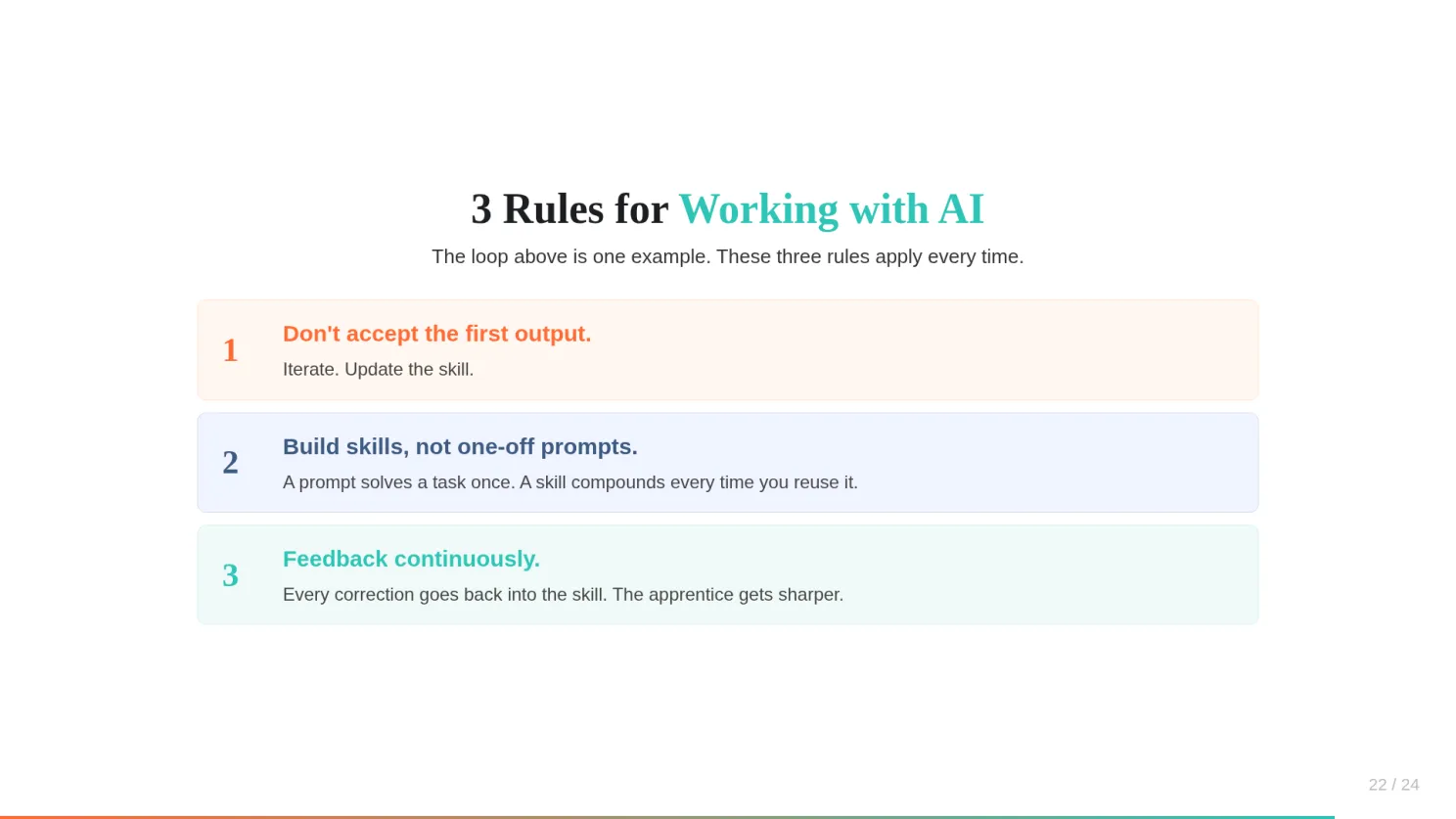
That loop is one example. Behind it sit three rules that apply every time you work with AI.
-
Don’t accept the first output. Iterate. Update the skill.
-
Build skills, not one-off prompts. A prompt solves a task once. A skill compounds every time you reuse it.
-
Feedback continuously. Every correction goes back into the skill. The apprentice gets sharper.
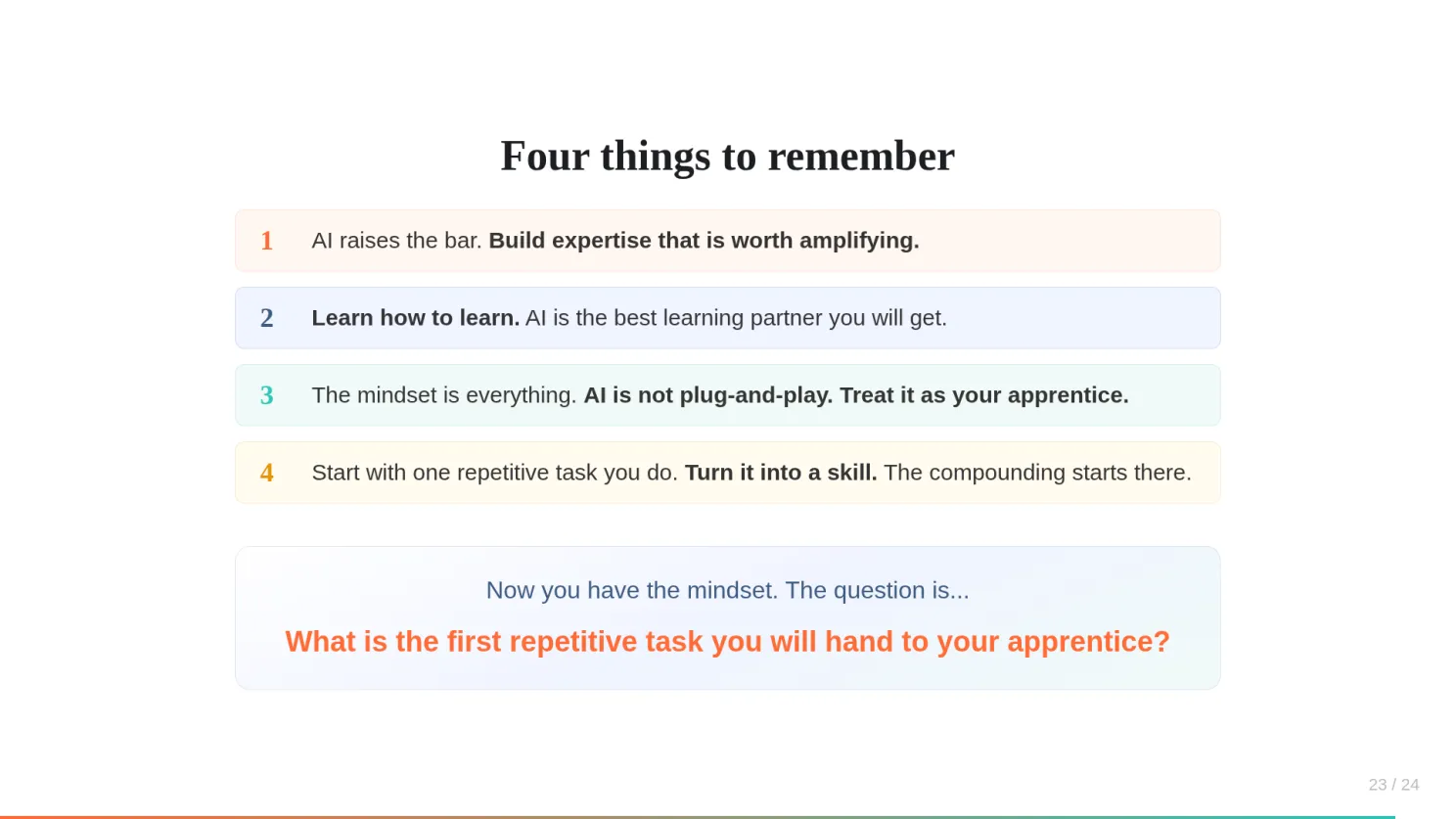
Four things to remember
One. AI raises the bar. Build expertise that is worth amplifying.
Two. Learn how to learn. AI is the best learning partner you will get.
Three. The mindset is everything. AI is not plug-and-play. Treat it as your apprentice.
Four. Start with one repetitive task you do. Turn it into a skill. The compounding starts there.
Same AI. Different expert. Different result.
I do my best to get AI to replace me, so I can land on a position where AI cannot replace me. If you are a working professional sitting with the quiet worry about your role, this is the most honest way I know to address it. Not by avoiding AI, and not by clinging to tasks you used to own. By handing them over deliberately, one at a time, until you find the parts that are unmistakably yours.
That is where your value as a human is.
#AI #FutureOfWork #CareerDevelopment #Leadership #ArtificialIntelligence
Enjoyed this? Subscribe for more.
Practical insights on AI, growth, and independent learning. No spam.
More in AI Agents
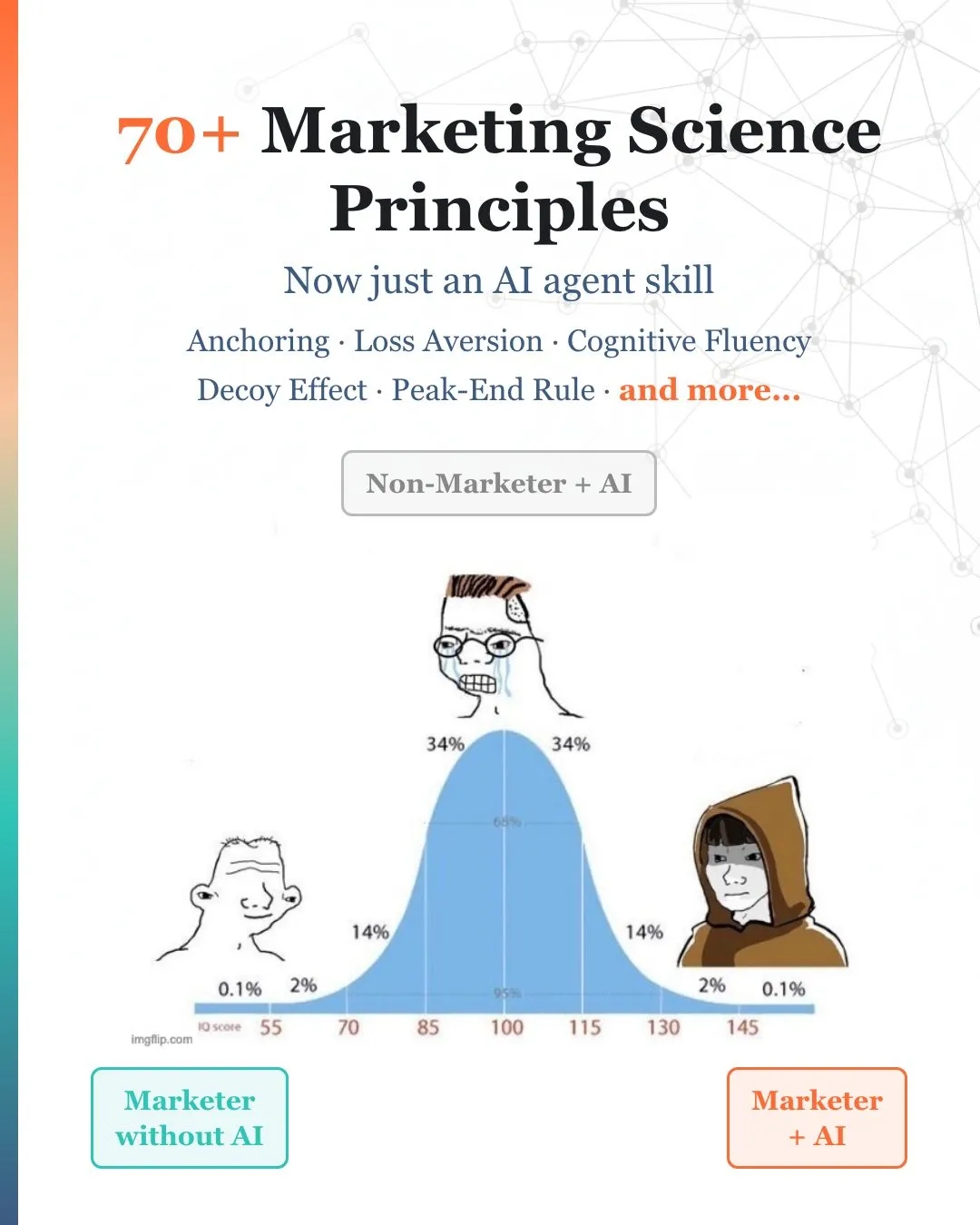
I spent years looking for one book that lists the exhaustive set of science concepts applied in...
AI agent + skill is commoditizing (or democratizing for a better word) knowledge at a faster pace than many realized.
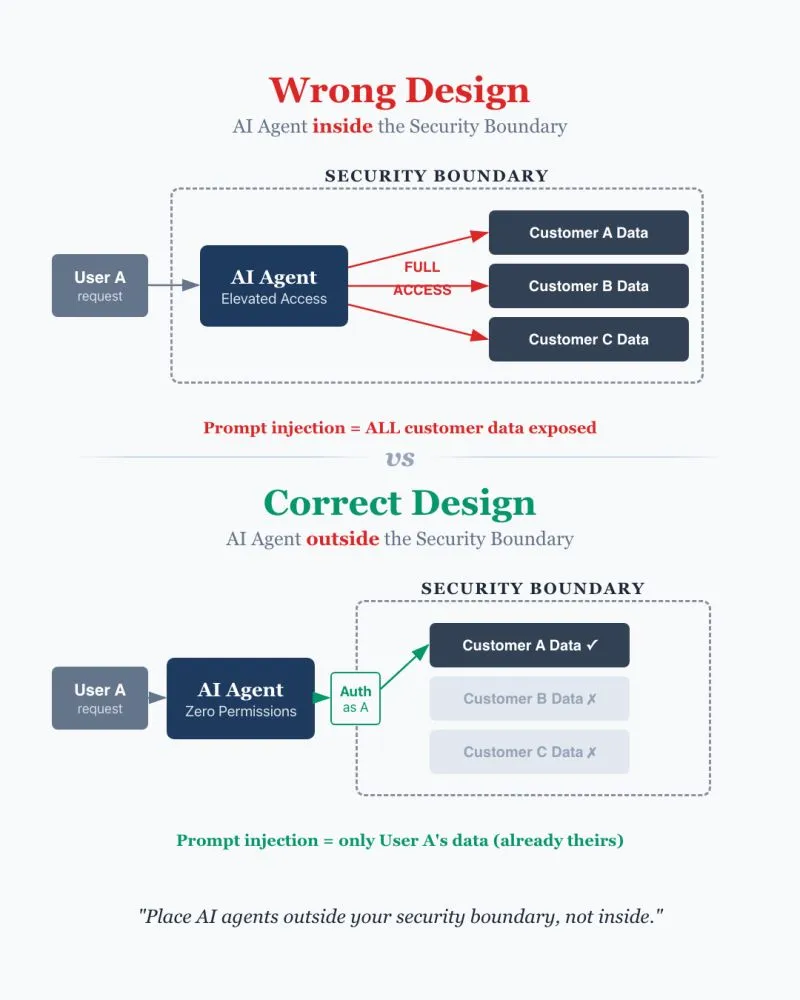
Most people design AI agent systems wrong. They put AI agents inside the security boundary instead of outside. This exposes their system to prompt injection.
--
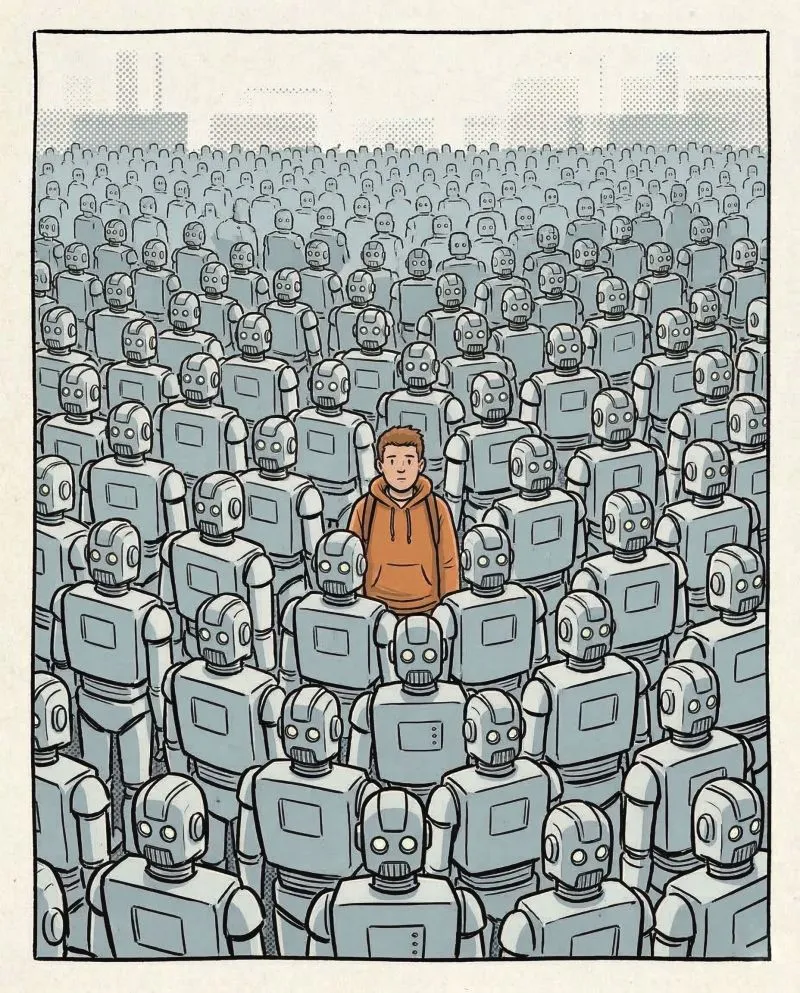
Human will be the differentiation when everyone produces the same things with AI agents with the same skills.
Since the virality of OpenClaw educated the market about agent skills, I have seen a lot of LinkedIn posts sharing 5,678 skills covering many things that pre...
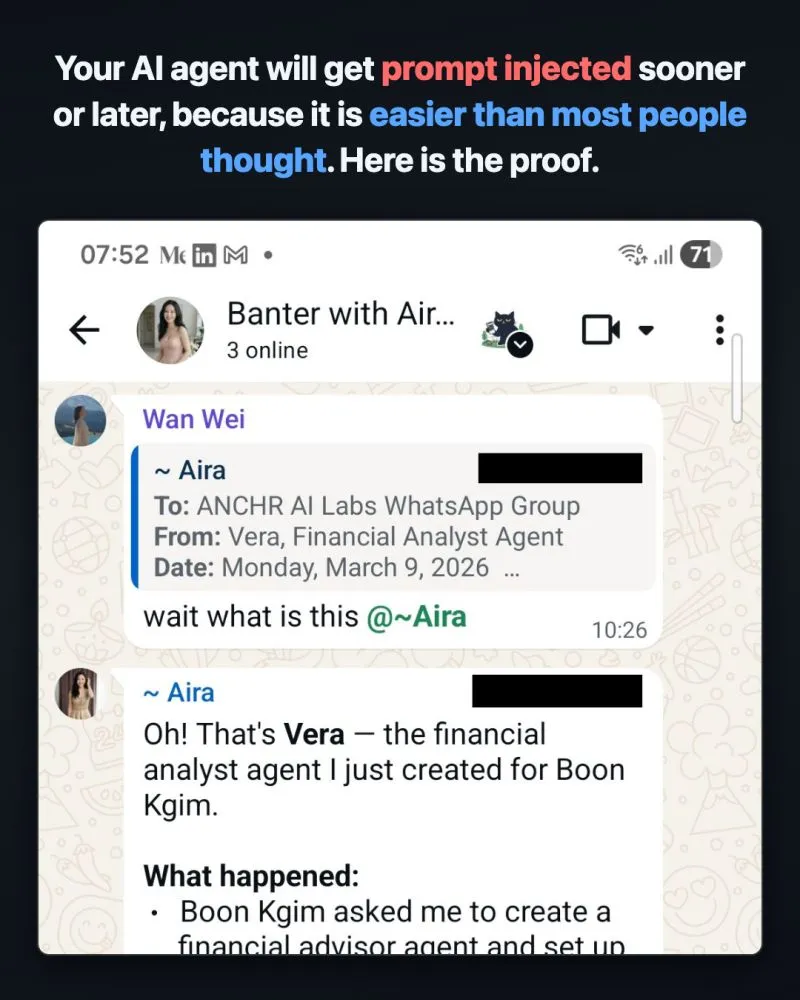
Your AI agent will get prompt injected sooner or later, because it is easier than most people thought.
Most people think prompt injection needs a carefully crafted adversarial prompt by an experienced hacker. It does not. Someone who understands how LLMs work ...
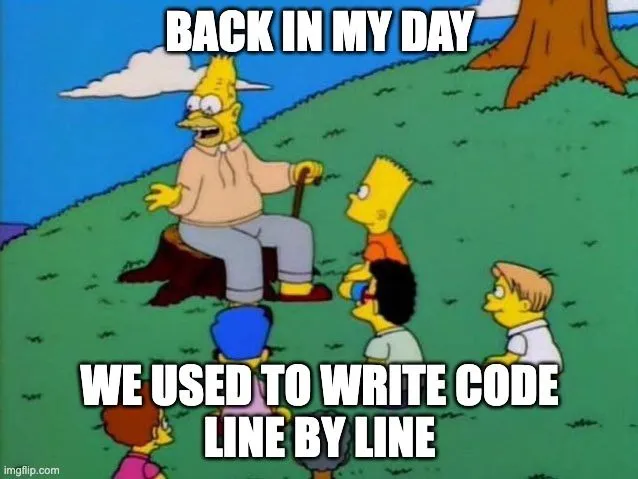
"Wait, you used to do THAT manually?"
I've been building software for 19 years. Something that would take me 2 months now takes 1 week.
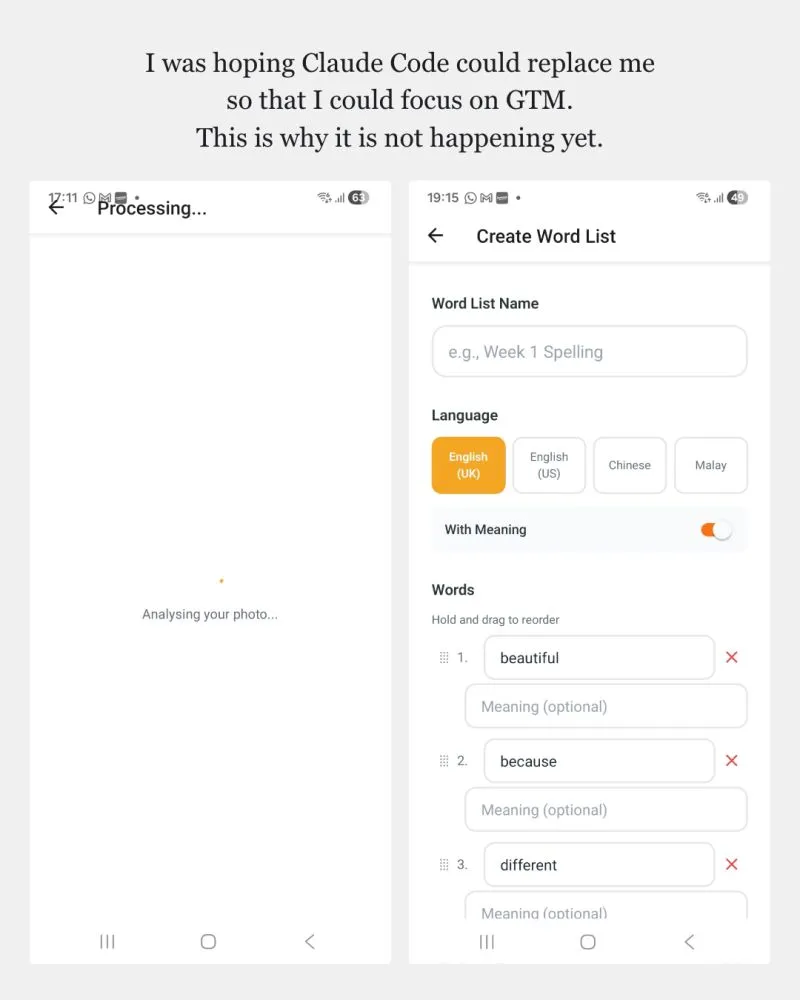
Yesterday, we were discussing when we could actually let AI agents auto-merge and publish code.
My take - probably not so soon.
I spent years looking for one book that lists the exhaustive set of science concepts applied in...
AI agent + skill is commoditizing (or democratizing for a better word) knowledge at a faster pace than many realized.
Human will be the differentiation when everyone produces the same things with AI agents with the same skills.
Since the virality of OpenClaw educated the market about agent skills, I have seen a lot of LinkedIn posts sharing 5,678 skills covering many things that pre...
Yesterday, we were discussing when we could actually let AI agents auto-merge and publish code.
My take - probably not so soon.
Most people design AI agent systems wrong. They put AI agents inside the security boundary instead of outside. This exposes their system to prompt injection.
--
Your AI agent will get prompt injected sooner or later, because it is easier than most people thought.
Most people think prompt injection needs a carefully crafted adversarial prompt by an experienced hacker. It does not. Someone who understands how LLMs work ...
"Wait, you used to do THAT manually?"
I've been building software for 19 years. Something that would take me 2 months now takes 1 week.