Why you should learn Claude Code before OpenClaw
If that is what you heard about the recent IMDA advisory, you only got half the picture.
“IMDA advises us to avoid using OpenClaw.”
If that is what you heard about the recent IMDA advisory, you only got half the picture.
I read the actual PDF. IMDA did not tell us to avoid OpenClaw. They explained how to deploy it responsibly. That is more useful than a blanket “don’t use OpenClaw.”
The original advisory: Case Study: Responsible Deployment of OpenClaw (IMDA, 14 May 2026).
OpenClaw is a double-edged sword
OpenClaw is like fire. Used responsibly, it is powerful. Used wrongly, it will burn your house down.
It is important to understand how it works in order to use it correctly. That is exactly what IMDA’s case study does. It walks through five real risk categories (lack of hardening, access control gaps, sensitive data exposure, supply chain risk from third-party skills, and memory poisoning) and pairs each with practical mitigations.
That is far more useful than telling people to stay away.
Before OpenClaw, learn a reactive AI agent
There is one piece of advice I would add for non-techies and first-time builders.
Before you learn OpenClaw, start with a reactive AI agent like Claude Code or Codex.
I wrote about why in a previous article. The short version: the framing “Claude Code is for developers, OpenClaw is for business users” is backwards. That mental model leads people to skip the foundation and jump straight to the wrapper.
In that article, I gave four reasons to learn Claude Code first. It has the tightest feedback loop for learning how agents work, because every action happens in front of you. It is actually easier to start with than OpenClaw (one command to install, no server to maintain, no messaging API to configure). It makes OpenClaw better when you get there, because both tools run on skills and the people who write good skills get dramatically better results from either wrapper. And it can help you debug OpenClaw when things break, by launching Claude Code from your OpenClaw config folder.
Read the full article: Claude Code is for software developers, and OpenClaw is more for business users
To put this into perspective, here is the 5-layer model I use to explain where each tool fits.
The 5 layers of AI access
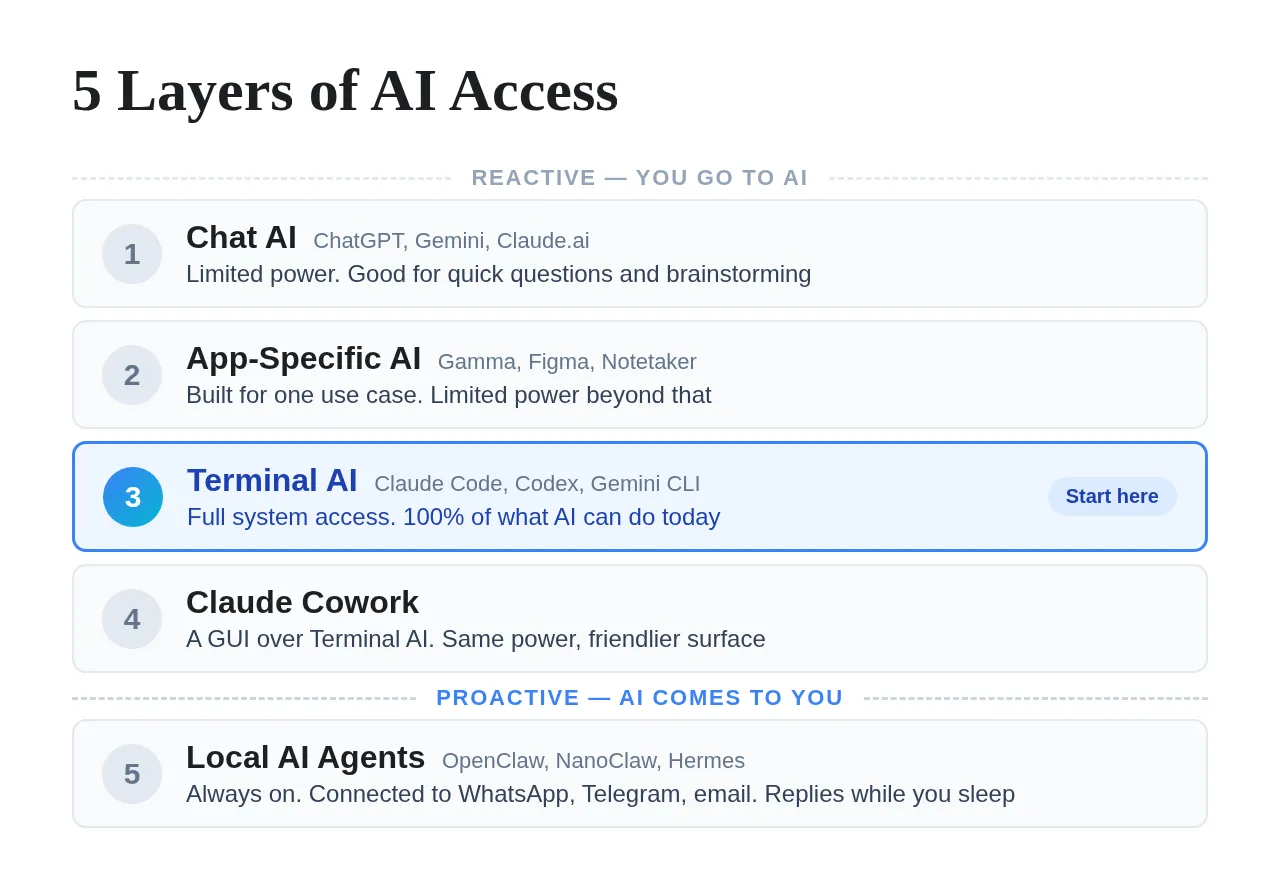
Reactive (you go to AI):
- Chat AI — ChatGPT, Gemini, Claude.ai. Limited power. Good for quick questions and brainstorming.
- App-Specific AI — Gamma, Figma, Notetaker. Built for one use case. Limited power beyond that.
- Terminal AI — Claude Code, Codex, Gemini CLI. Full system access. 100% of what AI can do today.
- Claude Cowork. A GUI over Terminal AI. Same power, friendlier surface. Trade-off is vendor lock-in.
Proactive (AI comes to you):
- Proactive AI Agents — OpenClaw, NanoClaw, Hermes. Always on. Connected to WhatsApp, Telegram, email. Replies while you sleep.
Layers 3 to 5 all give you 100% of the power. The difference is the interface and how conversations and tasks are initiated.
Layer 5 risk is different from the others
Layer 5 is as powerful as 3 and 4, but gives you more risk surface, and most of it is invisible.
At layer 3, you see every action the agent takes. Files it reads, commands it runs, output it writes. At layer 5, the work happens in the background. You don’t see what files or emails the agent sent to the model, or which third-party skill it just installed, or which message it just acted on.
The more chat interfaces you connect (WhatsApp, Telegram, Slack), the wider that risk surface gets. Add default settings you never reviewed, third-party skills you did not vet, and persistent memory that absorbs adversarial instructions over time. The result is a system that looks like a personal assistant but operates with the access of a system admin.
This is what makes layer 5 different from layers 1 to 4. Layer 3 hands you the same 100% power, but every action is in front of you. You can stop the agent, ask why, course-correct in seconds. At layer 5, the agent is acting on your behalf in a black box, and you find out what it did only when something looks off.
The fastest path to using OpenClaw well
The fastest way to handle layer 5 well is to spend some time at layer 3 first.
Learn how to instruct an agent, review its work, write skills, set guardrails. Those skills transfer directly to layer 5. The same instincts that let you spot a wrong file edit at layer 3 are what let you spot a wrong reply or a leaked attachment at layer 5.
This is also why IMDA’s advisory leads with Zero Trust principles (assume breach, least-privilege access, continuous monitoring). Those principles only make sense once you have a working mental model of what the agent actually does. Layer 3 builds that model fastest because every action is visible.
Where to start
If you would like to learn the foundation of AI agents like Claude Code hands-on, my next workshop is open.
Cohort #2 on 21 May is already full. Cohort #3 on 4 June, 1:30pm to 5:30pm, is open for registration. It will be the last cohort at the launch price of $268.
Register for the Foundations of Claude Code workshop
#AI #ClaudeCode #OpenClaw #AIAgents #AISecurity
Enjoyed this? Subscribe for more.
Practical insights on AI, growth, and independent learning. No spam.
More in AI Agents

Can LLMs like ChatGPT do reasoning? It failed my casual tests in under 30 minutes.
… more
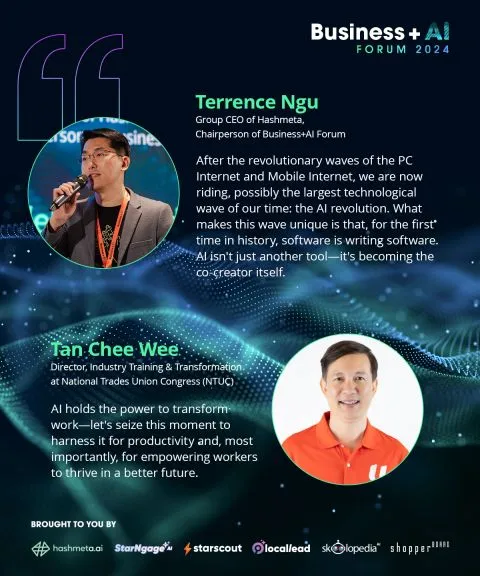
From insight to action: AI is not the future—it’s the now.
At the Business+AI Forum 2024, our speakers shared groundbreaking insights on how AI is transforming industries, creating opportunities, and solving real-wor...

The Worst Job Displacement of Software Engineers Is Yet to Come.
This is not another fear mongering post.
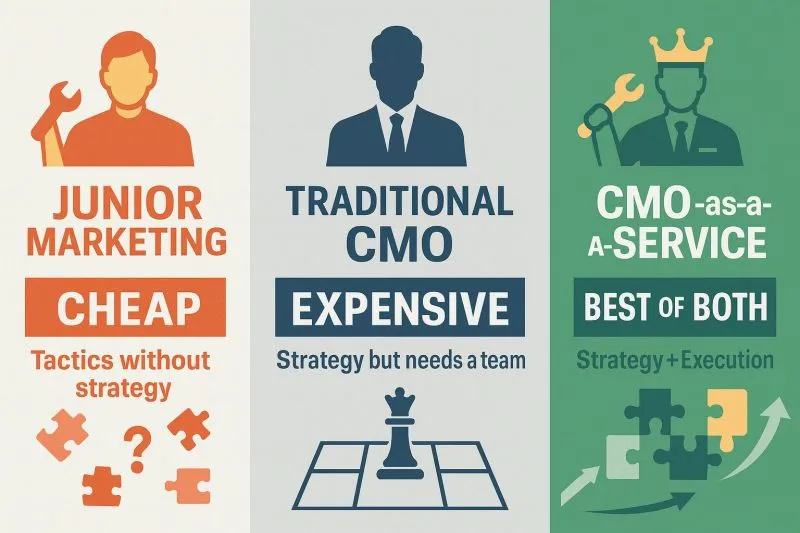
❌ One common mistake we keep seeing business owners make in marketing:
They hire a junior marketer to run ads, create content and post on social media... And think their marketing is covered.
Two Choices for Handling Tech Debt in Vibe Coding
· Go full vibe: ignore tech debt, and when things inevitably break, spend a week fixing it.

Good news!
What makes Eu Gene's training unique is that it's not only insightful but also entertaining and highly engaging.
Can LLMs like ChatGPT do reasoning? It failed my casual tests in under 30 minutes.
… more
The Worst Job Displacement of Software Engineers Is Yet to Come.
This is not another fear mongering post.
Two Choices for Handling Tech Debt in Vibe Coding
· Go full vibe: ignore tech debt, and when things inevitably break, spend a week fixing it.
From insight to action: AI is not the future—it’s the now.
At the Business+AI Forum 2024, our speakers shared groundbreaking insights on how AI is transforming industries, creating opportunities, and solving real-wor...
❌ One common mistake we keep seeing business owners make in marketing:
They hire a junior marketer to run ads, create content and post on social media... And think their marketing is covered.
Good news!
What makes Eu Gene's training unique is that it's not only insightful but also entertaining and highly engaging.