“My challenge in implementing AI is that I cannot justify the use cases to be implemented based on the labor cost in Asia.”
This quote from a COO of an insurance company was on a slide at Apidays Singapore last week. The slide was titled "What are the challenges? - Feedback from t...
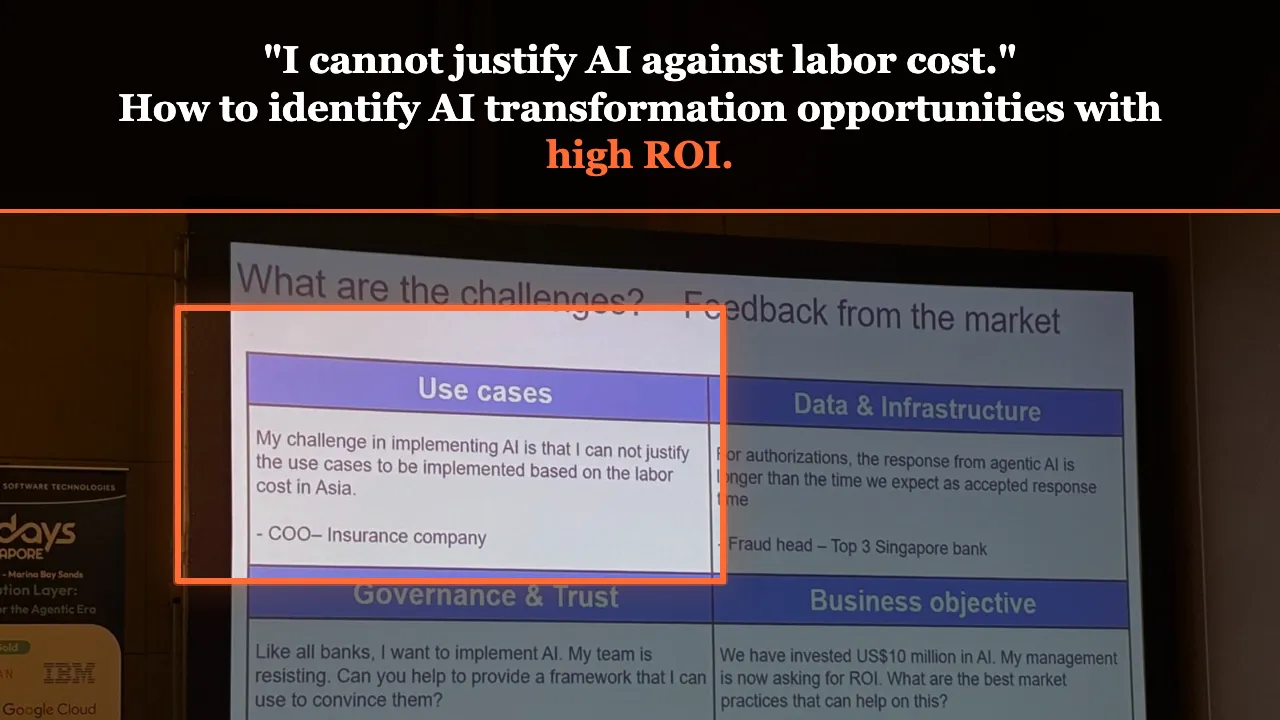
This quote from a COO of an insurance company was on a slide at Apidays Singapore last week. The slide was titled “What are the challenges? - Feedback from the market.”
Four challenges were listed: Use Cases, Data & Infrastructure, Governance & Trust, Business Objective.
I have seen every single one of these in client conversations. But the first one - use case identification - is where most AI transformation efforts stall before they even begin.
The knowledge gap nobody talks about
Most executives I speak to know AI is important. They have seen demos. They have read the McKinsey report. They feel the pressure from the board.
But when they sit down to actually decide WHAT to build, they freeze.
They lack exposure. Most have not seen enough real implementations to recognize what a good use case looks like in their own business.
Many business leaders are still benchmarking AI against 2023 capabilities - a glorified chatbot, a slightly better search bar. They do not know that in 2026, AI with system access can do anything a human can do on a computer - as long as the workflow can be articulated.
Draft and send emails. Pull data from a CRM, format it into a report, and email it to the right person. Log into a vendor portal and submit an order. Monitor a dashboard and trigger an action when a threshold is crossed. Compile research from ten sources and summarize it into a briefing document.
If you can describe the steps, AI can execute them. The only real constraint is whether your team can write down how the work gets done.
When you do not know what is possible, every AI project looks either impossibly expensive (compared to cheap labor in Asia) or impossibly risky (compared to what you already do manually).
The root cause is a reference problem. You cannot choose between options you have never seen.
The 5I Framework for AI Transformation
In this article, I share the framework I use to help clients go through end-to-end AI transformation - the 5I Framework. It covers the full lifecycle, from pre-implementation (where the use-case identification problem lives) to post-implementation and beyond.
Stage 1 - Inspire
See what good use cases and solutions actually look like.
Before we can identify the right use cases, we need exposure. We can start by looking at real deployments in our industry and adjacent ones. Not theoretical. Not “AI could do X.” Actual deployed workflows, with costs and results.
- Understand the landscape of what AI can do in 2026
- Learn from industry best practices
- See real examples of deployed AI systems
This closes the knowledge gap. Once a COO sees another insurance company using AI to pre-fill claims, triage complaints, or summarise policy documents, the “I cannot justify this against labor cost” conversation changes entirely. They stop comparing AI to data entry wages and start comparing it to what their team is NOT able to do today.
Stage 2 - Ideate
Use strategic frameworks to find high-ROI opportunities.
Inspiration closes the knowledge gap. Ideation turns the resulting wishlist into a prioritised roadmap. We can use four frameworks here:
- Theory of Constraints - identify the single bottleneck holding the business back, so the AI initiative addresses the highest-leverage point
- ICE Scoring - rank initiatives by Impact, Confidence, and Ease
- Three Horizons - separate quick wins, medium-term bets, and long-term transformation
- Cost-Benefit Matrix - quantify each use case against implementation cost and risk
This is where the “labor cost” argument gets resolved. A use case that frees up professional time to do higher-value work is not competing with data entry wages. It is competing with the opportunity cost of what your team is NOT able to do right now.
Most clients come out of this stage with a ranked list of 3 to 5 initiatives they can confidently commit to - instead of 30 possibilities they cannot decide between.
Stage 3 - Implement
Apply human-centered design in developing your solutions.
Even with the right use case, most AI projects fail at implementation because they are built for the AI, not the user. We should apply the same discipline as consumer product development:
- User research with the people who will actually use the tool
- Design thinking to frame the workflow from the user’s perspective
- Rapid prototyping to validate assumptions early
- User testing before scaling
Stage 4 - Integrate
Apply change management to actively push adoption.
An AI tool nobody uses has zero ROI. Integration is where we should actively handle communication, training, incentives, and progress tracking. Most technical teams underestimate this stage - and this is where I see AI projects quietly die even after a successful technical build.
Stage 5 - Iterate
Review and improve.
Business transformation is a journey, not a sprint. We can measure results, run continuous improvement, adjust strategy, and scale what works. The first version is never the final version.
Why the first two stages matter most
The other challenges from the Apidays slide - data, governance, ROI measurement - are real, but they are solvable with the right technical and change management discipline. I wrote a separate post on the ROI measurement problem if you are interested.
The pre-implementation challenge is different. If you never get to a defensible use case, you never start. And the companies that never start are the ones that wake up in 2028 to find their competitors already have AI-augmented teams.
If you have a huge list of possible AI initiatives but cannot decide which to commit to, you do not have an execution problem. You have a reference and prioritisation problem.
That is what the first two stages of the 5I Framework - Inspire and Ideate - are designed to solve.
Two questions I often ask clients
Before committing to an AI transformation roadmap, two questions I typically ask to gauge where a team actually stands:
- Have we seen at least 10 real AI deployments in our industry or adjacent industries in the last 12 months?
- Can we rank our top AI opportunities on ICE or Cost-Benefit scoring today?
If the answer to either is no, the gap is not in the AI technology. It is in exposure and prioritisation - and that is where the work should start.
#AI #AITransformation #DigitalTransformation #BusinessStrategy #GenAI
Enjoyed this? Subscribe for more.
Practical insights on AI, growth, and independent learning. No spam.
More in AI Strategy
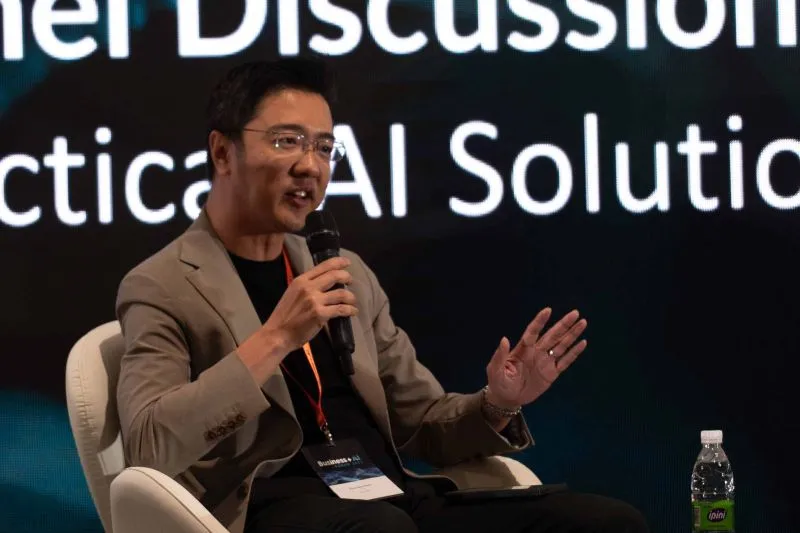
Our inaugural Business Plus AI Forum 2024 was a smashing success!
Here’s a big shoutout to the stars of the day:
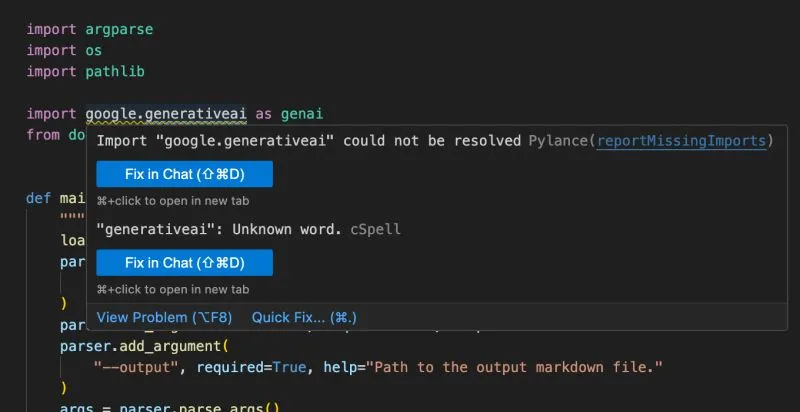
Gemini CLI stubbornly insisted its code was right and even did a Google search to prove it with an outdated article.
I was speechless. 😂
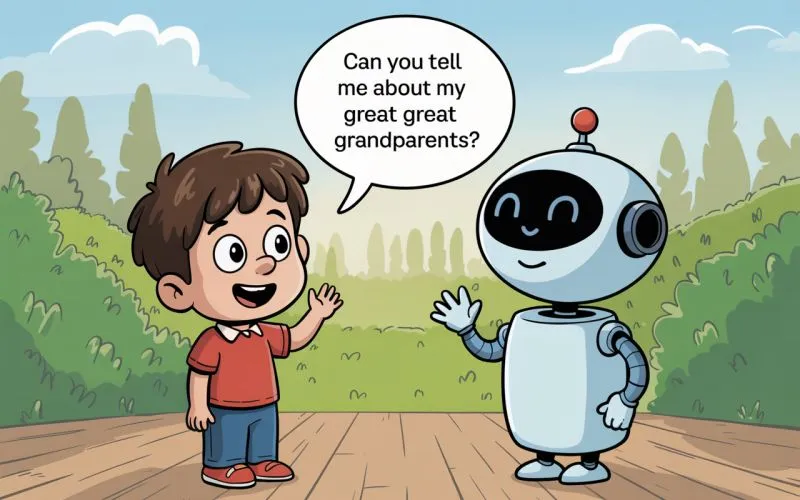
Recently, I heard an interesting view from Jeremy Tan during a panel discussion.
It sounded absurd at first, but on second thought, I think it might actually happen.
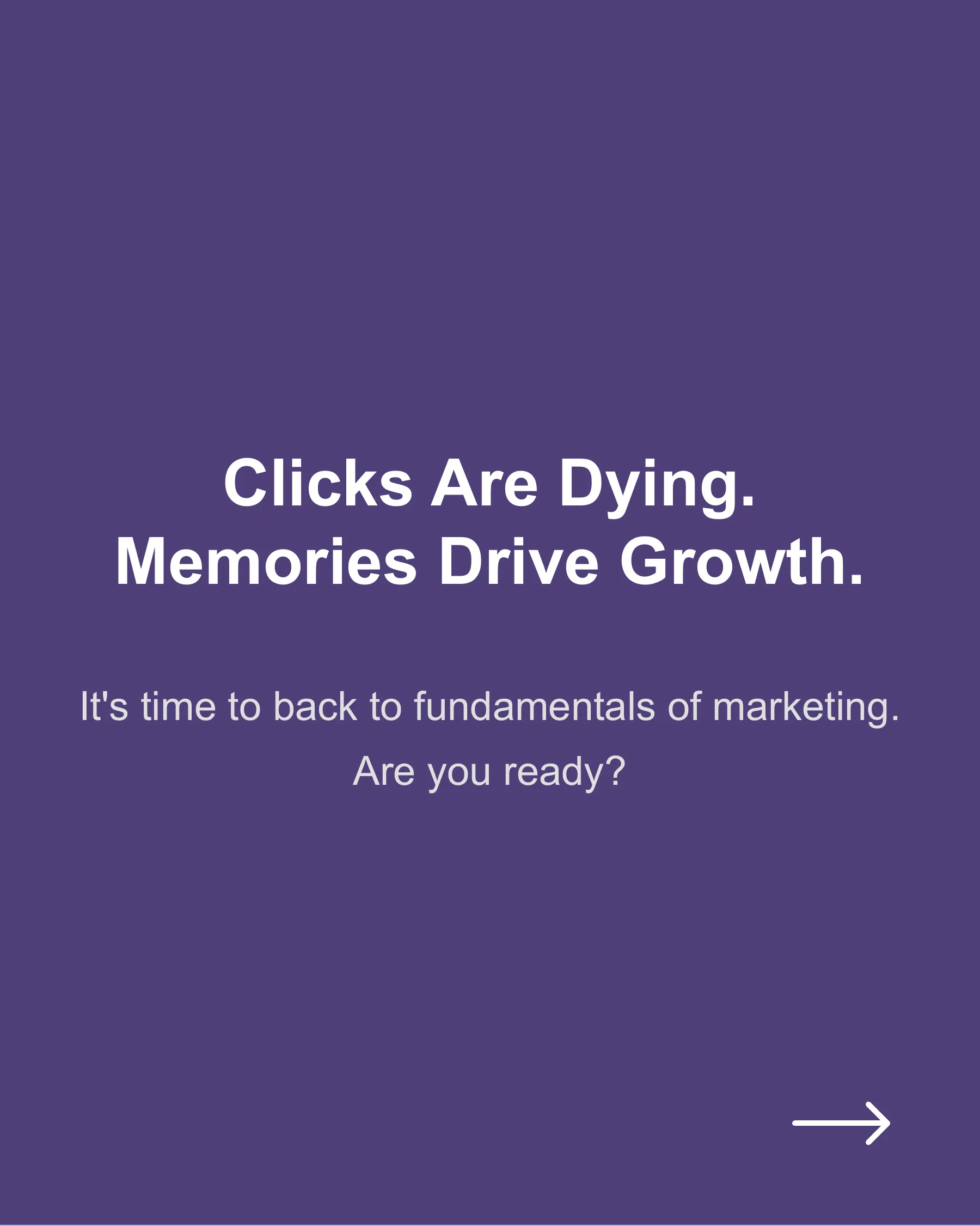
📉 Clicks Are Dying. Brands That Create Memories Will Win.
For the last 20 years, the rise of the internet has pushed many marketers to obsess over performance marketing — chasing clicks, leads, ROAS.
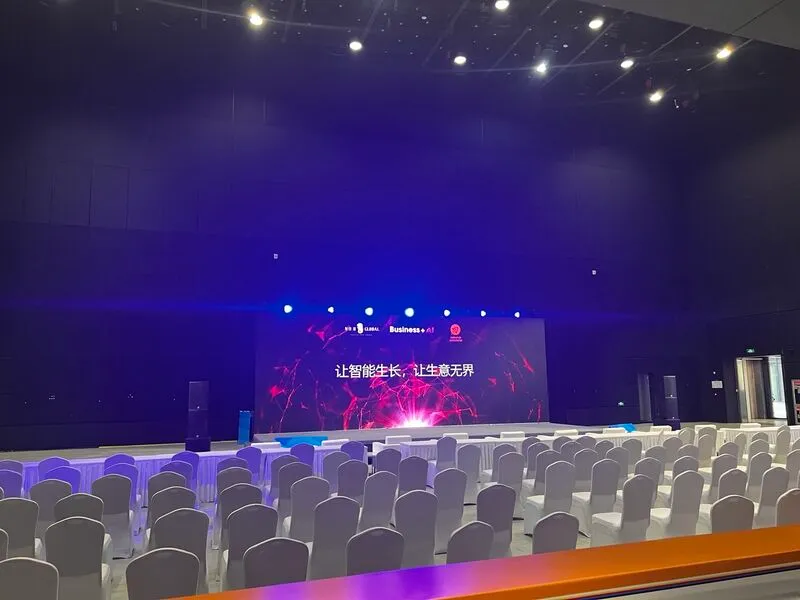
Our team is ready to kickstart the Business Plus AI Forum at CIFTIS Beijing 2025, in collaboration with Beijing Association for Trade in Services and World Trade Centers Association Beijing!
From rehearsals to the grand stage, everything is set for an exciting exchange of ideas on how AI is transforming industries and driving global collaboration...
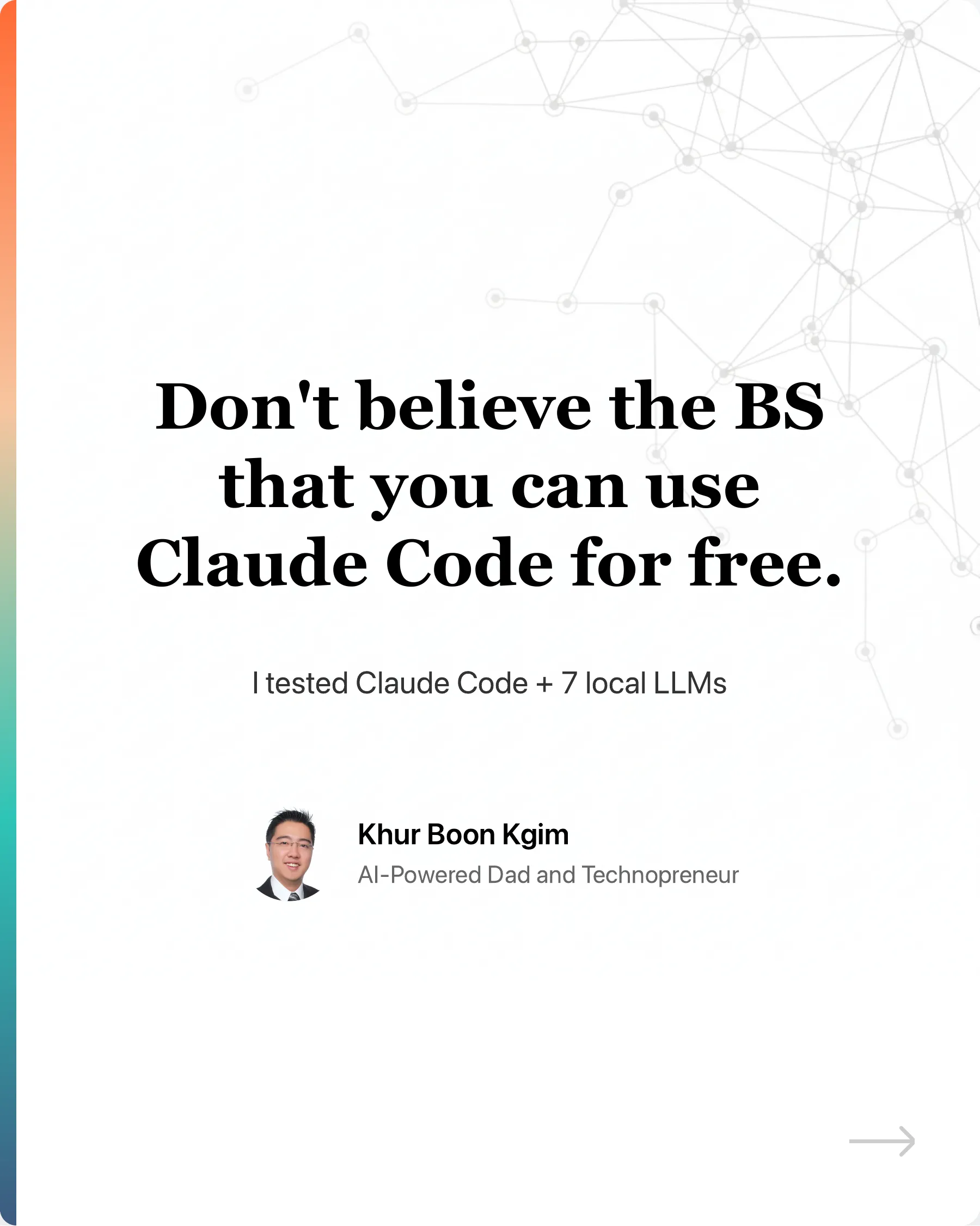
Don't believe the BS that you can use Claude Code for free.
Ollama recently made their API compatible with Claude Code. Many creators quickly jumped on the opportunity to farm engagement with the hook: "You can now u...
Our inaugural Business Plus AI Forum 2024 was a smashing success!
Here’s a big shoutout to the stars of the day:
📉 Clicks Are Dying. Brands That Create Memories Will Win.
For the last 20 years, the rise of the internet has pushed many marketers to obsess over performance marketing — chasing clicks, leads, ROAS.
Don't believe the BS that you can use Claude Code for free.
Ollama recently made their API compatible with Claude Code. Many creators quickly jumped on the opportunity to farm engagement with the hook: "You can now u...
Gemini CLI stubbornly insisted its code was right and even did a Google search to prove it with an outdated article.
I was speechless. 😂
Recently, I heard an interesting view from Jeremy Tan during a panel discussion.
It sounded absurd at first, but on second thought, I think it might actually happen.
Our team is ready to kickstart the Business Plus AI Forum at CIFTIS Beijing 2025, in collaboration with Beijing Association for Trade in Services and World Trade Centers Association Beijing!
From rehearsals to the grand stage, everything is set for an exciting exchange of ideas on how AI is transforming industries and driving global collaboration...